 Back
Nervous and Sensory Systems: Structure, Function, and Mechanisms (Exam 4)
Study Guide - Smart Notes
 Tailored notes based on your materials, expanded with key definitions, examples, and context.
Nervous System Overview
Organization and Function
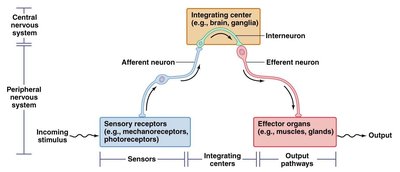
The nervous system is divided into the central nervous system (CNS) and the peripheral nervous system (PNS). It coordinates sensory input, integration, and motor output to maintain homeostasis and respond to environmental changes.
Sensory receptors detect stimuli and transmit signals via afferent neurons to integrating centers (e.g., brain, ganglia).
Integrating centers process information and send commands through efferent neurons to effector organs (muscles, glands).
Interneurons connect afferent and efferent pathways within the CNS.
Sensory Reception
Mechanisms of Signal Detection and Transduction
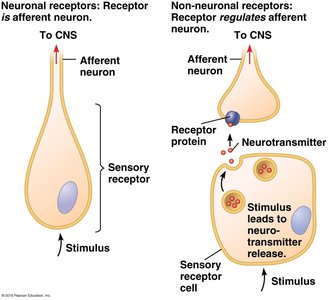
Sensory reception involves the detection of external or internal stimuli and their conversion into electrical signals (action potentials). This process is fundamental for the nervous system to interpret and respond to the environment.
Stimulus opens ion channels in sensory receptors, altering membrane potential.
Change in membrane potential initiates neurotransmitter release or direct action potential generation.
Information is decoded in the CNS based on the pathway and frequency of action potentials.
Information Coding
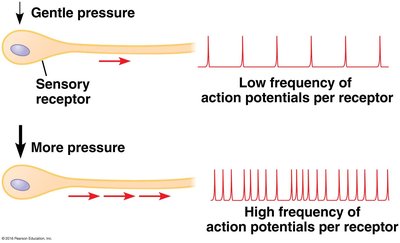
The magnitude of a stimulus is translated into the frequency of action potentials. Stronger stimuli produce higher frequencies, allowing the CNS to interpret intensity.
Gentle pressure results in low frequency of action potentials.
Greater pressure increases the frequency of action potentials.
Translation and Perception
Pathways and Perceptual Differences
The perception of a stimulus depends on which CNS neuron receives the signal. The brain distinguishes different stimuli (e.g., sight, sound) based on the neural pathway activated.
Polymodal receptors can respond to multiple types of stimuli (e.g., eyelid).
Redirecting a neuron can alter perception, demonstrating the importance of neural pathways.
Types of Sensory Signals
Classification of Stimuli
Sensory systems detect various types of signals, each with specialized receptors:
Mechanical (touch, pressure, vibration)
Electrical (electroreception in some aquatic animals)
Magnetic (magnetoreception for navigation)
Thermal (temperature changes)
Chemical (taste, smell)
Photo (light detection)
Magnetoreception
Detection of Magnetic Fields
Magnetoreception is the ability to sense magnetic fields, aiding navigation in migratory species such as birds and salmon. Specialized neurons may contain magnetite particles that respond to magnetic fields.
Rainbow trout have neurons in the olfactory epithelium with magnetite-like particles.
Magnetoreception is crucial for migration and homing behaviors.

Thermoreception
Heat Detection Mechanisms
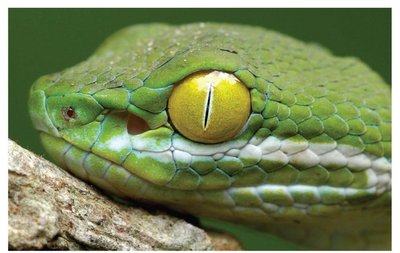
Thermoreception involves specialized organs or receptors that detect temperature changes. Some animals, such as pit vipers, have highly sensitive pit organs for detecting heat.
Pit organs are located between the eye and nostril in pit vipers.
Can detect minute temperature changes (as small as 0.003°C).
Humans detect changes of about 0.5°C.
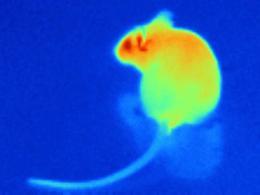
Thermoreception in Mammals
Some mammals, such as vampire bats, use thermal vision to locate blood vessels in prey. They switch from echolocation to thermal detection when close to their target.
Thermal vision helps bats find the warmest spot to bite.
Chemical Modulation of Thermoreceptors
Certain chemicals can activate thermoreceptors, altering perception of temperature:
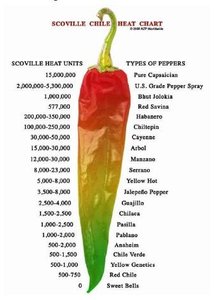
Capsaicin activates heat receptors (>42°C), making spicy food taste "hot".
Menthol activates cold receptors (<28°C), making food taste "cool".

Chemoreception
Olfaction (Smell)
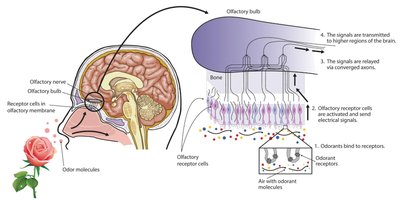
Chemoreception is the detection of chemical stimuli, such as odorants in the air. Olfactory neurons express specific receptor proteins, allowing for the recognition of a wide range of odors.
Each olfactory neuron expresses one odorant receptor protein.
Each receptor can recognize multiple odorants; each odorant can stimulate multiple receptors.
Olfactory neurons are short-lived and rapidly adapt to stimuli.
Odor Coding and Discrimination
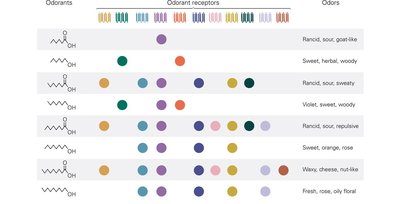
Humans have about 350 olfactory receptors, while mice have around 1000. Odors are coded by combinations of receptors, enabling discrimination of millions of scents.
Combinatorial coding allows for vast diversity in odor perception.
Dogs have much greater sensitivity to odors than humans.
Mechanoreception
Hearing and Equilibrium
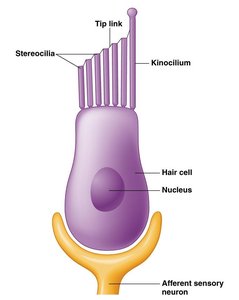
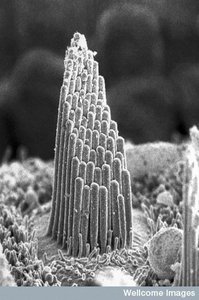
Mechanoreception involves the detection of mechanical forces, such as sound waves and balance. Hair cells in the ear are specialized mechanoreceptors that convert mechanical movement into electrical signals.
Mechanical bending of hair cells opens ion channels, leading to depolarization.
Hair cells release neurotransmitters to excite sensory neurons.
Ear Structure and Hearing
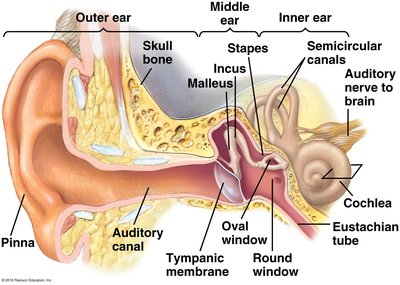
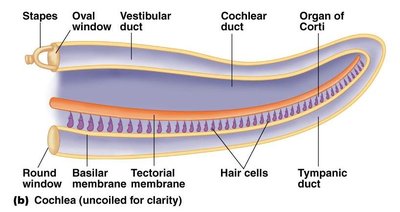
The ear is divided into outer, middle, and inner regions. Sound waves are transmitted through these regions, ultimately vibrating the basilar membrane and activating hair cells.
Sound waves vibrate the tympanic membrane.
Middle ear bones transmit vibrations to the oval window.
Pressure waves in the vestibular duct vibrate the basilar membrane.
Stereocilia on hair cells bend, causing depolarization and neurotransmitter release.
Round window acts as a pressure valve.
Frequency and Amplitude Detection
The basilar membrane varies in stiffness and width, allowing for detection of different sound frequencies and amplitudes.
High frequency sounds vibrate the stiff, narrow proximal end.
Low frequency sounds vibrate the flexible, wide distal end.
Loud sounds cause greater movement of the basilar membrane.

Equilibrium
Balance and Linear Acceleration
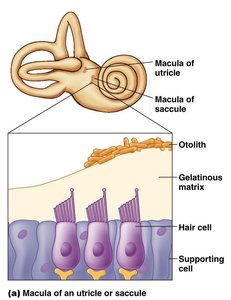
Equilibrium is maintained by structures in the inner ear, including the maculae of the utricle and saccule. These contain mineralized otoliths suspended in a gelatinous matrix, with hair cells embedded to detect linear acceleration and head tilting.
Maculae contain >100,000 hair cells.
Otoliths move in response to gravity and acceleration, bending hair cells.
Summary Table: Types of Sensory Reception
Type | Stimulus Detected | Example Organism/Structure |
|---|---|---|
Mechanical | Touch, pressure, vibration | Hair cells in ear |
Electrical | Electric fields | Electroreceptors in fish |
Magnetic | Magnetic fields | Magnetite particles in trout |
Thermal | Temperature changes | Pit organs in vipers |
Chemical | Odorants, tastants | Olfactory neurons |
Photo | Light | Photoreceptors in eyes |
