 Back
BackNervous System Organization and Neuron Function: Study Guide
Study Guide - Smart Notes
 Tailored notes based on your materials, expanded with key definitions, examples, and context.
Nervous System Organization and Neuron Function
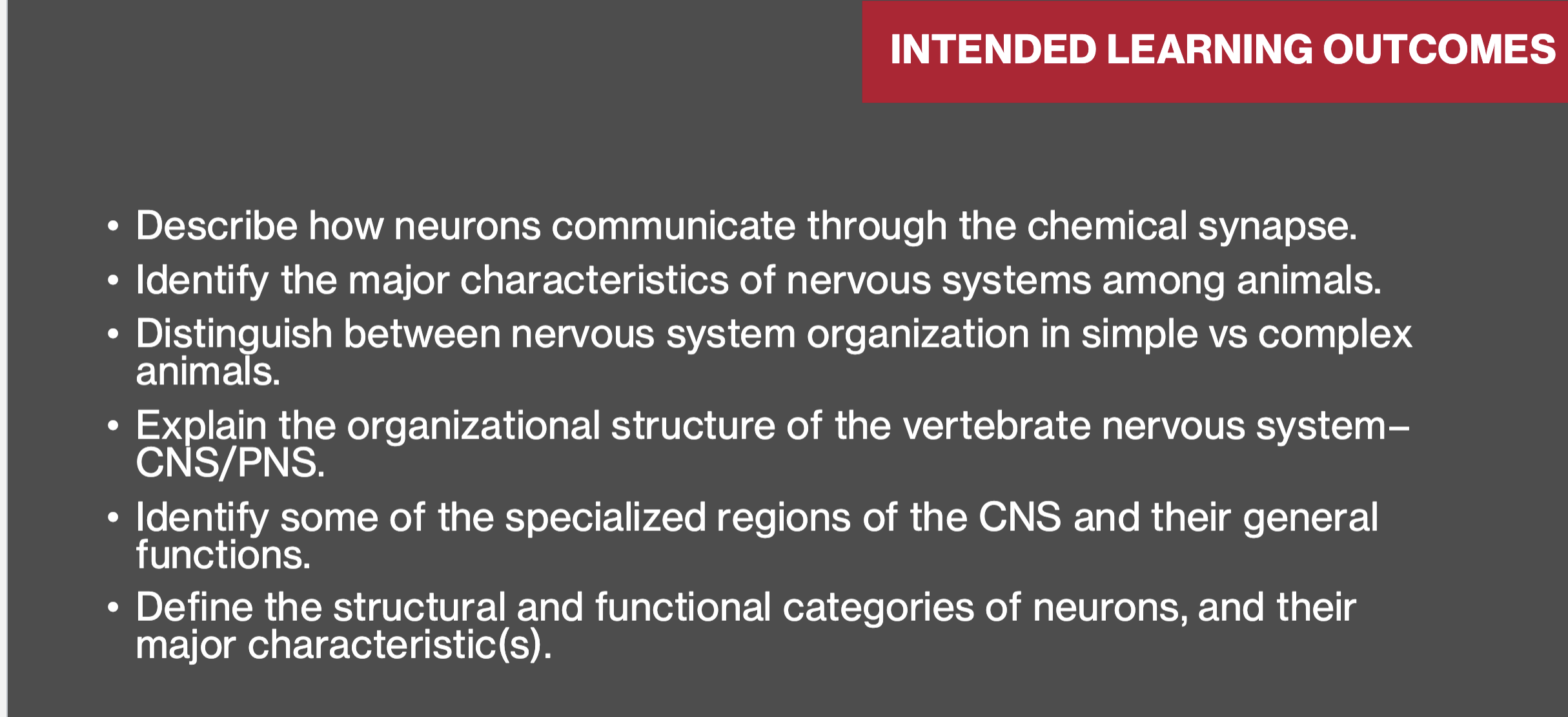
Chemical Synapse Communication
The chemical synapse is a specialized junction where neurons communicate with each other or with effector cells. This process involves the release of neurotransmitters, which transmit signals across the synaptic cleft.
Neurotransmitter Release: An action potential arriving at the axon terminal triggers the release of neurotransmitters from synaptic vesicles into the synaptic cleft.
Signal Transmission: Neurotransmitters bind to receptors on the postsynaptic membrane, causing ion channels to open and generating a new electrical signal.
Synaptic Integration: The postsynaptic cell integrates multiple inputs, which can be excitatory or inhibitory, determining whether it will fire its own action potential.
Example: Acetylcholine is a neurotransmitter that enables muscle contraction by transmitting signals from motor neurons to muscle cells.
Major Characteristics of Nervous Systems Among Animals
Nervous systems vary widely among animal groups, reflecting differences in complexity and function.
Basic Components: All nervous systems consist of neurons and supporting glial cells.
Simple Systems: Cnidarians (e.g., jellyfish) possess a nerve net, a diffuse network without a central control.
Complex Systems: Vertebrates have centralized nervous systems with specialized regions for processing information.
Example: Insects have a ventral nerve cord and ganglia, while mammals have a brain and spinal cord.
Nervous System Organization: Simple vs Complex Animals
The organization of nervous systems reflects evolutionary adaptations to environmental demands and behavioral complexity.
Simple Animals: Nerve nets provide basic responses to stimuli, lacking centralization.
Complex Animals: Centralized nervous systems (CNS) allow for advanced processing, learning, and coordination.
Comparison Table:
Feature | Simple Animals | Complex Animals |
|---|---|---|
Structure | Nerve net | CNS & PNS |
Centralization | None | Present |
Function | Basic reflexes | Advanced processing |
Organizational Structure of the Vertebrate Nervous System: CNS/PNS
Vertebrate nervous systems are divided into the central nervous system (CNS) and peripheral nervous system (PNS), each with distinct roles.
CNS: Composed of the brain and spinal cord; responsible for processing and integrating information.
PNS: Consists of nerves and ganglia outside the CNS; transmits sensory and motor signals between the CNS and the rest of the body.
Example: Sensory neurons in the PNS detect stimuli and relay information to the CNS for interpretation.
Specialized Regions of the CNS and Their Functions
The CNS contains specialized regions that perform distinct functions essential for survival and behavior.
Cerebrum: Responsible for higher cognitive functions, such as reasoning and memory.
Cerebellum: Coordinates movement and balance.
Brainstem: Controls basic life functions, including breathing and heart rate.
Spinal Cord: Conducts signals between the brain and peripheral nerves; mediates reflexes.
Example: The hypothalamus regulates homeostasis, including temperature and hunger.
Structural and Functional Categories of Neurons
Neurons are classified based on their structure and function, each type playing a unique role in the nervous system.
Structural Categories:
Multipolar Neurons: Multiple dendrites and one axon; common in CNS.
Bipolar Neurons: One dendrite and one axon; found in sensory organs.
Unipolar Neurons: Single process; typical in PNS sensory neurons.
Functional Categories:
Sensory Neurons: Transmit information from sensory receptors to CNS.
Motor Neurons: Convey signals from CNS to effectors (muscles/glands).
Interneurons: Connect neurons within CNS; integrate and process information.
Example: Motor neurons initiate muscle contraction, while interneurons facilitate complex reflexes.
Additional info: Expanded explanations and examples were added to provide academic context and ensure completeness for exam preparation.
