 Back
Neuronal Communication at Synapses: Mechanisms and Neurotransmitters
Study Guide - Smart Notes
 Tailored notes based on your materials, expanded with key definitions, examples, and context.
Neuronal Communication at Synapses
Types of Synapses
Neurons communicate with other cells at specialized junctions called synapses. There are two main types of synapses:
Electrical synapses: Electrical current flows directly from one neuron to another through gap junctions, allowing rapid signal transmission.
Chemical synapses: A chemical neurotransmitter carries information between neurons. Most synapses in the nervous system are chemical synapses.
Chemical Synapse Structure and Function
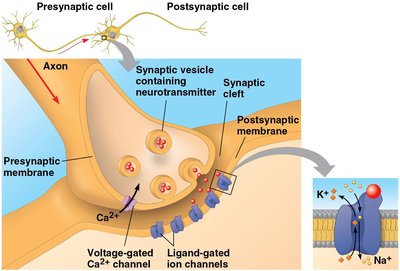
At chemical synapses, the presynaptic neuron synthesizes and packages neurotransmitters in synaptic vesicles located in the synaptic terminal. When an action potential arrives, it triggers the release of neurotransmitter into the synaptic cleft, where it is received by the postsynaptic cell.
Synaptic vesicles: Membrane-bound compartments containing neurotransmitter molecules.
Synaptic cleft: The narrow space between the presynaptic and postsynaptic membranes.
Postsynaptic membrane: Contains receptors that bind neurotransmitters.
Mechanism of Neurotransmitter Release
The release of neurotransmitter from the presynaptic membrane is triggered by the influx of Ca2+ ions through voltage-gated channels. The neurotransmitter then diffuses across the synaptic cleft and binds to receptors on the postsynaptic cell.
Action potential: Electrical signal that arrives at the synaptic terminal.
Voltage-gated Ca2+ channels: Open in response to depolarization, allowing Ca2+ to enter the terminal.
Neurotransmitter release: Ca2+ triggers fusion of synaptic vesicles with the membrane, releasing neurotransmitter.
BioFlix Animation: How Synapses Work
This animation visually demonstrates the process of synaptic transmission, including neurotransmitter release and binding to postsynaptic receptors.

Generation of Postsynaptic Potentials
At many chemical synapses, the receptor that binds and responds to neurotransmitters is a ligand-gated ion channel (ionotropic receptor). Neurotransmitter binding causes ion channels to open, generating a postsynaptic potential.
Ligand-gated ion channels: Open in response to neurotransmitter binding, allowing ions such as Na+ and K+ to flow.
Postsynaptic potentials: Changes in membrane potential of the postsynaptic cell.
Types of Postsynaptic Potentials
Excitatory postsynaptic potentials (EPSPs): Depolarizations that bring the membrane potential toward threshold, increasing the likelihood of an action potential.
Inhibitory postsynaptic potentials (IPSPs): Hyperpolarizations that move the membrane potential farther from threshold, decreasing the likelihood of an action potential.
Termination of Neurotransmitter Signaling
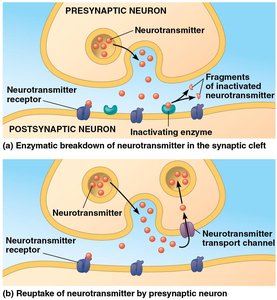
After a response is triggered, the chemical synapse returns to its resting state by clearing neurotransmitter molecules from the synaptic cleft. This is essential for proper nervous system function.
Enzymatic hydrolysis: Some neurotransmitters are inactivated by enzymes in the synaptic cleft.
Reuptake: Other neurotransmitters are recaptured into the presynaptic neuron via transport channels.
Clinical relevance: Blocking neurotransmitter clearance (e.g., by nerve gas sarin) can cause paralysis and death.
Neurotransmitters and Their Effects
A single neurotransmitter may bind to multiple types of receptors, producing different effects depending on the receptor type. For example, acetylcholine is a common neurotransmitter in both vertebrates and invertebrates, and can excite or inhibit postsynaptic cells.
Receptor diversity: A neurotransmitter can bind to more than a dozen different receptors.
Functional diversity: The same neurotransmitter can have excitatory or inhibitory effects depending on the postsynaptic cell's receptor.
Acetylcholine: Important in muscle contraction, learning, and memory.
Summary Table: Synaptic Transmission
Step | Description |
|---|---|
1. Action potential arrives | Depolarizes presynaptic terminal |
2. Ca2+ influx | Voltage-gated Ca2+ channels open |
3. Neurotransmitter release | Synaptic vesicles fuse with membrane |
4. Neurotransmitter binds receptor | Ligand-gated ion channels open |
5. Postsynaptic potential generated | EPSP or IPSP occurs |
6. Neurotransmitter clearance | Enzymatic breakdown or reuptake |
Key Terms and Definitions
Synapse: Junction between two neurons or a neuron and another cell.
Neurotransmitter: Chemical messenger released by neurons.
EPSP: Excitatory postsynaptic potential; depolarizes membrane.
IPSP: Inhibitory postsynaptic potential; hyperpolarizes membrane.
Ligand-gated ion channel: Ion channel that opens in response to a chemical signal.
Relevant Equations
The change in membrane potential due to ion flow can be described by:
where ΔV is the change in membrane potential, R is the gas constant, T is temperature, z is the ion charge, F is Faraday's constant, and the bracketed terms are ion concentrations.
Example Exam Questions
EPSPs are generated during depolarization.
IPSPs are generated during hyperpolarization.
Ca2+ is most directly involved in causing neurotransmitter release from the presynaptic membrane.
Acetylcholine is a common neurotransmitter in vertebrates and invertebrates. (True)
At chemical synapses, a chemical neurotransmitter carries information between neurons. (True)
Neurotransmitters are released in a synapse and bind to receptors on the postsynaptic cell.
Additional info: Expanded explanations and definitions were added for clarity and completeness. The summary table and equation provide academic context for synaptic transmission.
