 Back
Neurons, Synapses, and Signaling: Mechanisms of Neural Communication(final exam)
Study Guide - Smart Notes
 Tailored notes based on your materials, expanded with key definitions, examples, and context.
Neurons, Synapses, and Signaling
Signal Processing in Neurons
Neurons process signals through four main steps: reception, integration, conduction, and transmission/output. Each step is essential for the proper functioning of the nervous system and the communication between neurons and their target cells.
Reception: The neuron receives a signal, typically in the form of neurotransmitters or sensory input.
Integration: The neuron integrates incoming signals to determine whether to initiate an action potential.
Conduction: The action potential travels along the axon.
Transmission/output: The signal is transmitted to another cell, often across a synapse.
Membrane Potential and Ion Channels
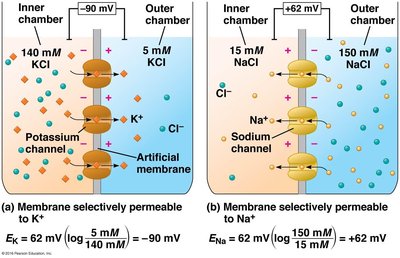
The membrane potential is the electrical potential difference across the neuronal membrane, primarily established by the distribution of ions such as potassium (K+) and sodium (Na+). The resting membrane potential is typically around -70 mV.
Potassium Channels: Opening more K+ channels increases K+ efflux, making the membrane potential more negative (hyperpolarization).
Sodium Channels: Opening more Na+ channels increases Na+ influx, making the membrane potential less negative (depolarization).
Key Equations:
Potassium equilibrium potential:
Sodium equilibrium potential:
Changes in Membrane Potential
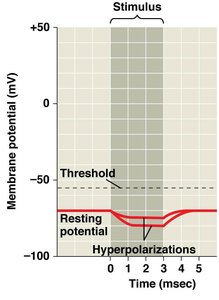
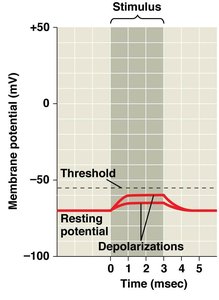
Neurons respond to stimuli by changing their membrane potential. These changes can be hyperpolarizations (making the membrane more negative) or depolarizations (making it less negative).
Hyperpolarization: Occurs when the membrane potential becomes more negative than the resting potential.
Depolarization: Occurs when the membrane potential becomes less negative, moving toward the threshold for action potential generation.
Action Potential: Generation and Properties
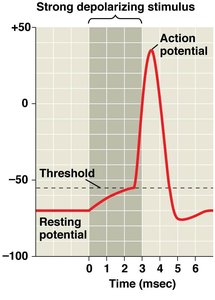
An action potential is a rapid, all-or-none electrical signal generated when a graded depolarization reaches the threshold (typically -55 mV). The action potential has a constant magnitude and is propagated along the axon.
Threshold: The minimum depolarization required to trigger an action potential.
All-or-None Principle: Once threshold is reached, the action potential occurs fully; if not, it does not occur.
Constant Magnitude: Action potentials do not vary in size.
Phases of the Action Potential
The action potential consists of several distinct phases, each involving specific ion channel activity:
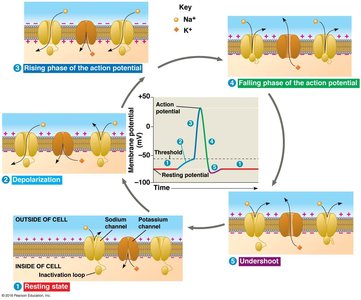
Resting State: Voltage-gated Na+ and K+ channels are closed; the membrane is at resting potential.
Depolarization: Na+ channels open, Na+ enters the cell, causing depolarization.
Rising Phase: More Na+ channels open due to positive feedback, rapidly increasing membrane potential.
Falling Phase: Na+ channels close (time-dependent), K+ channels open, K+ leaves the cell, repolarizing the membrane.
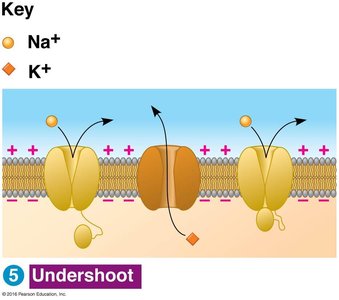
Undershoot: K+ channels remain open longer, causing hyperpolarization before returning to resting potential.
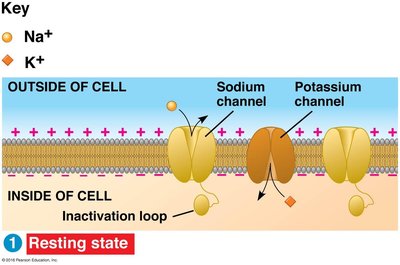
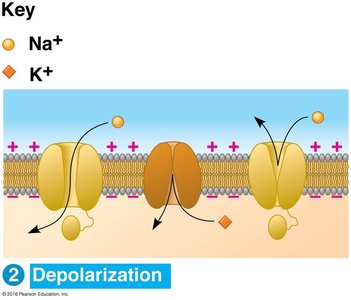
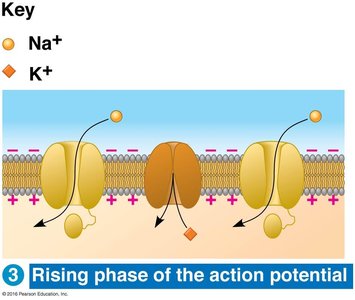
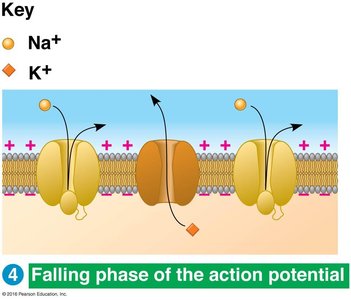
Action Potential Steps: Feedback Mechanisms
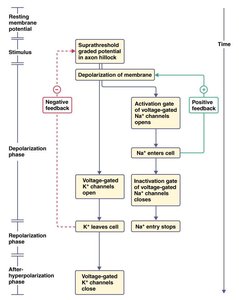
The action potential is regulated by both positive and negative feedback mechanisms:
Positive Feedback: Depolarization opens more Na+ channels, further increasing depolarization.
Negative Feedback: K+ channels open, Na+ channels close, restoring the membrane potential.
Conduction of Action Potentials
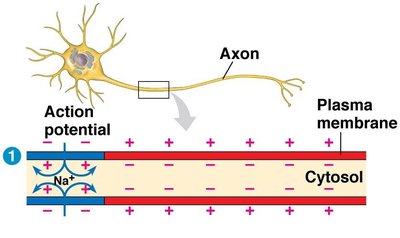
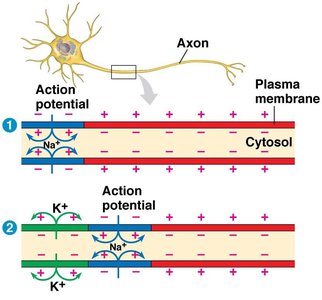
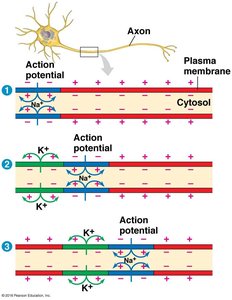
Action potentials are initiated at the axon hillock and propagate along the axon toward the synaptic terminals. The inactivation of Na+ channels behind the depolarization zone prevents backward propagation, ensuring unidirectional signal flow. The refractory period is the time during which a second action potential cannot be generated.
Axon Hillock: Site of action potential initiation.
Refractory Period: Ensures unidirectional propagation and limits firing frequency.
Conduction Speed and Myelination
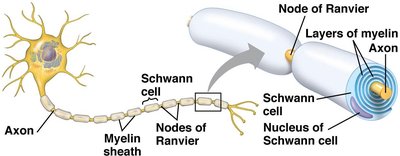
The speed of action potential conduction is influenced by the presence of myelin sheaths. Myelin increases conduction speed by allowing the action potential to jump between nodes of Ranvier (saltatory conduction), reducing the number of "boosts" needed along the axon.
Myelin Sheath: Insulating layer that increases conduction speed.
Nodes of Ranvier: Gaps in myelin where action potentials are regenerated.
Synaptic Signaling
Neurons transmit signals to other cells via synapses. The arrival of an action potential at the presynaptic terminal triggers neurotransmitter release, which binds to receptors on the postsynaptic membrane, causing ion channels to open and generating a postsynaptic response.
Action potential arrives, depolarizing the presynaptic membrane.
Depolarization opens voltage-gated Ca2+ channels, causing Ca2+ influx.
Elevated Ca2+ causes synaptic vesicles to fuse with the membrane, releasing neurotransmitter.
Neurotransmitter binds to ligand-gated ion channels, allowing ions to flow and generating a postsynaptic potential.
Human Consequences: Botulinum Toxin
Botulinum toxin inhibits the release of acetylcholine at neuromuscular junctions, preventing muscle contraction. This can lead to paralysis and death if respiratory muscles are affected. However, targeted use of the toxin can selectively inhibit specific muscles for medical or cosmetic purposes.
Botulinum Toxin: Blocks acetylcholine release, causing paralysis.
Medical Application: Used in small doses to treat muscle spasms or for cosmetic purposes (e.g., Botox).
Summary Table: Phases of the Action Potential
Phase | Main Ion Movement | Channel Activity | Membrane Potential Change |
|---|---|---|---|
Resting State | K+ out | K+ channels open, Na+ closed | -70 mV |
Depolarization | Na+ in | Na+ channels open | Rises toward threshold |
Rising Phase | Na+ in | More Na+ channels open | Rapid increase |
Falling Phase | K+ out | Na+ channels close, K+ open | Decrease toward resting |
Undershoot | K+ out | K+ channels remain open | Below resting |
Example: The action potential in a motor neuron allows rapid communication from the spinal cord to muscle fibers, enabling voluntary movement.
Additional info: The notes expand on the original slides by providing definitions, context, and a summary table for clarity.
