 Back
BackNew Renewable Energy Alternatives: Mechanisms, Benefits, and Drawbacks
Study Guide - Smart Notes
 Tailored notes based on your materials, expanded with key definitions, examples, and context.
New Renewable Energy Alternatives
Overview of Renewable Energy Sources
Renewable energy sources are increasingly important for meeting global energy demands while reducing environmental impacts. The most widely used conventional renewables are bioenergy and hydropower, while new renewables include solar, wind, geothermal, and ocean-based sources. These new renewables are primarily used for generating electricity, heating air or water, and fueling vehicles. Although they currently provide just over 1% of global energy, their use is rapidly growing and they are considered inexhaustible on a human timescale.
Bioenergy: Energy derived from organic materials.
Hydropower: Energy from moving water, typically via dams.
Solar, Wind, Geothermal, Ocean: Newer sources with significant growth potential.
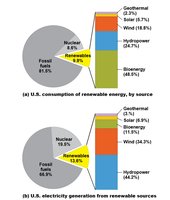
Figure: U.S. consumption and generation of renewable energy by source. Hydropower and bioenergy dominate, but wind and solar are growing rapidly.
Growth and Policy Incentives
Despite their potential, new renewables have historically received less policy support and investment compared to fossil fuels and nuclear power. This has slowed their adoption. On a per-year basis, oil and gas have received 13 times, and nuclear power 9 times, more support than new renewables.
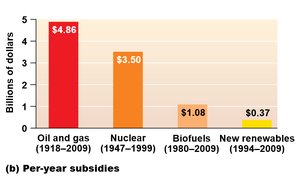
Figure: Comparison of per-year subsidies for oil and gas, nuclear, biofuels, and new renewables (in billions of dollars).
Trends in Renewable Energy Growth
Among new renewables, photovoltaic (PV) solar and concentrated solar power have the highest average yearly growth rates, followed by wind power. Nonrenewable energy sources show minimal growth.
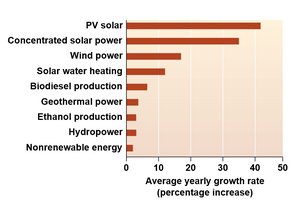
Figure: Average yearly growth rates for various renewable and nonrenewable energy sources.
Solar Energy
Mechanisms of Solar Energy Utilization
Solar energy is abundant, with the Earth receiving enough sunlight each day to meet human energy needs for 25 years. There are several methods to harness solar energy:
Passive Solar Energy: Involves building design and materials to maximize natural heating and lighting.
Active Solar Energy Collection: Uses devices to collect, focus, and store solar energy.
Concentrated Solar Power (CSP): Focuses sunlight from a wide area onto a single point to generate heat and electricity.
Photovoltaic (PV) Cells: Convert sunlight directly into electricity using silicon-based cells, which can be connected to batteries for storage.
Benefits: Safe, non-polluting, and requires little maintenance. Drawbacks: Not all regions are equally sunny, sunlight is intermittent, and equipment has high upfront costs.
Wind Power
Mechanisms and Applications
Wind power converts the kinetic energy of wind into electricity using wind turbines. Higher turbines capture more wind and are more efficient. Wind farms, which are groups of turbines, are often located in areas with consistent wind. Offshore wind farms benefit from higher wind speeds and less turbulence.
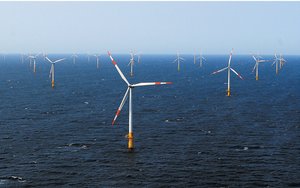
Figure: Offshore wind turbines, which take advantage of greater wind speeds and less turbulence at sea.
Benefits: No emissions, high energy return on investment (EROI), and provides income for landowners.
Drawbacks: Wind is intermittent, best sites are often far from population centers, and turbines can impact bird and bat populations.
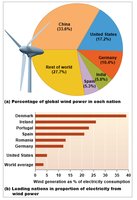
Figure: Distribution of global wind power and leading nations in wind energy production.
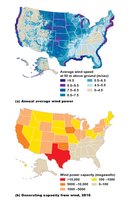
Figure: Maps showing average wind speed and wind power capacity across the United States.
Geothermal Energy
Mechanisms and Applications
Geothermal energy is derived from heat beneath the Earth's surface. It can be harvested directly from geysers or by drilling to access steam or hot water, which is used to turn turbines or heat buildings. Ground source heat pumps utilize the stable underground temperature for heating and cooling buildings.
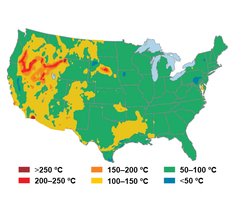
Figure: Geothermal resource map of the United States, showing regions with the highest geothermal potential.
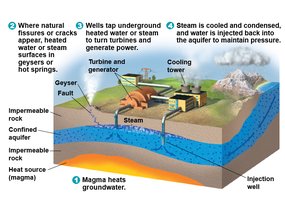
Figure: Diagram showing how geothermal power plants tap underground heat to generate electricity.
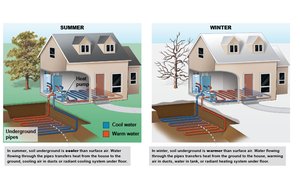
Figure: Ground source heat pump operation for heating and cooling buildings in different seasons.
Benefits: Non-polluting and renewable in theory.
Drawbacks: Limited to regions with accessible geothermal resources.
Ocean Energy Sources
Types and Mechanisms
Ocean energy includes wave energy, tidal energy, and energy from ocean currents. Wave energy is most abundant in open oceans, but transporting it to shore is challenging. Tidal energy works best in locations with large differences between high and low tides. Ocean currents can be harnessed using underwater turbines. These technologies are still being developed and may have ecological impacts.
Wave Energy: Uses the movement of surface water to generate electricity.
Tidal Energy: Exploits the rise and fall of tides, often with barrages or underwater turbines.
Ocean Currents: Underwater turbines capture kinetic energy from steady currents.
Benefits: Non-polluting and renewable. Drawbacks: Potential ecological impacts and technological challenges.
Hydrogen Fuel Cells
Mechanism and Potential
Hydrogen is the most abundant element and acts as an energy carrier rather than a primary source. Electricity from renewable sources can be used to produce hydrogen fuel cells, which power vehicles and homes. Widespread adoption requires new infrastructure and further research. There may be some environmental impacts, such as effects on the stratospheric ozone layer.
Hydrogen Fuel Cell Reaction:
Benefits: Clean energy carrier, potential for diverse applications.
Drawbacks: Infrastructure needs, possible environmental impacts.
