 Back
Niche Concept and Population Ecology: Study Notes
Study Guide - Smart Notes
 Tailored notes based on your materials, expanded with key definitions, examples, and context.
Niche Concept in Ecology
Definition and Importance of the Niche
The ecological niche of an organism describes its role and position within its environment, including all the abiotic and biotic factors that influence its survival, growth, and reproduction. The niche concept is fundamental to understanding species distribution and interactions within ecosystems.
Niche: The range of environmental conditions and resources within which individuals of a species can persist.
Distribution: The geographic area where a species is found, determined by its niche.
Abiotic factors: Non-living environmental variables such as temperature, humidity, and nutrient availability.
Biotic factors: Interactions with other living organisms, such as competition, predation, and disease.
Performance: The ability of an organism to survive, grow, and reproduce under specific environmental conditions.
Multidimensional Niche Space
G.E. Hutchinson (1957) formalized the niche concept as an n-dimensional hypervolume, where each dimension represents a different environmental variable (e.g., temperature, humidity, nitrogen concentration). The volume defines the limits within which a species can survive, grow, and reproduce.
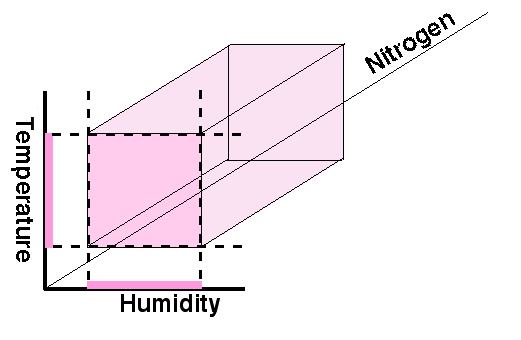
Each axis represents tolerance to an abiotic factor.
The intersection of tolerances defines the species' niche space.
Performance and Tolerance Breadth
Organisms have a range of tolerance for each environmental factor, which determines their performance. The optimal range allows for maximum survival and reproduction, while extremes can lead to reduced performance or mortality.
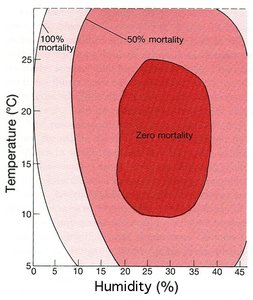
Critical thermal minimum (CTmin): Lowest temperature at which performance is possible.
Critical thermal maximum (CTmax): Highest temperature at which performance is possible.
Optimal temperature (T0): Temperature at which performance is maximized.
Fundamental vs. Realized Niche
The fundamental niche is determined by abiotic factors and represents all the environmental conditions under which a species can survive and reproduce. The realized niche is the portion of the fundamental niche actually occupied by the species, limited by biotic interactions such as competition, predation, or disease.
Type of Niche | Determining Factors | Description |
|---|---|---|
Fundamental Niche | Abiotic | All possible environments where a species can survive, grow, and reproduce |
Realized Niche | Biotic & Abiotic | Subset of the fundamental niche actually occupied due to biotic constraints |
Example: Hawaiian honeycreepers can live in forests at elevations of 1,000–3,500 m (fundamental niche), but due to avian malaria (a biotic factor), they are only found at 2,000–3,500 m (realized niche).
Case Study: Barnacles
Barnacle species such as Chthamalus and Semibalanus demonstrate the difference between fundamental and realized niches. Chthamalus can survive across a broader range of the intertidal zone (fundamental niche), but competition with Semibalanus restricts it to the upper zone (realized niche).
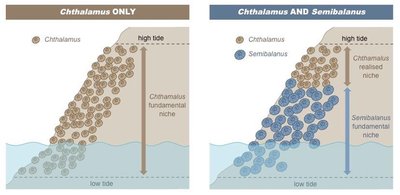
Fundamental niche: Determined by tolerance to abiotic factors (e.g., salinity, temperature, desiccation).
Realized niche: Limited by competition with other species.
Population Ecology
Population and Population Ecology
A population is a group of individuals of the same species living in the same area at the same time. Population ecology studies how and why the number of individuals in a population changes over time and space.
Species range: The spatial distribution of populations.
Populations are dynamic, changing in size and distribution due to births, deaths, immigration, and emigration.
Population Growth: Exponential and Logistic Models
Population growth can be described by mathematical models that predict changes in population size over time.
Exponential growth: Occurs when resources are unlimited and population growth is density independent.
Logistic growth: Occurs when resources are limited and population growth is density dependent.
Exponential Growth Model
Population grows at a constant per capita rate (r).
Equation:
r: Per capita rate of increase
N: Population size
Occurs in new habitats or after disturbances.
Logistic Growth Model
Population growth slows as it approaches the carrying capacity (K).
Equation:
K: Carrying capacity, the maximum population size the environment can sustain.
Growth rate decreases as population size increases due to resource limitation.
Growth Model | Equation | Key Features |
|---|---|---|
Exponential | Unlimited resources, density independent | |
Logistic | Limited resources, density dependent |
Population Dynamics
Populations gain individuals through births and immigration.
Populations lose individuals through deaths and emigration.
If birth rate + immigration rate > death rate + emigration rate, the population grows.
If birth rate + immigration rate < death rate + emigration rate, the population declines.
Applications and Examples
Exponential growth: Seen in invasive species colonizing new habitats or populations recovering after a disturbance.
Logistic growth: Typical of populations limited by resources, competition, or predation.
Example Question: Which population is most likely to demonstrate exponential growth? Answer: A population of an invasive grass species colonizing a new habitat.
Summary Table: Fundamental vs. Realized Niche
Aspect | Fundamental Niche | Realized Niche |
|---|---|---|
Determined by | Abiotic factors | Abiotic and biotic factors |
Potential range | All possible environments | Subset actually occupied |
Example constraint | Temperature, humidity | Competition, predation, disease |
Additional info: The niche concept is central to understanding species interactions, community structure, and the effects of environmental change on biodiversity.
