 Back
BackNon-Mendelian Inheritance and Sex-Linked Traits: Advanced Patterns of Heredity
Study Guide - Smart Notes
 Tailored notes based on your materials, expanded with key definitions, examples, and context.
Non-Mendelian Inheritance & Sex-Linked Traits
Introduction to Inheritance Patterns
Genetic inheritance can follow a variety of patterns beyond simple Mendelian dominance and recessiveness. This section explores dihybrid crosses, incomplete dominance, codominance, multiple alleles, polygenic inheritance, and sex-linked traits, providing a comprehensive overview of advanced genetics concepts relevant to college-level biology.
Dihybrid Crosses and Mendelian Ratios
Dihybrid Crosses
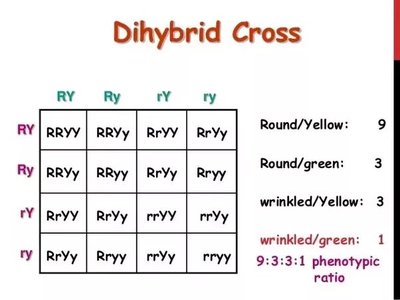
A dihybrid cross examines the inheritance of two different traits simultaneously. For example, in pea plants, seed color (yellow or green) and texture (round or wrinkled) are controlled by separate genes. A cross between two individuals heterozygous for both traits (RrYy x RrYy) demonstrates independent assortment and produces a characteristic phenotypic ratio.
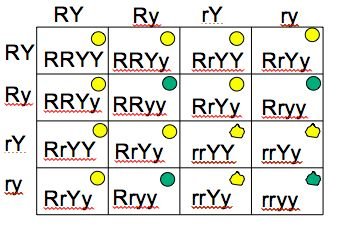
Possible gametes from a dihybrid (RrYy): RY, Ry, rY, ry
Punnett square for dihybrid cross yields a 9:3:3:1 phenotypic ratio:
9 round/yellow
3 round/green
3 wrinkled/yellow
1 wrinkled/green
Common Misconceptions about Dominance
Clarifying Dominant and Recessive Alleles
Dominant alleles do not necessarily correspond to darker, bigger, more common, or more advantageous traits. Dominance simply refers to the allele that is expressed in the heterozygote.
Dominant ≠ more common
Dominant ≠ advantageous
Dominant ≠ stronger phenotype
Non-Mendelian Patterns of Inheritance
Incomplete Dominance
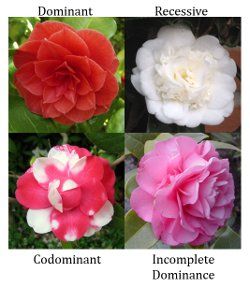
In incomplete dominance, the heterozygote displays a phenotype intermediate between the two homozygotes. This is often described as a blending of traits.
Example: Red (RR) x White (rr) flowers produce Pink (Rr) flowers.
Codominance
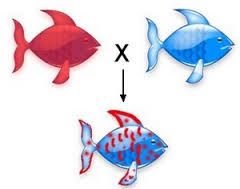
In codominance, both alleles in the heterozygote are fully expressed, resulting in a phenotype that simultaneously shows both traits without blending.
Example: A cross between a red and a blue fish produces offspring with both red and blue patches.
Multiple Alleles
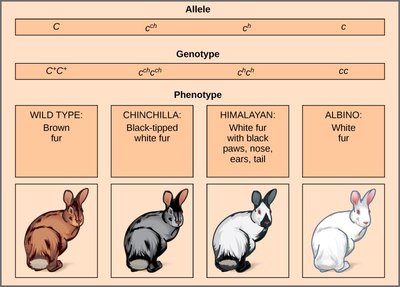
Some genes have more than two possible alleles in the population, though any individual can only carry two alleles per gene. An example is the coat color gene in rabbits, which has four alleles resulting in different fur colors.
Alleles: C, cchd, cch, c
Human ABO Blood Groups: Codominance and Multiple Alleles
The ABO blood group system in humans is a classic example of both codominance and multiple alleles. There are three alleles: IA, IB, and i. The IA and IB alleles are codominant, while i is recessive to both.
IAIA or IAi: Type A blood
IBIB or IBi: Type B blood
IAIB: Type AB blood (both antigens present)
ii: Type O blood (no antigens)

Phenotype (Blood Group) | Genotype | Antigen on RBC | Antibodies in Blood | Donation Status |
|---|---|---|---|---|
A | IAIA or IAi | Type A | Anti-B | - |
B | IBIB or IBi | Type B | Anti-A | - |
AB | IAIB | Type A & B | None | Universal recipient |
O | ii | None | Anti-A & Anti-B | Universal donor |
Polygenic Inheritance
In polygenic inheritance, a single trait is controlled by two or more genes, resulting in a continuous range of phenotypes. Examples include human skin color, height, and intelligence.
Phenotypes show a bell-shaped distribution in the population.
Review of Basic Genetics Concepts
Genes, Chromosomes, and Karyotypes
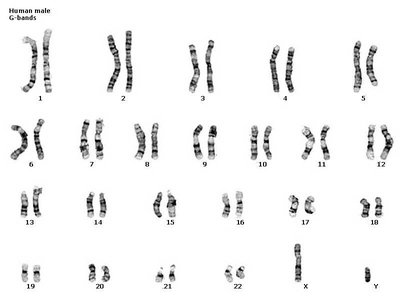
A gene is a segment of DNA that codes for a specific protein, while a chromosome is a structure composed of DNA and proteins that contains many genes. Humans have 46 chromosomes (23 pairs), including autosomes and sex chromosomes.
Autosomes: Non-sex chromosomes (22 pairs in humans)
Sex chromosomes: X and Y (XX = female, XY = male)
Sex-Linked Traits and Inheritance
Genes on Sex Chromosomes
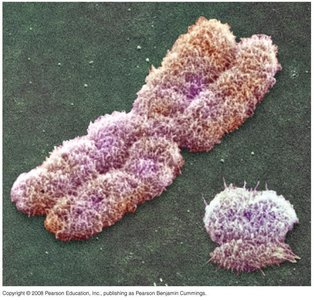
Sex-linked traits are controlled by genes located on the sex chromosomes, most commonly the X chromosome. The Y chromosome contains the SRY gene, which triggers male development. X-linked recessive disorders include hemophilia, color-blindness, and muscular dystrophy.
Females (XX) can be carriers for X-linked traits.
Males (XY) express X-linked traits if they inherit the affected X chromosome.
Hemophilia: X-Linked Recessive Inheritance
Hemophilia is a classic example of an X-linked recessive disorder. The inheritance pattern can be illustrated using Punnett squares and pedigrees. If a carrier female (XHXh) mates with a normal male (XHY), their sons have a 50% chance of having hemophilia, and daughters have a 50% chance of being carriers.
Colorblindness: X-Linked Recessive Inheritance
Red-green colorblindness is another X-linked recessive trait. Pedigree analysis can be used to determine the probability of inheritance in families.

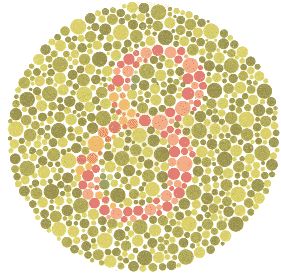
Calculating Probabilities in Pedigrees
To determine the probability of inheriting a sex-linked trait, multiply the independent probabilities at each step. For example, if the probability a mother is a carrier is 1/2, and the probability she passes the affected X chromosome to her son is 1/2, the probability the son is affected is 1/2 × 1/2 = 1/4.
Summary Table: Key Inheritance Patterns
Pattern | Definition | Example |
|---|---|---|
Simple Dominance | One allele masks the other in heterozygotes | Purple vs. white pea flowers |
Incomplete Dominance | Heterozygote is intermediate | Pink snapdragons |
Codominance | Both alleles fully expressed | AB blood type |
Multiple Alleles | More than two alleles in population | Rabbit coat color, ABO blood group |
Polygenic | Trait controlled by multiple genes | Skin color, height |
Sex-linked | Gene on X or Y chromosome | Hemophilia, colorblindness |
Review Questions
How many phenotypes are possible for one gene in simple dominance?
Can two brown-eyed parents have a blue-eyed child? Why or why not?
What is the difference between polygenic traits and multiple alleles?
Do homologous chromosomes always have the same alleles?
What is the difference between a gene and a chromosome?
How many chromosomes do humans have?
What determines genetic sex in humans?
