 Back
BackNoncoding RNAs and Their Roles in Gene Expression Regulation
Study Guide - Smart Notes
 Tailored notes based on your materials, expanded with key definitions, examples, and context.
Noncoding RNAs in Gene Expression
Overview of Noncoding RNAs (ncRNAs)
Recent advances in genome sequencing have revealed that only a small fraction of the human genome codes for proteins, while a significant portion is transcribed into noncoding RNAs (ncRNAs). These RNAs, once considered 'junk DNA,' are now recognized as crucial regulators of gene expression in eukaryotic cells.
Noncoding RNAs (ncRNAs): RNA molecules that are not translated into proteins but have regulatory or structural roles in the cell.
Types of ncRNAs: Includes ribosomal RNA (rRNA), transfer RNA (tRNA), microRNAs (miRNAs), small interfering RNAs (siRNAs), and piwi-interacting RNAs (piRNAs).
Transcriptional Activity: Approximately 75% of the human genome is transcribed at some point, with much of this RNA being noncoding.
Functional Significance: Many ncRNAs are involved in regulating gene expression at multiple levels, including chromatin modification, mRNA degradation, and translation inhibition.
Regulation of mRNAs by MicroRNAs and Small Interfering RNAs
MicroRNAs (miRNAs)
MicroRNAs (miRNAs) are small, single-stranded RNA molecules (about 22 nucleotides) that regulate gene expression by binding to complementary sequences in target mRNAs. Their discovery has significantly expanded our understanding of post-transcriptional gene regulation.
Biogenesis: miRNAs are processed from longer RNA precursors by cellular enzymes.
Mechanism: miRNAs form complexes with proteins, allowing them to bind to mRNAs with at least 7-8 complementary bases.
Outcomes: The miRNA-protein complex can either degrade the target mRNA or block its translation, depending on the degree of complementarity.
Prevalence: There are about 1,500 miRNA genes in humans, potentially regulating over half of all human genes.
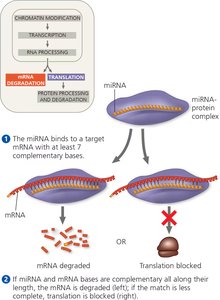
Example: If an miRNA targets an mRNA coding for a protein that promotes cell division, loss of the miRNA could lead to uncontrolled cell proliferation.
Small Interfering RNAs (siRNAs) and RNA Interference (RNAi)
Small interfering RNAs (siRNAs) are similar in size and function to miRNAs. They are processed from double-stranded RNA precursors and can guide the degradation or translational repression of target mRNAs. The process by which siRNAs silence gene expression is known as RNA interference (RNAi).
Mechanism: siRNAs associate with the same protein complexes as miRNAs, leading to mRNA degradation or translation inhibition.
Laboratory Use: RNAi is a powerful tool for gene function studies, allowing researchers to selectively silence specific genes.
Evolutionary Perspective: RNAi may have evolved as a defense mechanism against viruses with double-stranded RNA genomes, but it also regulates endogenous gene expression.
Chromatin Remodeling and Transcriptional Regulation by Noncoding RNAs
Chromatin Remodeling by siRNAs and piRNAs
In addition to post-transcriptional regulation, small ncRNAs can influence gene expression by modifying chromatin structure, thereby affecting transcription.
siRNAs in Chromatin Remodeling: In some yeasts, siRNAs derived from centromeric DNA are essential for the formation of heterochromatin at centromeres during the cell cycle.
Mechanism: siRNAs interact with larger ncRNAs and chromatin-modifying enzymes to condense chromatin into heterochromatin, silencing gene expression in those regions.
piwi-interacting RNAs (piRNAs): A class of small ncRNAs (24–31 nucleotides) that associate with Piwi proteins. They induce heterochromatin formation and silence transposons, especially in germ cells, helping to maintain genome integrity.
Role in Germ Cells: piRNAs help reestablish DNA methylation patterns during gamete formation, protecting the genome from transposable elements.
Summary Table: Classes of Small Noncoding RNAs
Type | Size (nucleotides) | Origin | Main Function |
|---|---|---|---|
miRNA | ~22 | Single-stranded RNA precursor | mRNA degradation or translation inhibition |
siRNA | ~22 | Double-stranded RNA precursor | mRNA degradation, chromatin remodeling (in some species) |
piRNA | 24–31 | Single-stranded RNA precursor | Transposon silencing, heterochromatin formation in germ cells |
Additional Context and Applications
CRISPR-Cas9 System: Bacteria use small ncRNAs in the CRISPR-Cas9 system as a defense against viral infection, illustrating the evolutionary conservation of RNA-based regulation.
X-Chromosome Inactivation: In female mammals, the noncoding RNA XIST coats one X chromosome, leading to its inactivation and formation of a Barr body (see Concept 12.2).
Conclusion: Noncoding RNAs add complexity to gene regulation, acting at multiple levels to fine-tune gene expression. Ongoing research continues to uncover new roles and mechanisms for these versatile molecules.
