 Back
Nonvascular and Seedless Vascular Plants: Structure, Evolution, and Diversity
Study Guide - Smart Notes
 Tailored notes based on your materials, expanded with key definitions, examples, and context.
Classification and Diversity of Plants
Major Plant Groups and Evolutionary Relationships
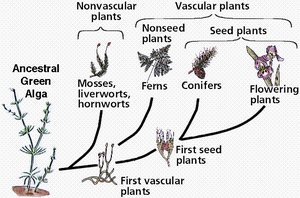
Plants are a dominant group of terrestrial organisms, exhibiting great diversity in form and function. Their evolutionary history is marked by the development of key anatomical traits and adaptations that allowed them to colonize land and diversify into approximately 290,000 living species. The classification of plants is primarily based on the presence or absence of vascular tissue and the ability to produce seeds.
Nonvascular plants (Bryophytes): Lack vascular tissue; include mosses, liverworts, and hornworts.
Vascular plants: Possess vascular tissue (xylem and phloem); subdivided into seedless vascular plants (lycophytes and monilophytes) and seed plants (gymnosperms and angiosperms).
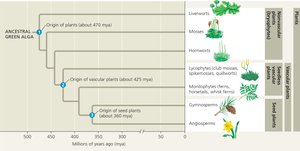
Example: Ferns are seedless vascular plants, while mosses are nonvascular plants.
Key Anatomical Traits in Plant Evolution
Rhizoids, Vascular Tissue, Roots, and Leaves
The evolution of specialized structures enabled plants to adapt to terrestrial environments:
Rhizoids: Hair-like structures in bryophytes that anchor the plant but do not absorb water and nutrients efficiently.
Vascular tissue: Specialized cells (xylem and phloem) that transport water, minerals, and organic compounds throughout the plant.
Roots: True roots evolved in vascular plants, providing anchorage and efficient absorption of water and nutrients from the soil.
Leaves: Photosynthetic organs that increase surface area for light capture; classified as microphylls (single vein, found in lycophytes) and megaphylls (branched veins, found in other vascular plants).
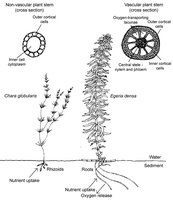
Additional info: The presence of lignin in vascular tissue provides structural support, allowing plants to grow taller and develop complex forms.
Alternation of Generations in Plants
Sporophyte and Gametophyte Dominance
All plants exhibit alternation of generations, a life cycle that alternates between a multicellular haploid gametophyte (n) and a multicellular diploid sporophyte (2n). The relative dominance of these stages varies among plant groups:
Bryophytes: Gametophyte is dominant; sporophyte is nutritionally dependent on the gametophyte.
Seedless vascular plants: Sporophyte is dominant; gametophyte is reduced and often independent but small.
Seed plants: Sporophyte is dominant; gametophyte is highly reduced and dependent on the sporophyte.
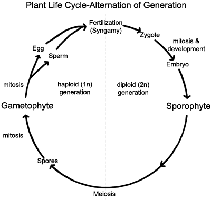
Example: In mosses, the green leafy structure is the gametophyte, while in ferns, the large leafy plant is the sporophyte.
Nonvascular Plants (Bryophytes)
Characteristics and Life Cycle
Bryophytes are small, simple plants that thrive in moist environments. They lack true stems, roots, or leaves, and do not possess a vascular system. Water and nutrients are absorbed directly from the environment by osmosis and diffusion.
Rhizoids: Anchor the plant but play a minimal role in absorption.
Fertilization: Requires water; flagellated sperm swim to the egg.
Reproduction: Produce spores for dispersal; asexual reproduction is common.
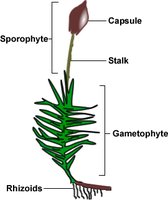
Example: Mosses can survive desiccation and freezing, allowing them to colonize diverse substrates.
Liverworts and Hornworts
Liverworts and hornworts are two other groups of bryophytes. Liverworts may have leafy or thalloid forms and lack stomata, while hornworts are characterized by their horn-like sporophytes.
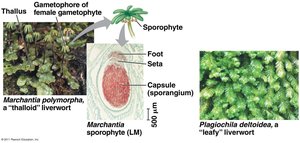
Additional info: Liverworts and hornworts also require moist environments for fertilization and spore dispersal.
Vascular Plants
Vascular Tissue: Xylem and Phloem
Vascular plants possess specialized conductive tissues that allow for the transport of water, minerals, and photosynthetic products throughout the plant body:
Xylem: Transports water and minerals from roots to shoots; composed of tracheids and, in angiosperms, vessel elements. Cell walls are strengthened by lignin.
Phloem: Transports sugars, amino acids, and other organic products in all directions within the plant.
Additional info: The evolution of vascular tissue enabled plants to grow taller and develop more complex morphologies.
Roots and Leaves
Roots anchor vascular plants, absorb water and nutrients, and store food. Leaves are the main photosynthetic organs and are classified as:
Microphylls: Small leaves with a single vein (lycophytes).
Megaphylls: Larger leaves with a branched vascular system (all other vascular plants).
Seedless Vascular Plants
Traits and Life Cycle
Seedless vascular plants, including lycophytes and monilophytes (ferns, horsetails, whisk ferns), possess true vascular tissue and most have true roots. They reproduce via spores and require moist environments for fertilization, as sperm are flagellated and must swim to the egg.
Lycophytes: Club mosses, spike mosses, and quillworts; have microphylls and dichotomously branching roots.
Monilophytes: Ferns, horsetails, and whisk ferns; have megaphylls and roots that branch.
Additional info: The gametophyte generation is reduced and often develops underground, sometimes in association with fungi.
Comparison of Plant Groups
Key Features Table
Feature | Bryophytes (Nonvascular) | Seedless Vascular Plants | Seed Plants |
|---|---|---|---|
Vascular Tissue | No | Yes | Yes |
Dominant Generation | Gametophyte | Sporophyte | Sporophyte |
Roots | Rhizoids only | True roots | True roots |
Leaves | No true leaves | Microphylls or megaphylls | Megaphylls |
Reproduction | Spores, water required for fertilization | Spores, water required for fertilization | Seeds, pollen (no water required for fertilization) |
Summary
The evolution of vascular tissue, roots, and leaves allowed plants to grow larger, become more complex, and colonize a wider range of terrestrial environments. Nonvascular plants are limited by their lack of vascular tissue and reliance on moist environments, while seedless vascular plants represent an evolutionary step toward greater independence from water for reproduction and increased structural complexity.
