 Back
Nuclear Chemistry and the Electronic Structure of Atoms
Study Guide - Smart Notes
 Tailored notes based on your materials, expanded with key definitions, examples, and context.
Nuclear Chemistry
Introduction to Nuclear Chemistry
Nuclear chemistry is the study of the properties and changes of atomic nuclei. Unlike chemical reactions, which involve the rearrangement of electrons and the formation or breaking of chemical bonds, nuclear reactions involve changes in the nucleus of an atom, often resulting in the transformation of one element into another.
Nuclear Reaction: Changes the atom’s nucleus; different isotopes of the same element behave differently; very large energy changes; no conservation of atoms.
Chemical Reaction: Changes the way atoms are combined; different isotopes behave similarly; smaller energy changes; conservation of atoms.
Radioactivity
Radioactivity is the spontaneous decay and emission of radiation from an unstable nucleus, either naturally or as a result of a nuclear reaction. This phenomenon was discovered by Henry Becquerel in 1896 and named by Marie Curie.
Radioisotope: A radioactive isotope. Every element in the periodic table has at least one radioactive isotope.
Types of Radiation
There are several types of radiation emitted during nuclear decay:
Alpha (𝛂) Radiation: Emission of an alpha particle (a helium-4 nucleus; 2 protons and 2 neutrons).
Beta (𝛽) Radiation: Emission of a beta particle (an electron).
Gamma (𝛾) Radiation: Emission of very high energy electromagnetic radiation.
Positron Emission: Emission of a positron (a particle with the same mass as an electron but a positive charge).
Electron Capture: The nucleus captures one of the surrounding electrons, converting a proton to a neutron.
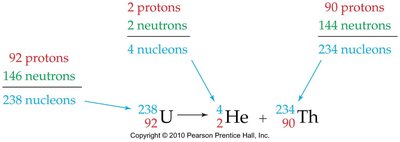
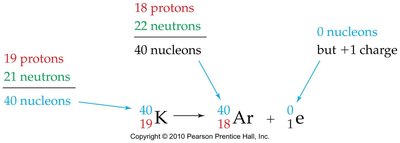
Summary of Radioactive Decay Processes
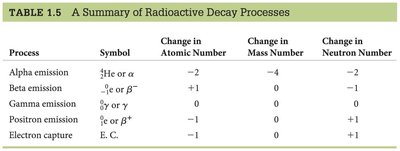
The following table summarizes the main types of radioactive decay, their symbols, and the changes they cause in atomic and mass numbers:
Process | Symbol | Change in Atomic Number | Change in Mass Number | Change in Neutron Number |
|---|---|---|---|---|
Alpha emission | or | -2 | -4 | -2 |
Beta emission | or | +1 | 0 | -1 |
Gamma emission | or | 0 | 0 | 0 |
Positron emission | or | -1 | 0 | +1 |
Electron capture | E.C. | -1 | 0 | +1 |
Applications of Nuclear Chemistry
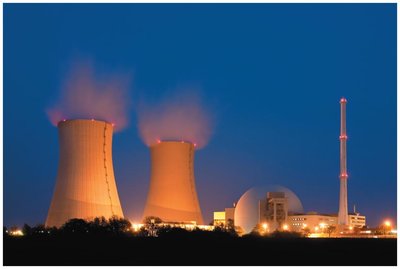
Nuclear Energy Production: Nuclear reactions are used to generate electricity in nuclear power plants.
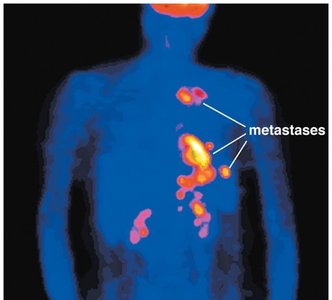
Medical Imaging: Techniques such as PET (Positron Emission Tomography) scans use radioisotopes to detect diseases like cancer.
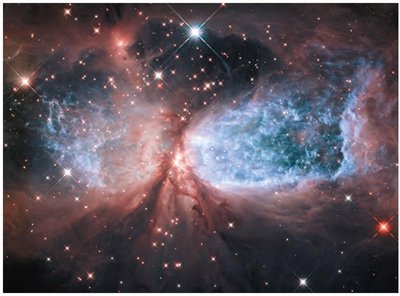
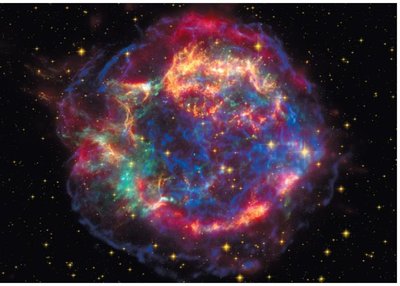
Cosmology: Radioactive decay helps in understanding the age and processes of stars and the universe.
Periodicity and the Electronic Structure of Atoms
Wavelength, Frequency, and Energy of Electromagnetic Radiation
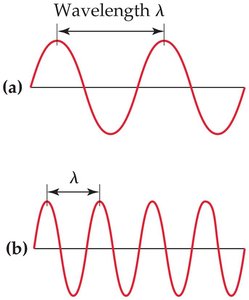
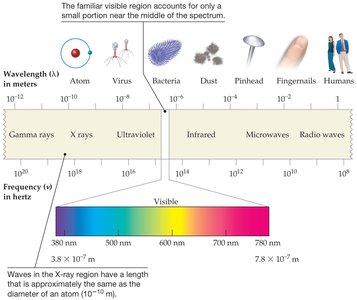
Electromagnetic radiation, including visible light, can be described by its wavelength (), frequency (), and energy (). These properties are related by the following equations:
Speed of Light:
Energy of a Photon:
Speed of Light (c): m/s
Planck’s Constant (h): J·s
Quantum Mechanics and Electron Behavior
Quantum mechanics explains the behavior of electrons in atoms. Electrons are extremely small, and their arrangement and movement determine the chemical properties of elements. The study of light emitted or absorbed by substances has been crucial in understanding electronic structure.
Wave-Particle Duality: Light exhibits both wave-like and particle-like properties.
Quanta/Photons: Energy is absorbed or emitted in discrete packets called quanta or photons.
The Photoelectric Effect
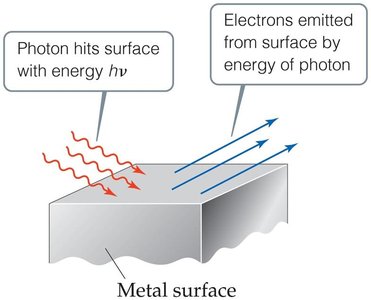
The photoelectric effect demonstrates that light can eject electrons from a metal surface if its energy exceeds a certain threshold. This effect supports the particle nature of light and is described by the equation:
Practice Problem: Calculations Using Avogadro’s Number
Example: The fuel used in many disposable lighters is liquid butane, C4H10. How many carbon atoms are in 1.00 g of butane given that the molar mass of butane is 58.12 g/mol?
Calculate moles of butane:
Find moles of carbon: Each mole of butane contains 4 moles of carbon atoms.
Calculate number of carbon atoms:
Avogadro’s Number: particles/mol

Additional info: This calculation is fundamental in stoichiometry and is widely used in both chemistry and biology to relate mass, moles, and number of particles.
