 Back
Nucleic Acid Structure and Function: DNA and RNA
Study Guide - Smart Notes
 Tailored notes based on your materials, expanded with key definitions, examples, and context.
Ch 4 – Nucleic Acid Structure and Function
Nucleotide Structure
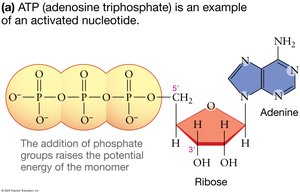
Nucleotides are the fundamental building blocks of nucleic acids, such as DNA and RNA. Each nucleotide consists of three components: a phosphate group, a five-carbon sugar (ribose in RNA, deoxyribose in DNA), and a nitrogenous base. The carbons in the sugar are numbered 1’ through 5’, which is important for understanding the directionality and linkage of nucleic acids.
Phosphate group: Attached to the 5’ carbon of the sugar.
Sugar: Ribose (RNA) or deoxyribose (DNA); the difference is the presence or absence of a hydroxyl group at the 2’ carbon.
Nitrogenous base: Attached to the 1’ carbon; can be a purine (adenine, guanine) or pyrimidine (cytosine, thymine in DNA, uracil in RNA).
Numbering: Carbons are numbered 1’ (base attachment), 2’ (OH in RNA, H in DNA), 3’ (OH group for polymerization), 4’, and 5’ (phosphate attachment).
Difference between DNA and RNA: DNA has deoxyribose (lacks 2’ OH), RNA has ribose (has 2’ OH).
Example: A nucleotide of DNA contains a phosphate, deoxyribose sugar, and a nitrogenous base (e.g., adenine).
Polymerization of Nucleic Acids
Nucleic acids are formed by linking nucleotides together via phosphodiester bonds. This bond forms between the 3’ hydroxyl group of one nucleotide and the 5’ phosphate group of the next, creating a sugar-phosphate backbone.
Directionality: Nucleic acid strands have a 5’ to 3’ direction, with sequences written from 5’ to 3’.
Primary structure: The sequence of nucleotides, with nitrogenous bases projecting away from the backbone.
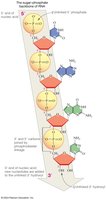
Example: The sequence 5’ UAGC 3’ is written from the 5’ to 3’ end.
Nitrogenous Bases and Base Pairing
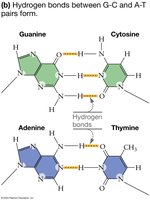
Nitrogenous bases are classified as purines (adenine, guanine) and pyrimidines (cytosine, thymine, uracil). In double-stranded DNA, bases pair via hydrogen bonds: A pairs with T, and G pairs with C. In RNA, uracil replaces thymine.
G-C base pair: Forms three hydrogen bonds, making it more stable.
A-T base pair: Forms two hydrogen bonds.
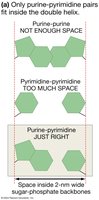
Purine-pyrimidine pairing: Only purine-pyrimidine pairs fit inside the double helix, ensuring proper spacing.
Example: Given the sequence 5’ AGTACTAG 3’, the complementary DNA strand is 3’ TCATGATC 5’.
DNA Secondary Structure: The Double Helix
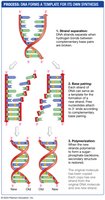
DNA’s secondary structure is a double helix formed by two antiparallel strands held together by complementary base pairing. The double helix is stabilized by hydrogen bonds and hydrophobic interactions between stacked bases.
Antiparallel strands: One strand runs 5’ to 3’, the other 3’ to 5’.
Base pairing: Ensures accurate copying and stability.
Central Dogma and Nucleic Acid Function
Nucleic acids store and transmit genetic information. The central dogma describes the flow of information: DNA is transcribed to RNA, which is translated to protein. DNA is stable and easy to copy due to complementary base pairing.
Stability: DNA is less reactive and more stable than RNA.
Replication: DNA serves as a template for its own synthesis.
Nucleic Acid Function: Energy (ATP)
ATP (adenosine triphosphate) is a nucleotide that serves as a primary energy carrier in cells. The addition of phosphate groups increases its potential energy, making it a good source of chemical energy.
High potential energy: Due to the presence of three phosphate groups, which are negatively charged and repel each other.
Energy release: Hydrolysis of ATP releases energy for cellular processes.
Example: ATP hydrolysis powers muscle contraction and active transport.
RNA Structure and Versatility
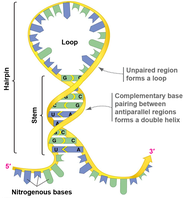
RNA is more versatile than DNA in both structure and function. Its single-stranded nature allows it to fold into complex shapes, enabling diverse roles such as catalysis and regulation.
Secondary structure: RNA can form hairpins, loops, and double helices through intramolecular base pairing.
Structural diversity: Enables RNA to act as enzymes (ribozymes) and regulatory molecules.
RNA Function: Catalysis and Regulation
RNA can catalyze chemical reactions, a property not shared by DNA. Ribozymes are RNA molecules with enzymatic activity, and their function is enabled by complex folding that brings distant nucleotides together at the active site.
Ribozyme: RNA enzyme that catalyzes reactions such as peptide bond formation.
Versatility: RNA’s structural flexibility allows it to perform many functions in the cell.
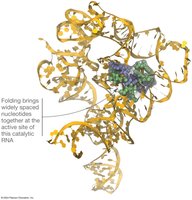
Example: The ribosome’s catalytic site is composed of RNA, not protein.
Practice: Drawing Nucleotides and Dinucleotides
To reinforce understanding, students should practice drawing nucleotides, labeling the sugar carbons, and distinguishing between ribonucleotides and deoxyribonucleotides. A dinucleotide is formed by connecting two nucleotides via a phosphodiester linkage.
Ribonucleotide: Contains ribose with a 2’ OH group.
Deoxyribonucleotide: Contains deoxyribose with a 2’ H group.
Phosphodiester linkage: Connects the 3’ OH of one nucleotide to the 5’ phosphate of another.
Additional info: Students should be able to identify and label all important functional groups and carbons on the sugar ring.
