 Back
Nucleic Acid Structure and Function: DNA and RNA
Study Guide - Smart Notes
 Tailored notes based on your materials, expanded with key definitions, examples, and context.
Ch 4 – Nucleic Acid Structure and Function
Historical Discovery of DNA Structure
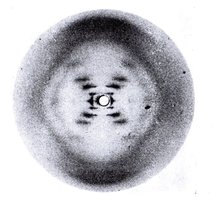
The structure of DNA was first elucidated in 1953 by James Watson and Francis Crick, building on the foundational work of Rosalind Franklin and Maurice Wilkins. Franklin's famous 'Photo 51' provided critical evidence for the helical structure of DNA, and Chargaff's rules established the base pairing relationships.
Photo 51: X-ray diffraction image by Rosalind Franklin, revealing the helical nature of DNA.
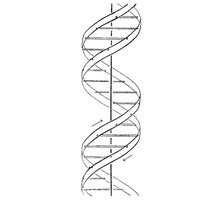
Watson and Crick Model: Proposed the double helix structure, with antiparallel strands and specific base pairing.
Chargaff's Rules: In double-stranded DNA, the amount of adenine equals thymine, and the amount of guanine equals cytosine.
The Structure of a Nucleotide
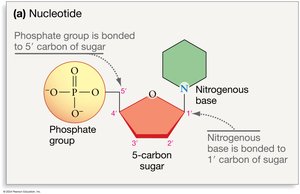
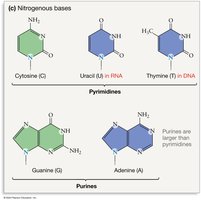
Nucleotides are the monomers of nucleic acids, consisting of three components: a phosphate group, a five-carbon sugar, and a nitrogenous base. The sugar is either ribose (in RNA) or deoxyribose (in DNA), and the base can be a purine or pyrimidine.
Phosphate group: Attached to the 5' carbon of the sugar.
Five-carbon sugar: Ribose in RNA, deoxyribose in DNA.
Nitrogenous base: Attached to the 1' carbon of the sugar; can be adenine, guanine, cytosine, thymine (DNA), or uracil (RNA).
Differences Between DNA and RNA
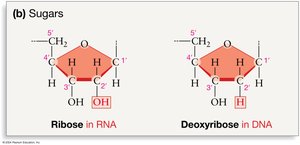
DNA and RNA differ in their sugar component and one of their nitrogenous bases. These differences affect their stability and function.
DNA: Contains deoxyribose (lacks an oxygen at the 2' carbon) and thymine.
RNA: Contains ribose (has a hydroxyl group at the 2' carbon) and uracil.
Stability: The 2' hydroxyl group in RNA makes it more reactive and less stable than DNA.
Polymerization and Directionality of Nucleic Acids
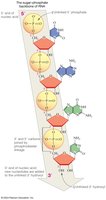
Nucleic acids are polymers formed by linking nucleotides via phosphodiester bonds. The backbone consists of alternating sugar and phosphate groups, with bases projecting outward. Strands have directionality, written from 5' to 3'.
Phosphodiester linkage: Connects the 3' hydroxyl of one nucleotide to the 5' phosphate of the next.
Directionality: Sequences are always written 5' to 3'.
Polarity: Each strand has a distinct 5' and 3' end.
DNA Secondary Structure: Base Pairing and Double Helix
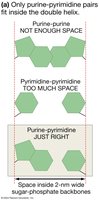
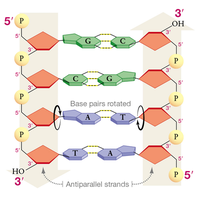
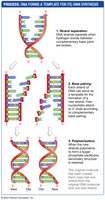
The secondary structure of DNA is the double helix, stabilized by complementary base pairing. Purines (adenine, guanine) pair with pyrimidines (thymine, cytosine) via hydrogen bonds.
A-T base pair: Two hydrogen bonds.
G-C base pair: Three hydrogen bonds (stronger).
Antiparallel strands: Strands run in opposite directions.
Only purine-pyrimidine pairs fit inside the helix: Ensures uniform width.
Complementary Base Pairing and Sequence Determination
Complementary base pairing allows for the determination of the sequence of one strand from the other. This is essential for DNA replication and transcription.
Example: If the sequence is 5' AGTACTAG 3', the complementary strand is 3' TCATGATC 5'.
Chargaff's Rule: If the percentage of one base is known, the others can be calculated.
Nucleic Acid Function: Information Storage and Central Dogma
Nucleic acids store genetic information and direct the synthesis of proteins. The central dogma describes the flow of information: DNA is transcribed to RNA, which is translated into protein.
DNA: Stable, easy to copy due to complementary base pairing.
Central Dogma: DNA → RNA → Protein.
Nucleic Acid Function: Energy (ATP)
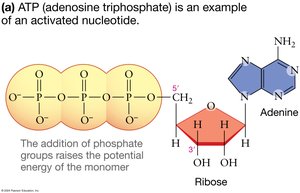
ATP (adenosine triphosphate) is a nucleotide that serves as a primary energy carrier in cells. Its high potential energy comes from the repulsion between phosphate groups and the favorable conversion to ADP and inorganic phosphate.
ATP: Contains three phosphate groups, ribose, and adenine.
High energy bonds: Electrostatic repulsion and solvation cost make ATP unstable and a good energy source.
Equation:
Nucleic Acid Application: Medical Use of Adenosine
Adenosine, the unphosphorylated nucleoside, is used medically to treat supraventricular tachycardia (SVT). It temporarily stops the heart, allowing it to restart with a regular rhythm.
SVT treatment: Adenosine induces a brief flatline on EKG, followed by heart restart.
Versatility of RNA: Structure and Function
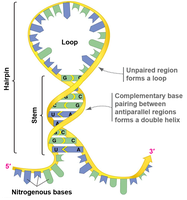
RNA is more versatile than DNA due to its ability to form complex secondary structures and its reactivity. RNA can act as a messenger, catalyst, and regulator.
Types of RNA: mRNA, rRNA, tRNA, miRNA, siRNA, lncRNA, snRNA.
RNA interference: miRNA and siRNA modulate gene expression.
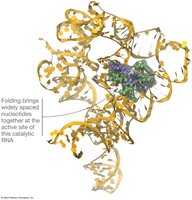
Ribozyme: RNA molecules that catalyze chemical reactions.
Complex structures: Stem-loops, pseudoknots, and other motifs allow diverse functions.
Summary Table: DNA vs. RNA
Feature | DNA | RNA |
|---|---|---|
Sugar | Deoxyribose | Ribose |
Base | Thymine | Uracil |
Stability | Stable | Less stable, more reactive |
Function | Information storage | Information transfer, catalysis, regulation |
Practice and Application
Draw and label a nucleotide, number the carbons, and indicate the important functional groups.
Determine complementary sequences for given DNA or RNA strands.
Calculate base percentages using Chargaff's rules.
Explain why ATP is a good source of chemical energy.
Compare primary and secondary structures of DNA and RNA.
Discuss the versatility of RNA in cellular function.
