 Back
BackBio 190 Chapter 4: Nucleic Acids and an RNA World: Structure, Function, and Evolution
Study Guide - Smart Notes
 Tailored notes based on your materials, expanded with key definitions, examples, and context.
Chapter 4: Nucleic Acids and an RNA World
Introduction to Nucleic Acids and the RNA World Hypothesis
Nucleic acids are essential biological macromolecules responsible for the storage, transmission, and expression of genetic information. The RNA world hypothesis proposes that early life forms may have relied on RNA both to store genetic information and to catalyze chemical reactions, preceding the evolution of DNA and proteins.
Deoxyribonucleic acid (DNA): Stores genetic information and is replicated with the help of proteins.
RNA World Hypothesis: Suggests a period in evolutionary history when RNA molecules functioned as both genetic material and catalysts for their own replication.
Once self-replicating molecules evolved, biological evolution began.
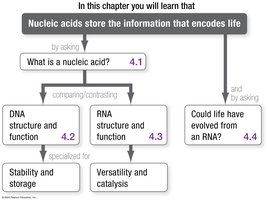
What is a Nucleic Acid?
Structure of Nucleotides
Nucleic acids are polymers composed of nucleotide monomers. Each nucleotide consists of three components:
Phosphate group
Five-carbon sugar (ribose in RNA, deoxyribose in DNA)
Nitrogenous base (purine or pyrimidine)
The phosphate group and nitrogenous base are both bonded to the sugar molecule.
Types of Nucleotides
Ribonucleotides: Monomers of RNA, containing ribose sugar. Ribose has a hydroxyl group (-OH) at the 2' carbon.
Deoxyribonucleotides: Monomers of DNA, containing deoxyribose sugar. Deoxyribose lacks an oxygen atom at the 2' carbon (has H instead of OH).
Nitrogenous Bases
Purines: Double-ring structures (adenine [A], guanine [G])
Pyrimidines: Single-ring structures (cytosine [C], uracil [U]—found only in RNA, thymine [T]—found only in DNA)
Mnemonic: "C U T of P y" for pyrimidines (C, U, T)
Origin of Nucleotides and Chemical Evolution
Simulations of early Earth conditions suggest that nitrogenous bases and sugars could be synthesized abiotically. Recent research highlights the role of deep-sea hydrothermal vent minerals in binding and concentrating ribose, a key sugar in nucleotide formation.
Polymerization of Nucleic Acids
Condensation Reactions and Phosphodiester Linkages
Nucleic acids are formed by condensation reactions, creating phosphodiester bonds between the phosphate group on the 5' carbon of one nucleotide and the hydroxyl group on the 3' carbon of another. This process produces a sugar–phosphate backbone.
Directionality: One end of the nucleic acid has an unlinked 5' phosphate group, and the other has an unlinked 3' hydroxyl group.
The sequence of nitrogenous bases is written from 5' to 3'.
Energy for Polymerization
Polymerization requires energy, often provided by nucleoside triphosphates (e.g., ATP).
Hydrolysis of high-energy phosphate bonds releases energy, making the reaction spontaneous.
DNA Structure and Function
Primary and Secondary Structure
DNA consists of two antiparallel strands held together by hydrogen bonds between complementary bases (A pairs with T, C pairs with G).
The strands twist to form a double helix, with the sugar–phosphate backbone on the outside and nitrogenous bases on the inside.
Major and minor grooves are present, providing binding sites for proteins.
Tertiary Structure
DNA can form supercoils or wrap around histone proteins for compaction within cells.
DNA as an Information-Containing Molecule
DNA stores genetic information in the sequence of its bases, analogous to letters in a word.
Replication involves strand separation, base pairing with free nucleotides, and formation of new phosphodiester bonds, resulting in two identical DNA molecules.
Stability of the DNA Double Helix
Stabilized by phosphodiester linkages, hydrogen bonds, and hydrophobic interactions.
Highly resistant to degradation, making DNA an effective long-term information storage molecule.
RNA Structure and Function
Primary and Secondary Structure
RNA contains ribose and uracil (instead of thymine).
RNA is typically single-stranded but can form secondary structures (e.g., hairpins) through intramolecular base pairing (A with U, G with C).
Tertiary Structure and Versatility
RNA can fold into complex three-dimensional shapes, allowing for diverse functions.
RNA is less stable than DNA due to the reactive 2' hydroxyl group on ribose.
RNA as a Catalytic Molecule (Ribozymes)
Some RNA molecules (ribozymes) can catalyze chemical reactions, including the formation of phosphodiester bonds.
Ribozymes have active sites similar to protein enzymes and are crucial for the RNA world hypothesis.
Comparing DNA and RNA Structure
Feature | DNA | RNA |
|---|---|---|
Sugar | Deoxyribose | Ribose |
Strands | Double-stranded | Single-stranded (usually) |
Nitrogenous Bases | A, T, C, G | A, U, C, G |
Stability | High | Lower |
Function | Information storage | Information transfer, catalysis |
The RNA World and the Origin of Life
Self-Replication and Evolution
The first life forms may have been "naked self-replicators"—molecules capable of both storing information and catalyzing their own replication.
RNA is capable of acting as both a template and a catalyst, supporting the RNA world hypothesis.
Experimental Evidence
Laboratory studies have isolated ribozymes capable of catalyzing RNA replication and nucleotide addition, mimicking natural selection.
Modern ribozymes are essential for protein synthesis, suggesting RNA preceded proteins in evolutionary history.
Key Characteristics of Life Established in the RNA World
Information processing
Replication of hereditary information
Evolution by random changes in nucleic acids
Summary Table: DNA and RNA Structure
Characteristic | DNA | RNA |
|---|---|---|
Sugar | Deoxyribose | Ribose |
Pyrimidines | C, T | C, U |
Purines | A, G | A, G |
Strands | Double | Single (can form secondary/tertiary structures) |
Function | Genetic information storage | Information transfer, catalysis |
Key Equations
Phosphodiester bond formation:
Hydrolysis of ATP (energy for polymerization):
Example Application
Ribozymes are RNA molecules that catalyze specific biochemical reactions, such as the cleavage and ligation of RNA strands. Their discovery supports the hypothesis that early life could have relied on RNA for both genetic information storage and catalysis.
