 Back
BackNucleic Acids and an RNA World: Structure, Function, and Evolution
Study Guide - Smart Notes
 Tailored notes based on your materials, expanded with key definitions, examples, and context.
Chapter 4: Nucleic Acids and an RNA World
Introduction to Nucleic Acids and the RNA World
Nucleic acids are essential biomolecules that store and transmit genetic information in all living organisms. The RNA world hypothesis proposes that early life forms relied on RNA for both genetic information storage and catalytic activity, preceding the evolution of DNA and proteins.
Chemical evolution led to the production of self-replicating molecules.
DNA stores genetic information and is replicated with the help of proteins.
RNA world hypothesis: Suggests a period in evolutionary history when RNA both stored genetic information and catalyzed its own replication.
Once self-replicating molecules evolved, biological evolution began.
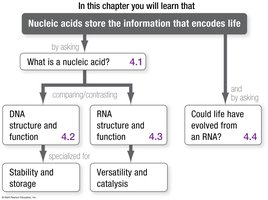
What is a Nucleic Acid?
Structure of Nucleic Acids
Nucleic acids are polymers composed of nucleotide monomers. Each nucleotide consists of three components: a phosphate group, a five-carbon sugar, and a nitrogenous base. The phosphate group and nitrogenous base are bonded to the sugar molecule.
Ribonucleotides (RNA monomers) contain ribose as their sugar.
Deoxyribonucleotides (DNA monomers) contain deoxyribose, which lacks an oxygen atom at the 2' carbon.
Both sugars have a phosphate group bonded to the 5' carbon.
Nitrogenous Bases
Nitrogenous bases are classified into two groups:
Purines: Two-ring structure; includes adenine (A) and guanine (G).
Pyrimidines: One-ring structure; includes cytosine (C), uracil (U) (found only in RNA), and thymine (T) (found only in DNA).
Mnemonic: "C U T of Py" for pyrimidines.

Polymerization of Nucleic Acids
Formation of Nucleic Acid Polymers
Nucleic acids are formed by condensation reactions that create phosphodiester linkages between nucleotides. The bond forms between the phosphate group on the 5' carbon of one nucleotide and the hydroxyl group on the 3' carbon of another.
Phosphodiester linkage: Joins nucleotides to form the sugar–phosphate backbone.
Polymerization requires energy, often provided by nucleoside triphosphates (e.g., ATP).
Energy is released when activated nucleotides polymerize, making the reaction spontaneous.
Directionality of Nucleic Acid Strands
The sugar–phosphate backbone of nucleic acids is directional, with one end having an unlinked 5' phosphate group and the other an unlinked 3' hydroxyl group. The sequence of bases is written from 5' to 3'.
DNA Structure and Function
Secondary Structure of DNA
DNA's secondary structure is a double helix formed by two antiparallel strands held together by hydrogen bonds between complementary bases (A-T and C-G). The sugar–phosphate backbone faces the exterior, while the nitrogenous bases face the interior.
Complementary base pairing: A pairs with T, C pairs with G.
Antiparallel orientation: Strands run in opposite directions.
Hydrophobic interactions and van der Waals forces stabilize the helix.
Major and minor grooves provide binding sites for proteins.
Tertiary Structure of DNA
DNA can form more compact structures, such as supercoils and nucleosomes (DNA wrapped around histone proteins), allowing efficient packaging within cells.
Supercoiling occurs when DNA is overwound or underwound.
Nucleosomes are fundamental units of chromatin structure in eukaryotes.
DNA as an Information-Containing Molecule
DNA stores genetic information in the sequence of its bases, which encode instructions for growth, reproduction, and cellular function. DNA replication involves:
Strand separation by breaking hydrogen bonds.
Formation of complementary base pairs with free nucleotides.
Creation of new phosphodiester linkages to form daughter strands.
Complementary base pairing ensures accurate copying of genetic information.
Stability of the DNA Double Helix
The double helix is highly stable due to phosphodiester linkages, hydrogen bonds, and hydrophobic interactions. This stability is crucial for reliable information storage but suggests DNA was unlikely the first self-replicating molecule in early life.
RNA Structure and Function
Primary and Secondary Structure of RNA
RNA differs from DNA in several ways:
Contains ribose instead of deoxyribose.
Contains uracil instead of thymine.
2' hydroxyl group on ribose makes RNA more reactive and less stable than DNA.
RNA's secondary structure arises from complementary base pairing (A-U, G-C) within the same strand, forming hairpin loops and other shapes.
Tertiary Structure of RNA
RNA molecules can fold into complex three-dimensional shapes, allowing diverse functions. Tertiary structure forms when secondary structures interact further.
Comparison of DNA and RNA Structure
Feature | DNA | RNA |
|---|---|---|
Sugar | Deoxyribose | Ribose |
Bases | A, T, C, G | A, U, C, G |
Strands | Double-stranded | Single-stranded (often with secondary structure) |
Stability | High | Low |
Function | Information storage | Information transfer, catalysis |
RNA's Versatility and Catalytic Function
RNA is highly versatile, capable of folding into complex shapes and performing various functions:
mRNA: Transmits genetic information from DNA to protein synthesis machinery.
Regulatory RNAs: Control gene expression.
Ribozymes: RNA molecules with catalytic activity, capable of catalyzing reactions such as phosphodiester bond formation.
RNA's ability to catalyze reactions supports the RNA world hypothesis.
Origin of Life and the RNA World Hypothesis
Search for the First Life-Form
The theory of chemical evolution suggests life began as a naked self-replicator, a molecule capable of providing a template and polymerizing monomers to copy itself. RNA is proposed as the first self-replicating molecule due to its ability to store information and catalyze its own replication.
Experimental Evidence for the RNA World
Studies have shown that ribozymes can catalyze the addition of nucleotides and even synthesize RNA nucleotides, mimicking natural selection and supporting the plausibility of an RNA world.
Modern ribozymes are essential for protein production.
RNA likely preceded proteins in evolutionary history.
Three key characteristics of life established: information processing, replication, and evolution by random changes in nucleic acids.
Summary Table: DNA and RNA Structure
Characteristic | DNA | RNA |
|---|---|---|
Sugar | Deoxyribose | Ribose |
Bases | A, T, C, G | A, U, C, G |
Strands | Double | Single (with secondary/tertiary structure) |
Stability | Stable | Less stable |
Function | Genetic information storage | Information transfer, catalysis |
Key Terms and Concepts
Nucleotide: Monomer of nucleic acids, composed of a phosphate group, five-carbon sugar, and nitrogenous base.
Phosphodiester linkage: Covalent bond joining nucleotides in a nucleic acid strand.
Complementary base pairing: Specific hydrogen bonding between A-T (DNA), A-U (RNA), and C-G.
Ribozyme: RNA molecule with catalytic activity.
RNA world hypothesis: Theory that early life relied on RNA for both genetic information and catalysis.
Additional info: The study notes expand on the brief points in the original material, providing definitions, examples, and context for college-level biology students. Tables are reconstructed to compare DNA and RNA structure and function. Images are included only where directly relevant to the explanation.
