 Back
BackNucleic Acids and DNA: Structure, Synthesis, and Repair
Study Guide - Smart Notes
 Tailored notes based on your materials, expanded with key definitions, examples, and context.
Nucleic Acids and DNA: Structure, Synthesis, and Repair
What Are Genes Made Of?
Historical Context and Discovery
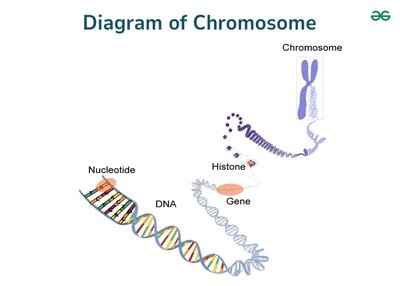
Genes are segments of DNA that encode information for the synthesis of proteins and functional RNA molecules.
Early geneticists debated whether genes were composed of DNA or protein, as proteins are more chemically diverse.
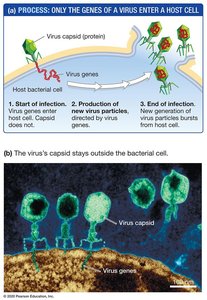
The Hershey–Chase experiment demonstrated that DNA, not protein, is the genetic material by tracking radioactive isotopes in the viral infection of Escherichia coli.
32P in DNA
35S in proteins
DNA enters the host cell and directs viral replication, while the protein coat remains outside.
Structure of Nucleic Acids
Nucleotide Structure
Nucleic acids are polymers of nucleotide monomers.
Each nucleotide consists of three components:
Phosphate group
Five-carbon sugar (ribose in RNA, deoxyribose in DNA)
(OH bonded to 2' carbon in Ribo)
(H bonded to 2' carbon in Deoxy)
(Both have OH bonded to 3' carbon)
Nitrogenous base (purine or pyrimidine)
Purines: Adenine (A), Guanine (G) – two rings
Pyrimidines: Cytosine (C), Thymine (T, in DNA), Uracil (U, in RNA) – one ring
Phosphodiester Linkages
Nucleotides are joined by phosphodiester bonds between the 3' hydroxyl of one sugar and the 5' phosphate of the next.
This forms the sugar-phosphate backbone of nucleic acids.
DNA and RNA Differences
DNA contains deoxyribose and the bases A, T, C, G.
RNA contains ribose and the bases A, U, C, G.
Uracil replaces thymine in RNA.
The Structure of DNA
Double Helix and Antiparallel Strands
DNA is a double-stranded molecule with antiparallel strands (one runs 5'→3', the other 3'→5'). WATSON AND CRICK PROPOSED
The strands are held together by hydrogen bonds between complementary bases: A pairs with T, G pairs with C.
The double helix is stabilized by base pairing and hydrophobic interactions between stacked bases.
Primary (sequence of bases) Secondary (twisting of antiparralel strands into helix) and Tertiary Structures (double helical forms compact structures due to wrapping around hisytones and twisting into supercoils)
DNA as an Information-Containing Molecule
The sequence of bases in DNA encodes genetic information, analogous to letters in a word.
DNA replication ensures faithful transmission of genetic information to daughter cells.
DNA Replication
Models of Replication
Three models were proposed for DNA replication:
Semiconservative: Each daughter molecule has one old and one new strand.
Conservative: One daughter has both old strands, the other both new.
Dispersive: Each strand is a mix of old and new DNA.
The Meselson–Stahl experiment confirmed the semiconservative model.
Mechanism of DNA Synthesis
DNA polymerase catalyzes DNA synthesis, adding nucleotides only to the 3' end (5'→3' direction).
DNA synthesis is endergonic, driven by the hydrolysis of high-energy bonds in deoxyribonucleoside triphosphates (dNTPs).
Replication begins at the origins of replication, forming replication bubbles with two replication forks. (Bacteria one, Eukarya multiple)
Enzymes and Proteins in DNA Replication
Helicase: Unwinds the DNA double helix.
Single-strand binding proteins (SSBPs): Stabilize unwound DNA.
Topoisomerase: Relieves tension ahead of the replication fork.
Primase: Synthesizes RNA primers to provide a starting point for DNA polymerase.
DNA ligase: Joins Okazaki fragments on the lagging strand.
Replisome: contains enzyme responsible for DNA synthesis around replication fork
Leading and Lagging Strand Synthesis
The leading strand is synthesized continuously toward the replication fork.
The lagging strand is synthesized discontinuously, away from the fork, in short segments called Okazaki fragments.
Okazaki fragments are later joined by DNA ligase.
Summary Table: Proteins Required for DNA Synthesis in Bacteria
Protein | Function |
|---|---|
DNA polymerase III | Main enzyme for DNA synthesis |
Helicase | Unwinds DNA helix |
SSBPs | Stabilize single-stranded DNA |
Primase | Synthesizes RNA primer |
DNA ligase | Joins Okazaki fragments |
Topoisomerase | Relieves supercoiling |
DNA polymerase I | Removes RNA primers, replaces with DNA |
DNA Repair Mechanisms
Proofreading and Mismatch Repair
DNA polymerase has proofreading ability, correcting errors during synthesis.
Mismatch repair enzymes correct errors missed by DNA polymerase after replication is complete.
Exonuclease Active Site: Site that catalyzes the removal of incorrect deoxyribonucleotides
Repairing DNA Damage
DNA can be damaged by UV light, chemicals, and radiation.
Nucleotide excision repair removes damaged DNA segments (e.g., thymine dimers) and fills in the gap using the undamaged strand as a template.
Defects in DNA repair systems can lead to diseases such as xeroderma pigmentosum (XP), which increases sensitivity to UV light and risk of skin cancer.
