 Back
Nucleic Acids and DNA Synthesis: Foundations of Genetic Material and Replication
Study Guide - Smart Notes
 Tailored notes based on your materials, expanded with key definitions, examples, and context.
Nucleic Acids and DNA Synthesis
Genetic Material: Identification and Significance
The discovery of the genetic material was a pivotal moment in biology, establishing DNA as the molecule responsible for heredity. Early experiments distinguished DNA from other macromolecules and demonstrated its role in genetic transformation.
Macromolecules in Cells: Cells contain four main classes of macromolecules: carbohydrates, lipids, proteins, and nucleic acids (DNA and RNA).
Genetic Material: DNA is the primary genetic material in most organisms, encoding instructions for cellular function and inheritance.
Historical Context: Early 20th-century experiments sought to identify which macromolecule carried genetic information.
Griffith’s Experiments with Pneumococcus
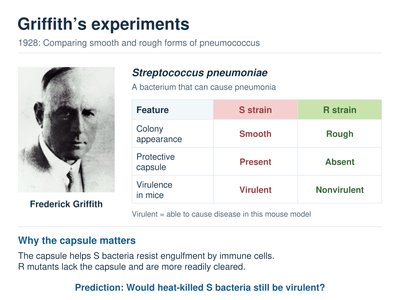
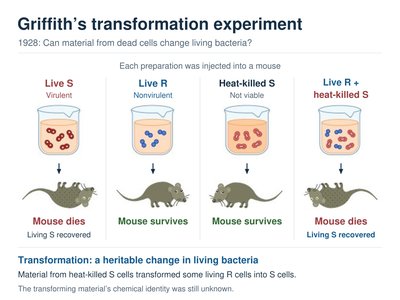
Frederick Griffith’s experiments in 1928 with Streptococcus pneumoniae revealed the phenomenon of transformation, suggesting that a "transforming principle" could transfer genetic traits between bacteria.
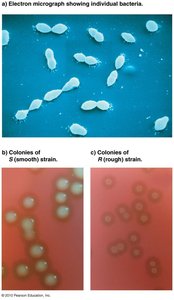
S (Smooth) Strain: Virulent, causes pneumonia in mice, possesses a protective capsule.
R (Rough) Strain: Nonvirulent, lacks capsule, does not cause disease.
Transformation: Heat-killed S strain mixed with live R strain resulted in live S strain recovery, indicating transfer of genetic material.
Capsule Importance: The capsule protects bacteria from immune cells; mutants lacking the capsule are more easily cleared.
Key Finding: Genetic information can be transferred from dead to living cells, but the chemical nature was unknown.
Avery, MacLeod, and McCarty: The Transforming Principle is DNA
In 1944, Oswald Avery and colleagues demonstrated that DNA, not protein, was responsible for transformation in bacteria, confirming DNA as the genetic material.
Experimental Approach: Used enzymes to selectively destroy proteins or DNA in bacterial extracts.
Result: Only DNA-containing extracts could transform R strain into S strain.
Conclusion: DNA is the "transforming principle" and the fundamental unit of heredity.
The Hershey-Chase Experiment
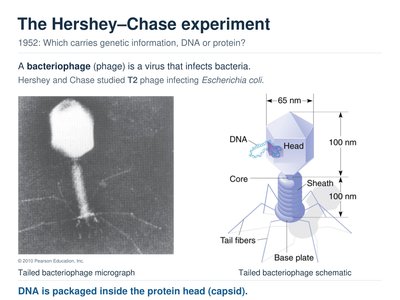
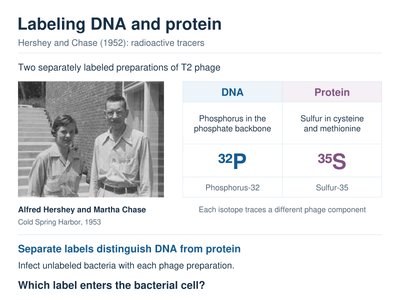
The Hershey-Chase experiment (1952) used bacteriophages and radioactive labeling to definitively show that DNA, not protein, is the genetic material passed to offspring.
Bacteriophage Structure: Consists of a protein coat (capsid) and DNA core.
Radioactive Tracers: DNA labeled with 32P, protein labeled with 35S.
Key Finding: Only DNA entered bacterial cells and was inherited by progeny.
Structure of DNA
Nucleotide Composition and Double Helix
DNA is composed of nucleotides, each containing a deoxyribose sugar, a phosphate group, and a nitrogenous base. The double helix structure is stabilized by complementary base pairing.
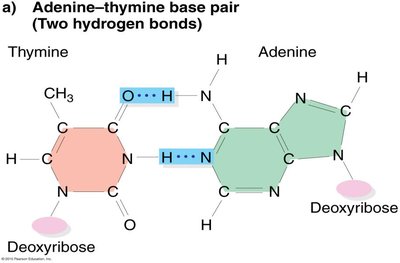
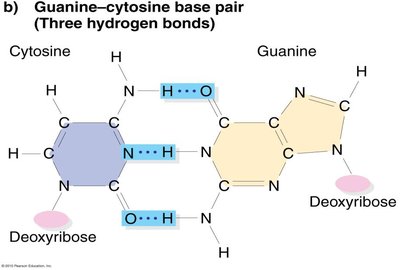
Nucleotide Structure: Each nucleotide has a sugar (deoxyribose), phosphate, and one of four bases: adenine (A), thymine (T), guanine (G), cytosine (C).
Base Pairing: A pairs with T via two hydrogen bonds; G pairs with C via three hydrogen bonds.
Double Helix: Two antiparallel strands twist to form a helical structure.
Carbon Numbering: Carbons in the sugar are numbered 1' to 5', important for directionality.
The DNA Double Helix Discovery
The discovery of the double helix by Watson and Crick provided insight into the mechanism of DNA replication and genetic inheritance.
Specific Pairing: Complementary base pairing enables accurate copying of genetic material.
Antiparallel Strands: Strands run in opposite directions (5' to 3' and 3' to 5').
DNA Replication
Cell Cycle and DNA Synthesis
DNA replication occurs during the S phase of the cell cycle, ensuring genetic material is duplicated before cell division.
S Phase: DNA synthesis and replication.
M Phase: Mitosis, segregation of chromosomes.
G1 and G2 Phases: Gap phases for cell growth and preparation.
Models of DNA Replication
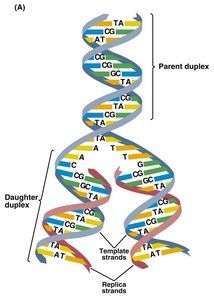
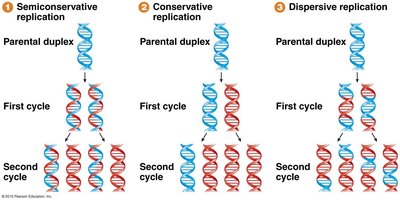
Three models were proposed for DNA replication: semiconservative, conservative, and dispersive. Experiments confirmed the semiconservative model.
Semiconservative Replication: Each new DNA molecule contains one parental and one daughter strand.
Conservative Replication: Parental strands remain together; new strands form a separate molecule.
Dispersive Replication: Parental and daughter segments are interspersed in both strands.
Mechanism and Chemistry of DNA Synthesis
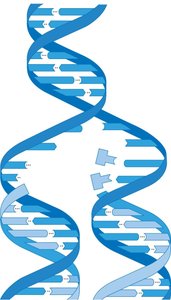
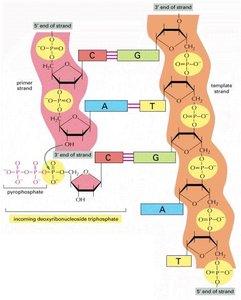
DNA polymerase synthesizes new DNA by adding nucleotides to the 3' end of the growing strand, forming phosphodiester bonds. Replication is highly accurate and rapid, with built-in proofreading mechanisms.
Directionality: DNA is synthesized in the 5' to 3' direction; nucleotides are added to the free 3' hydroxyl group.
Phosphodiester Bond Formation: The 3' hydroxyl attacks the incoming nucleotide, releasing pyrophosphate.
Replication Speed: E. coli replicates at ~1000 nucleotides/second; human cells are slower but highly accurate.
Proofreading: DNA polymerase corrects mismatched base pairs, reducing errors to about 1 per 100,000,000 base pairs.
Example: During replication, if a mismatched base is incorporated, DNA polymerase can remove and replace it, ensuring fidelity of genetic information.
Additional info: The accuracy of DNA replication is essential for maintaining genetic stability and preventing mutations that could lead to disease.
