 Back
CH 5 PT 2 Nucleic Acids and Lipids: Structure, Function, and Comparison of Biological Macromolecules
Study Guide - Smart Notes
 Tailored notes based on your materials, expanded with key definitions, examples, and context.
Nucleic Acids
Structure and Components of Nucleic Acids
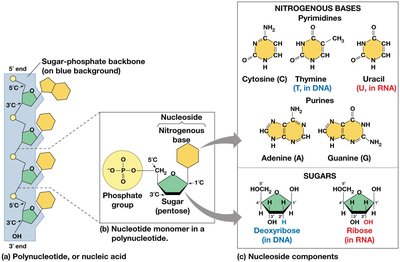
Nucleic acids, including DNA and RNA, are the information-carrying molecules of the cell. They are polymers made up of nucleotide monomers, each consisting of three components: a phosphate group, a five-carbon sugar (deoxyribose in DNA, ribose in RNA), and a nitrogenous base.
Nucleotide: The monomer of nucleic acids, composed of a phosphate group, a pentose sugar, and a nitrogenous base.
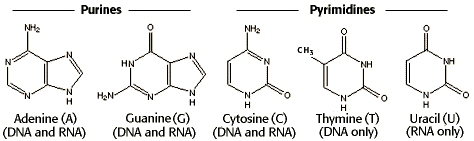
Nitrogenous Bases: Two families exist: purines (adenine, guanine) and pyrimidines (cytosine, thymine in DNA, uracil in RNA).
Phosphodiester Bond: The covalent bond linking nucleotides in a chain, forming the sugar-phosphate backbone.
DNA vs. RNA
DNA and RNA differ in their sugar component, nitrogenous bases, and strand structure.
DNA: Contains deoxyribose, bases A, T, G, C, and is typically double-stranded.
RNA: Contains ribose, bases A, U, G, C, and is usually single-stranded.

Complementary Base Pairing and Antiparallel Strands
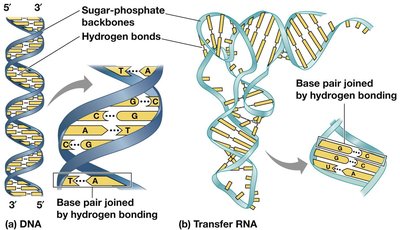
DNA strands are antiparallel, meaning they run in opposite directions (5'→3' and 3'→5'). Complementary base pairing ensures that adenine (A) pairs with thymine (T) via two hydrogen bonds, and guanine (G) pairs with cytosine (C) via three hydrogen bonds. In RNA, uracil (U) replaces thymine.
Chargaff's Rule: In double-stranded DNA, %A = %T and %G = %C due to exclusive base pairing.
Antiparallel Arrangement: Essential for correct base pairing and the double helix structure.

Elements Found in Nucleic Acids
Nucleic acids are composed of the elements carbon (C), hydrogen (H), oxygen (O), nitrogen (N), and phosphorus (P). Phosphorus is a signature element, contributing to the negative charge of DNA/RNA and forming the backbone's covalent bonds.
Key Elements: C, H, O, N, P
Functions of Nucleic Acids
DNA stores hereditary information, while RNA plays various roles in gene expression, including carrying instructions from DNA to ribosomes.
Components | Examples | Functions |
|---|---|---|
Nitrogenous base, phosphate group, sugar | DNA: deoxyribose, A, T, G, C, double-stranded RNA: ribose, A, U, G, C, single-stranded | DNA: Stores hereditary information RNA: Gene expression, information transfer |

Lipids
Major Classes of Lipids
Lipids are a diverse group of hydrophobic molecules that do not form true polymers. The three main classes are fats (triglycerides), phospholipids, and steroids.
Fats (Triglycerides): Glycerol backbone with three fatty acid tails; function in long-term energy storage.
Phospholipids: Glycerol, two fatty acid tails, and a phosphate-containing head; primary component of cell membranes.
Steroids: Four fused carbon rings; include cholesterol and steroid hormones, involved in membrane structure and signaling.



Saturated vs. Unsaturated Fatty Acids
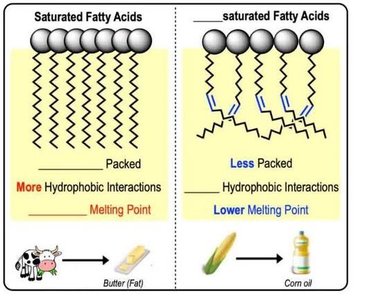
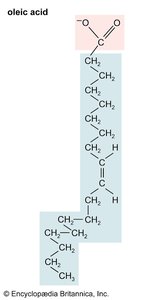
Fatty acids can be saturated (no double bonds, straight chains, solid at room temperature) or unsaturated (one or more double bonds, kinked chains, liquid at room temperature). The degree of saturation affects the physical properties and biological roles of lipids.
Saturated: Tightly packed, higher melting point (e.g., butter).
Unsaturated: Loosely packed due to kinks, lower melting point (e.g., olive oil).

Phospholipid Bilayer and Membrane Structure
Phospholipids spontaneously form bilayers in aqueous environments, with hydrophilic heads facing water and hydrophobic tails facing inward. This arrangement is the foundation of all biological membranes.
Hydrophilic Head: Interacts with water.
Hydrophobic Tails: Avoid water, aggregate inward.
Membrane Fluidity and Permeability
Membrane fluidity is influenced by the saturation of fatty acid tails and cholesterol content. More unsaturated tails increase fluidity and permeability, while more saturated tails decrease them. Cholesterol moderates fluidity at both temperature extremes.
Unsaturated Tails: Increase fluidity and permeability.
Saturated Tails: Decrease fluidity and permeability.
Cholesterol: Buffers membrane fluidity, preventing extremes.



Functions of Lipids
Fats (Triglycerides): Long-term energy storage, insulation, and protection.
Phospholipids: Form the structural basis of cell membranes, creating selective barriers.
Steroids: Reinforce membrane structure (cholesterol) and act as signaling molecules (hormones).



Comparing Major Classes of Biological Molecules
Monomers, Bonds, and Functions
The four major classes of biological macromolecules differ in their monomer subunits, types of bonds, elemental composition, and biological functions.
Class | Monomer | Key Bond | Elements | Main Functions |
|---|---|---|---|---|
Carbohydrates | Monosaccharide | Glycosidic bond | C, H, O | Quick energy, structural support |
Proteins | Amino acid | Peptide bond | C, H, O, N, S | Enzymes, structure, transport, defense, movement, signaling |
Nucleic Acids | Nucleotide | Phosphodiester bond | C, H, O, N, P | Store & transmit genetic information |
Lipids | No true monomer (glycerol + fatty acids) | Ester bond | C, H, O (+P in phospholipids) | Energy storage, membranes, signaling |
Structure-Function Relationships and Diversity
The structure of biological molecules determines their function. Proteins, with 20 diverse amino acids, have greater structural and functional diversity than nucleic acids, which are built from only four nucleotides. Proteins can fold into complex 3D shapes, enabling a wide range of functions, while nucleic acids primarily store and transmit information.
Building-block diversity: Proteins (20 amino acids) > Nucleic acids (4 nucleotides)
Structural diversity: Proteins fold into complex shapes; RNA folds somewhat; DNA is a double helix
Functional diversity: Proteins > RNA > DNA
