 Back
Nucleic Acids and the RNA World: Structure, Function, and Evolution
Study Guide - Smart Notes
 Tailored notes based on your materials, expanded with key definitions, examples, and context.
Chapter 4: Nucleic Acids and the RNA World
Introduction to Nucleic Acids
Nucleic acids are essential biomolecules that store and transmit genetic information in all living organisms. The two main types are deoxyribonucleic acid (DNA) and ribonucleic acid (RNA). DNA serves as the genetic blueprint, while RNA is primarily involved in protein synthesis and can also have catalytic functions.
What Is a Nucleic Acid?
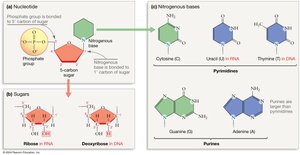
A nucleic acid is a polymer composed of nucleotide monomers. Each nucleotide consists of three components:
A five-carbon sugar (ribose in RNA, deoxyribose in DNA)
A phosphate group
A nitrogenous base (purine or pyrimidine)
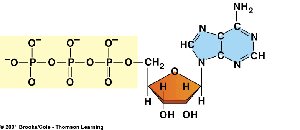
There are two types of nucleotides:
Ribonucleotides: Contain ribose sugar and are the monomers of RNA.
Deoxyribonucleotides: Contain deoxyribose sugar (lacking an oxygen atom at the 2' carbon) and are the monomers of DNA.
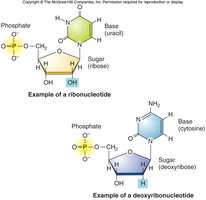
The nitrogenous bases are classified as:
Pyrimidines: Cytosine (C), Uracil (U, in RNA), Thymine (T, in DNA)
Purines: Guanine (G), Adenine (A)
Nucleotide Polymerization and the Sugar–Phosphate Backbone
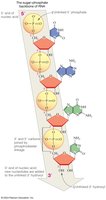
Nucleic acids are formed by the polymerization of nucleotides through condensation (dehydration synthesis) reactions. The bond formed between the phosphate group of one nucleotide and the 3' hydroxyl group of another is called a phosphodiester linkage. This process creates a directional sugar–phosphate backbone, with one end having a free 5' phosphate group and the other a free 3' hydroxyl group.
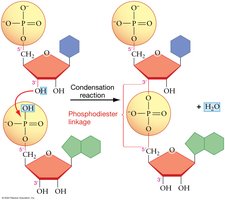
The backbone is hydrophilic, allowing nucleic acids to interact with the aqueous environment of the cell.
DNA Structure: Primary, Secondary, and Tertiary Levels
Chargaff's Rules and the Discovery of DNA Structure
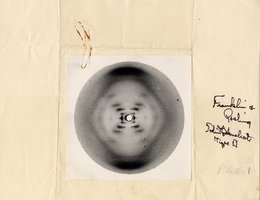
Erwin Chargaff discovered that in DNA, the number of purines (A, G) equals the number of pyrimidines (T, C), and the amount of adenine equals thymine, while cytosine equals guanine. Rosalind Franklin and Maurice Wilkins used X-ray crystallography to reveal the helical structure of DNA.
Antiparallel Double Helix
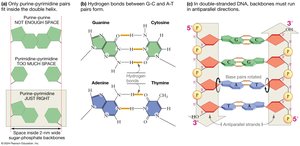
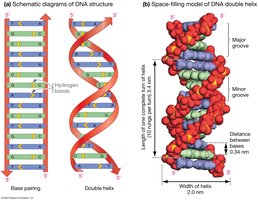
James Watson and Francis Crick determined that DNA consists of two antiparallel strands forming a double helix. The strands are held together by hydrogen bonds between complementary bases: adenine pairs with thymine (A–T), and guanine pairs with cytosine (G–C). The sugar–phosphate backbone faces outward, while the nitrogenous bases are stacked inside the helix.
One strand runs 5' to 3', the other 3' to 5'.
Hydrophobic interactions among bases stabilize the helical structure.
Negatively charged phosphate groups make DNA overall hydrophilic.
Tertiary Structure of DNA
In cells, DNA is further compacted into higher-order structures by wrapping around proteins (chromatin in eukaryotes). This compaction allows DNA to fit inside the nucleus and facilitates its function during cell division.
RNA Structure and Function
Primary and Secondary Structure
RNA differs from DNA in several ways:
Contains ribose sugar (more reactive and less stable than deoxyribose)
Uses uracil (U) instead of thymine (T)
Usually single-stranded, but can form complex secondary structures through intramolecular base pairing (e.g., hairpins, loops)
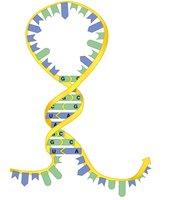
RNA's secondary structure is stabilized by hydrogen bonds between complementary bases on the same strand (A–U, G–C).
Tertiary Structure and Catalytic Function
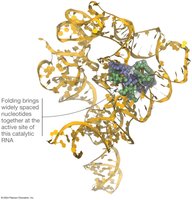
RNA can fold into complex tertiary structures, enabling it to act as a catalyst (ribozyme) in some biological reactions. This versatility supports the hypothesis that RNA may have been the first self-replicating molecule in early evolution (the "RNA World" hypothesis).
DNA vs. RNA: Comparison Table
Feature | DNA | RNA |
|---|---|---|
Sugar | Deoxyribose | Ribose |
Strands | Double-stranded (usually) | Single-stranded (usually) |
Nitrogenous Bases | A, T, G, C | A, U, G, C |
Stability | More stable | Less stable |
Function | Genetic information storage | Protein synthesis, catalysis |
Applications and Evolutionary Context
Understanding nucleic acids is fundamental to genetics, molecular biology, and biotechnology. The discovery of catalytic RNA supports the idea that life may have originated from self-replicating RNA molecules, leading to the evolution of DNA and proteins.
Example: Synthetic biology aims to create minimal cells and artificial life forms by manipulating nucleic acids, as discussed in recent scientific literature and media.
Additional info: The RNA World hypothesis proposes that RNA molecules were precursors to current life, capable of both storing genetic information and catalyzing chemical reactions before the evolution of DNA and proteins.
