 Back
Chapter 4
Study Guide - Smart Notes
 Tailored notes based on your materials, expanded with key definitions, examples, and context.
Chapter 4: Nucleic Acids and the RNA World
Introduction to Nucleic Acids
Nucleic acids are essential biomolecules that store and transmit genetic information in all living organisms. The two main types are deoxyribonucleic acid (DNA) and ribonucleic acid (RNA). This chapter explores their structure, function, and the hypothesis that RNA played a central role in the origin of life.
Overview and Learning Objectives
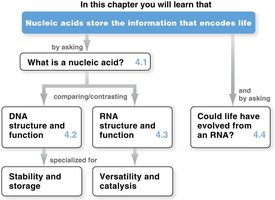
This chapter addresses the following key questions:
What is a nucleic acid?
How do DNA and RNA differ in structure and function?
Could life have evolved from an RNA molecule?
DNA is specialized for stability and storage of genetic information, while RNA is versatile and capable of catalysis.
Structure of Nucleic Acids
Types of Nucleic Acids
There are two primary types of nucleic acids:
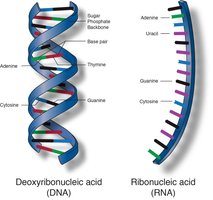
DNA (Deoxyribonucleic Acid): Double-stranded, stores genetic information.
RNA (Ribonucleic Acid): Usually single-stranded, involved in protein synthesis and catalysis.
Nucleotide Structure
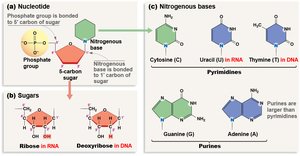
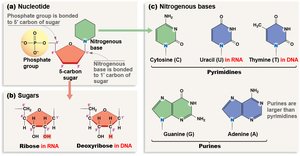
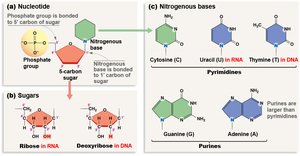
Nucleic acids are polymers of nucleotide monomers. Each nucleotide consists of three components:
Phosphate group
Five-carbon sugar (ribose in RNA, deoxyribose in DNA)
Nitrogenous base (purine or pyrimidine)
Nitrogenous Bases: Purines and Pyrimidines
Nitrogenous bases are classified as:
Pyrimidines: Cytosine (C), Thymine (T, in DNA), Uracil (U, in RNA)
Purines: Adenine (A), Guanine (G)
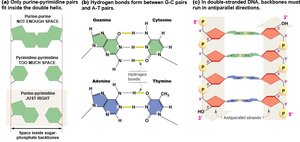
Purines are larger, double-ring structures, while pyrimidines are smaller, single-ring structures.
Numbering Carbons in the Sugar
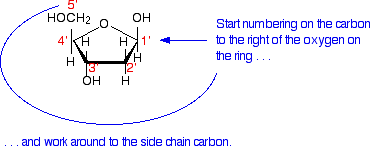
The carbons in the sugar are numbered 1' to 5'. Numbering starts at the carbon to the right of the ring oxygen and proceeds clockwise. This numbering is important for describing the directionality of nucleic acids and the positions of functional groups.
Differences Between DNA and RNA Nucleotides
The sugar component distinguishes DNA from RNA:
Ribose (RNA): Has an –OH group at the 2' carbon.
Deoxyribose (DNA): Has an –H at the 2' carbon (lacks oxygen).
Both have an –OH group at the 3' carbon, which is essential for polymerization.
Polymerization of Nucleotides
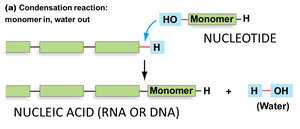
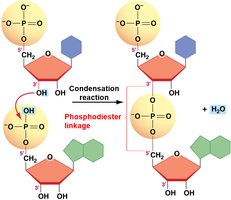
Nucleotides polymerize via condensation reactions, forming a covalent bond called a phosphodiester linkage between the 3' hydroxyl of one nucleotide and the 5' phosphate of the next. This process releases a molecule of water and requires energy input.
Sugar–Phosphate Backbone and Directionality
The sugar–phosphate backbone of nucleic acids is directional, running from the 5' end (with a free phosphate group) to the 3' end (with a free hydroxyl group). The sequence of nitrogenous bases along this backbone encodes genetic information.
Levels of Nucleic Acid Structure
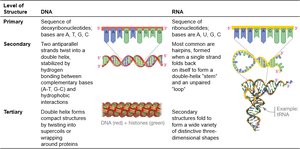
Nucleic acids have three levels of structure:
Primary: Linear sequence of nucleotides (A, T/U, G, C)
Secondary: Local folding patterns (e.g., double helix in DNA, hairpins in RNA)
Tertiary: Three-dimensional folding (e.g., supercoiling in DNA, complex shapes in RNA)
DNA Structure and Function
Double Helix and Base Pairing
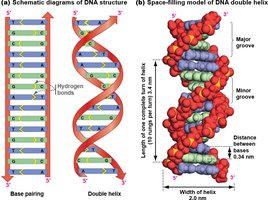
DNA's secondary structure is a double helix, with two antiparallel strands held together by hydrogen bonds between complementary bases:
Adenine (A) pairs with Thymine (T)
Guanine (G) pairs with Cytosine (C)
Base pairing is specific and ensures accurate replication and information transfer.

Stability and Storage
DNA is highly stable due to:
Hydrogen bonding between base pairs
Hydrophobic interactions among stacked bases
Negatively charged phosphate groups facing outward, making DNA hydrophilic
One turn of the helix occurs every 10 base pairs.
Tertiary Structure: DNA Compaction
In cells, DNA forms compact 3-D structures (chromatin) by supercoiling and wrapping around proteins (histones). This compaction allows DNA to fit inside the nucleus and facilitates cell division.
RNA Structure and Function
Primary and Secondary Structure of RNA
RNA is usually single-stranded but can fold into complex secondary structures, such as hairpins, through complementary base pairing (A with U, G with C) within the same strand.
Tertiary Structure and Catalytic Activity
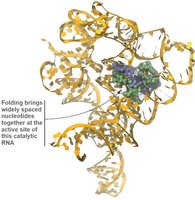
RNA molecules can fold into diverse three-dimensional shapes, enabling them to act as catalysts (ribozymes) and perform a variety of functions beyond information storage.
Versatility of RNA
Can store genetic information
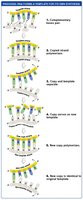
Capable of self-replication
Can catalyze chemical reactions (ribozymes)
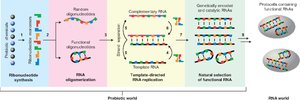
This versatility supports the hypothesis that RNA may have been the first self-replicating molecule in the origin of life.
The RNA World Hypothesis and the Origin of Life
Prebiotic Chemistry and the Formation of Nucleic Acids
Laboratory simulations suggest that sugars and nucleotides could have formed on early Earth, especially in environments like hydrothermal vents. Once activated, nucleotides could polymerize to form RNA.

RNA World Hypothesis
The RNA World Hypothesis proposes that RNA was the first molecule to store genetic information and catalyze its own replication, preceding the evolution of protein enzymes. This hypothesis accounts for three key characteristics of life:
Information processing
Replication of hereditary information
Evolution by random changes in nucleic acids
Evidence for Catalytic RNA
In 1982, Thomas Cech discovered the first ribozyme in Tetrahymena thermophila, demonstrating that RNA can catalyze reactions. This finding supports the idea that RNA could have played a central role in the origin of life.
Summary Table: DNA vs. RNA Structure
Level of Structure | DNA | RNA |
|---|---|---|
Primary | Sequence of deoxyribonucleotides, bases are A, T, G, C | Sequence of ribonucleotides, bases are A, U, G, C |
Secondary | Double helix, antiparallel strands, base pairing (A-T, G-C) | Hairpins and other structures, base pairing (A-U, G-C) |
Tertiary | Supercoiling, compaction with proteins | Complex folding, catalytic sites (ribozymes) |
