 Back
4 Nucleic Acids and the RNA World: Structure, Function, and the Origin of Life
Study Guide - Smart Notes
 Tailored notes based on your materials, expanded with key definitions, examples, and context.
Chapter 4: Nucleic Acids and an RNA World
Introduction to Nucleic Acids and the RNA World
Nucleic acids are essential biomolecules that store and transmit genetic information in all living organisms. The RNA world hypothesis proposes that early life forms may have relied on RNA both to store genetic information and to catalyze chemical reactions, preceding the evolution of DNA and proteins. Understanding the structure and function of nucleic acids is fundamental to grasping how life originated and evolved.
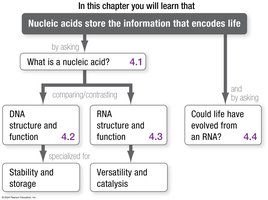
4.1 What is a Nucleic Acid?
Structure of Nucleic Acids
Nucleic acids are polymers composed of nucleotide monomers. Each nucleotide consists of three components:
Phosphate group
Five-carbon sugar (ribose in RNA, deoxyribose in DNA)
Nitrogenous base (purine or pyrimidine)
The phosphate group and nitrogenous base are both bonded to the sugar molecule. Nucleotides are linked together by phosphodiester bonds to form the nucleic acid polymer.
Types of Nucleotides
Ribonucleotides: Monomers of RNA, containing ribose sugar and the bases adenine (A), guanine (G), cytosine (C), and uracil (U).
Deoxyribonucleotides: Monomers of DNA, containing deoxyribose sugar and the bases adenine (A), guanine (G), cytosine (C), and thymine (T).
Purines (A, G) have two rings; pyrimidines (C, U, T) have one ring. Uracil is found only in RNA, and thymine only in DNA.
Polymerization of Nucleic Acids
Nucleic acids are formed by condensation reactions that create phosphodiester linkages between the 5' phosphate group of one nucleotide and the 3' hydroxyl group of another. This process produces a sugar–phosphate backbone that is directional, with one end having an unlinked 5' phosphate and the other an unlinked 3' hydroxyl group.
Energy for Polymerization
Polymerization requires energy, which is provided by nucleoside triphosphates (e.g., ATP). The hydrolysis of high-energy phosphate bonds drives the formation of nucleic acid polymers.
Equation:
$\text{Nucleoside triphosphate} \rightarrow \text{Nucleotide} + 2\,\text{Pi} + \text{Energy}$
4.2 DNA Structure and Function
Primary and Secondary Structure of DNA
The primary structure of DNA is the sequence of nucleotide bases. The secondary structure is the famous double helix, as determined by Watson and Crick. Key features include:
Two antiparallel strands held together by hydrogen bonds between complementary bases (A-T, C-G)
Sugar–phosphate backbone on the outside, bases on the inside
Double helix stabilized by hydrophobic interactions and van der Waals forces
Major and minor grooves provide access for proteins to interact with bases
Tertiary Structure of DNA
DNA can form more compact three-dimensional structures, such as supercoils and nucleosomes (DNA wrapped around histone proteins), allowing efficient packaging within cells.
DNA as an Information-Containing Molecule
DNA stores genetic information in the sequence of its bases. During replication:
The two strands separate by breaking hydrogen bonds.
Free nucleotides pair with complementary bases on each template strand.
Phosphodiester bonds form, creating two identical daughter molecules.
This mechanism ensures accurate transmission of genetic information.
Stability of the DNA Double Helix
The double helix is highly stable due to its structure and interactions, making DNA an effective long-term information storage molecule. However, evidence suggests that DNA was not the first genetic material in early life forms.
4.3 RNA Structure and Function
Primary and Secondary Structure of RNA
RNA is typically single-stranded and contains ribose and uracil. Its secondary structure arises from complementary base pairing (A-U, G-C) within the same strand, forming hairpin loops and other shapes.
Tertiary Structure and Versatility of RNA
RNA can fold into complex three-dimensional shapes, giving it a wide range of functions. It is more reactive and less stable than DNA due to the presence of the 2' hydroxyl group on ribose.
RNA as a Catalytic Molecule (Ribozymes)
Some RNA molecules, called ribozymes, can catalyze chemical reactions, including the formation of phosphodiester bonds. This catalytic ability supports the RNA world hypothesis, suggesting that RNA could have both stored genetic information and catalyzed its own replication.
4.4 The Origin of Life and the RNA World Hypothesis
Chemical Evolution and the First Self-Replicator
The theory of chemical evolution proposes that life began with a self-replicating molecule, likely RNA, capable of serving as a template and catalyzing its own replication. This molecule would not have been enclosed in a membrane initially.
Experimental Evidence for the RNA World
Laboratory experiments have produced ribozymes that can catalyze the addition of nucleotides to RNA strands.
Some ribozymes can even synthesize RNA nucleotides, supporting the plausibility of an RNA-based origin of life.
Transition from the RNA World to Modern Biology
Most modern ribozymes are involved in protein synthesis. The evolution of protein enzymes likely marked the end of the RNA world, but the essential characteristics of life—information processing, replication, and evolution—were established in this era.
Table: Comparison of DNA and RNA Structure
Feature | DNA | RNA |
|---|---|---|
Sugar | Deoxyribose | Ribose |
Pyrimidine Bases | Cytosine, Thymine | Cytosine, Uracil |
Strandedness | Double-stranded (usually) | Single-stranded (usually) |
Secondary Structure | Double helix | Hairpins, loops, complex shapes |
Function | Information storage | Information transfer, catalysis |
Key Terms and Concepts
Nucleic acid: Polymer of nucleotide monomers; includes DNA and RNA.
Phosphodiester bond: Covalent bond linking nucleotides in nucleic acids.
Ribozyme: RNA molecule with catalytic activity.
RNA world hypothesis: Theory that early life was based on RNA molecules capable of self-replication and catalysis.
Example Application
In modern cells, messenger RNA (mRNA) acts as an intermediate, carrying genetic information from DNA to ribosomes for protein synthesis. Ribozymes, such as the ribosome's peptidyl transferase center, catalyze peptide bond formation during translation.
Additional info: The RNA world hypothesis is supported by the discovery of ribozymes and the central role of RNA in fundamental biological processes, such as translation and splicing.
