 Back
Nucleic Acids and the RNA World: Structure, Function, and Evolution
Study Guide - Smart Notes
 Tailored notes based on your materials, expanded with key definitions, examples, and context.
Chapter 4: Nucleic Acids and the RNA World
Introduction to Nucleic Acids
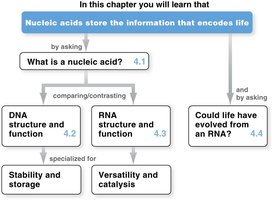
Nucleic acids are essential biomolecules that store and transmit hereditary information in all living organisms. The two main types of nucleic acids are deoxyribonucleic acid (DNA) and ribonucleic acid (RNA). These molecules are responsible for encoding the instructions necessary for life, including the synthesis of proteins and the regulation of cellular activities.
What Is a Nucleic Acid?
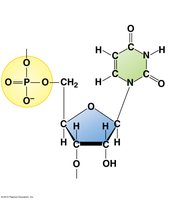
A nucleic acid is a polymer composed of monomers called nucleotides. Each nucleotide consists of three components:
A phosphate group
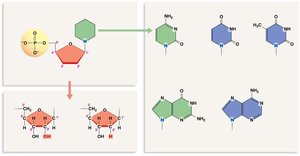
A five-carbon sugar (either ribose in RNA or deoxyribose in DNA)
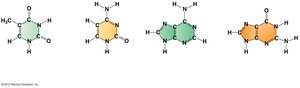
A nitrogenous base (adenine, guanine, cytosine, thymine in DNA, or uracil in RNA)
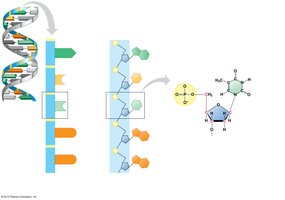
The portion of a nucleotide without the phosphate group is called a nucleoside.
Types of Nitrogenous Bases
Nitrogenous bases are classified into two groups:
Purines: Double-ring structures (adenine and guanine)
Pyrimidines: Single-ring structures (cytosine, thymine, and uracil)
The Roles of Nucleic Acids
There are two main types of nucleic acids:
DNA: Stores genetic information and provides instructions for its own replication.
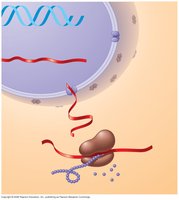
RNA: Functions in the synthesis of proteins by conveying genetic information from DNA to ribosomes (as messenger RNA, or mRNA).
Protein synthesis occurs in ribosomes, where mRNA is translated into polypeptides.
Polymerization of Nucleic Acids
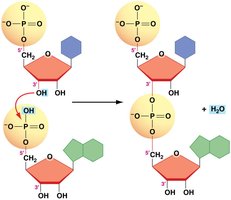
Nucleic acids are formed when nucleotides polymerize via condensation reactions, creating phosphodiester linkages between the 3' hydroxyl group of one nucleotide and the 5' phosphate group of the next. This forms the sugar-phosphate backbone of the nucleic acid.
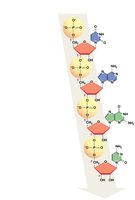
The directionality of nucleic acids is defined by the 5' and 3' ends, which is crucial for replication and transcription.
DNA Structure: The Double Helix
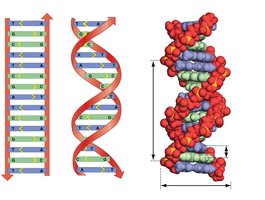
DNA consists of two antiparallel strands that form a double helix. The strands are held together by hydrogen bonds between complementary nitrogenous bases:
Adenine (A) pairs with Thymine (T) via two hydrogen bonds
Guanine (G) pairs with Cytosine (C) via three hydrogen bonds
This is known as Watson–Crick base pairing. The sugar-phosphate backbone faces outward, while the bases are oriented toward the interior of the helix. The two strands run in opposite directions (antiparallel): one 5' to 3', the other 3' to 5'.
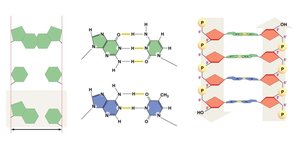
One turn of the helix occurs every 10 base pairs, with major and minor grooves providing binding sites for proteins.
DNA Tertiary Structure and Compaction
In cells, DNA is further compacted into higher-order structures, such as supercoils and nucleosomes (in eukaryotes, DNA wraps around histone proteins). This compaction is essential for fitting DNA into the nucleus and for regulating gene expression.
DNA as an Information Molecule
DNA stores and transmits genetic information required for growth, development, and reproduction. The flow of genetic information follows the central dogma: DNA → RNA → Protein.
Transcription: DNA is transcribed into RNA.
Translation: RNA is translated into protein.
DNA Replication
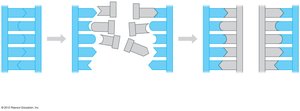
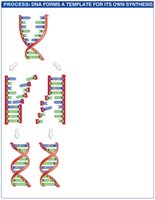
DNA replication is a semi-conservative process involving three main steps:
The two DNA strands are separated by breaking hydrogen bonds (using enzymes or heat).
Free deoxyribonucleotides hydrogen-bond to complementary bases on the template strand.
Phosphodiester linkages form, creating a new complementary strand. Each new DNA molecule consists of one old and one new strand.
Stability and Function of DNA
DNA is highly stable and resistant to chemical degradation, making it an ideal molecule for long-term storage of genetic information. However, its stability also means it does not function as a catalyst. This has led to the hypothesis that the first life-forms may have used RNA, which is more versatile and can act as a catalyst (ribozymes).
RNA Structure and Function
RNA is similar to DNA but has several key differences:
Contains ribose sugar (with a 2' –OH group) instead of deoxyribose
Uses uracil (U) instead of thymine (T)
Usually single-stranded, but can form complex secondary structures (e.g., hairpins) through internal base pairing
Less stable than DNA due to the reactive 2' –OH group
RNA's secondary structure often involves the formation of hairpin loops, where complementary bases on the same strand pair with each other.
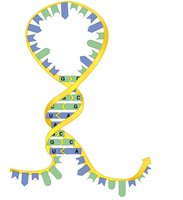
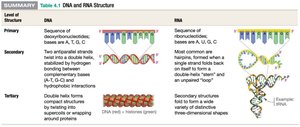
Comparison of DNA and RNA Structure
Level of Structure | DNA | RNA |
|---|---|---|
Primary | Sequence of deoxyribonucleotides; bases are A, T, C, G | Sequence of ribonucleotides; bases are A, U, C, G |
Secondary | Two antiparallel strands form a double helix, stabilized by hydrogen bonding between complementary bases (A-T, G-C) and hydrophobic interactions | Most common are hairpins, where a single strand folds back on itself to form double helix "stems" and unpaired "loops" |
Tertiary | DNA forms compact structures by twisting into supercoils or wrapping around proteins | RNA molecules fold to form a wide variety of distinctive three-dimensional shapes |
Summary
Nucleic acids are polymers of nucleotides that store and transmit genetic information.
DNA is stable, double-stranded, and specialized for information storage.
RNA is versatile, single-stranded, and capable of catalysis and information transfer.
The structure of nucleic acids underlies their function in heredity, protein synthesis, and evolution.
