 Back
Nucleic Acids and the RNA World: Structure, Function, and Evolution
Study Guide - Smart Notes
 Tailored notes based on your materials, expanded with key definitions, examples, and context.
Chapter 4: Nucleic Acids and the RNA World
Introduction to Nucleic Acids and the RNA World Hypothesis
Nucleic acids are essential macromolecules that store and transmit genetic information in all living organisms. The RNA World hypothesis proposes that early life was based on RNA molecules, which could both store genetic information and catalyze chemical reactions, preceding the evolution of DNA and proteins.
Chemical evolution led to the production of self-replicating molecules.
Deoxyribonucleic acid (DNA) stores genetic information and is replicated using proteins.
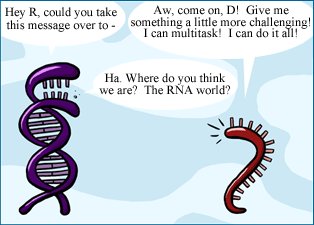
RNA World Hypothesis: Suggests a period in evolution where RNA served as both the genetic material and a catalyst for its own replication.
What is a Nucleic Acid?
Structure of Nucleotides
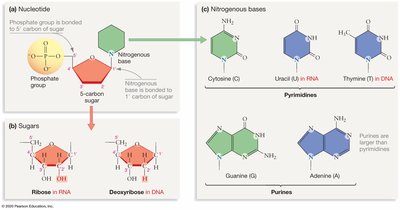
Nucleic acids are polymers of nucleotide monomers. Each nucleotide consists of three components:
Phosphate group
Five-carbon sugar (ribose in RNA, deoxyribose in DNA)
Nitrogenous base (purine or pyrimidine)
The phosphate group and nitrogenous base are both bonded to the sugar molecule.
Types of Nitrogenous Bases
Purines (two rings, 9 atoms): Adenine (A), Guanine (G) – "Pur As Gold"
Pyrimidines (one ring, 6 atoms): Cytosine (C), Uracil (U, in RNA), Thymine (T, in DNA) – "CUT the Py"
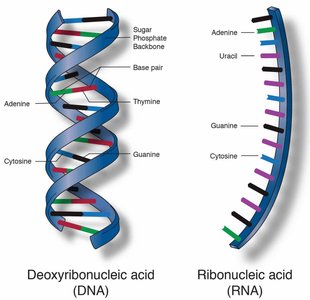
Comparison of DNA and RNA Structure
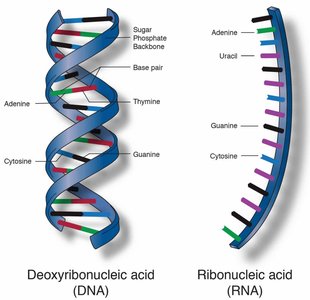
DNA and RNA differ in their sugar component and one of their nitrogenous bases:
DNA contains deoxyribose and thymine.
RNA contains ribose and uracil.
Origin of Nucleotides: Chemical Evolution
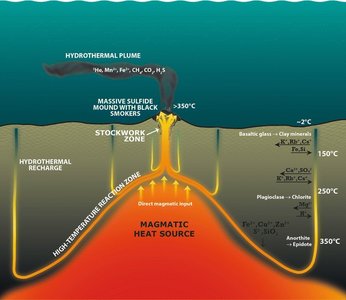
Experiments simulating early Earth conditions (such as Miller-Urey experiments) have shown that amino acids, nitrogenous bases, and sugars can be synthesized abiotically. Recent research suggests that deep-sea hydrothermal vents may have provided minerals that concentrated and enriched ribose, facilitating nucleotide formation.
Polymerization of Nucleotides
Formation of Phosphodiester Bonds
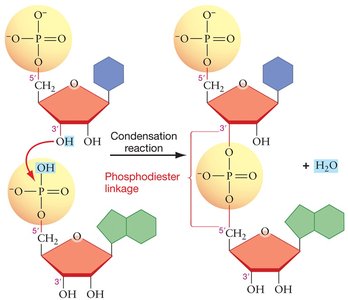
Nucleotides polymerize via condensation (dehydration synthesis) reactions, forming strong covalent phosphodiester bonds between the 5′ phosphate group of one nucleotide and the 3′ hydroxyl group of another. This linkage forms the sugar-phosphate backbone of DNA and RNA.
Water is released as a byproduct of the reaction.
Activated Nucleotides
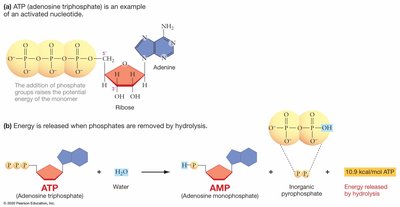
Polymerization is driven by activated nucleotides such as ATP (adenosine triphosphate), which have high potential energy due to their phosphate groups. Hydrolysis of these phosphates releases energy to drive the reaction.
Structure of DNA
Primary Structure
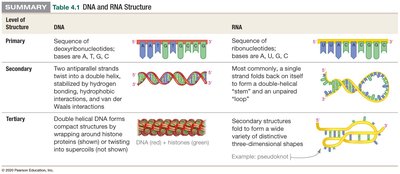
The primary structure of DNA is the sequence of deoxyribonucleotides, written using single-letter abbreviations for the bases (A, T, G, C).
Secondary Structure: The Double Helix
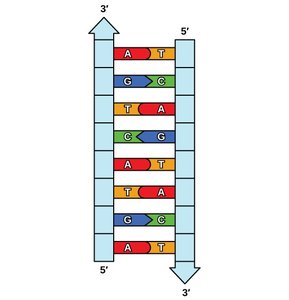
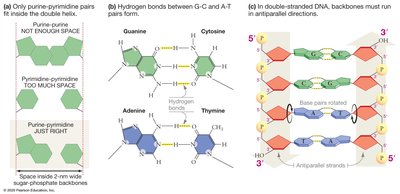
DNA consists of two antiparallel strands that twist into a double helix. The sugar-phosphate backbones form the sides of the ladder, while the nitrogenous bases form the rungs. The strands are held together by hydrogen bonds between complementary base pairs (A-T and G-C) and stabilized by hydrophobic and van der Waals interactions.
Antiparallel orientation: One strand runs 5′ to 3′, the other 3′ to 5′.
Complementary base pairing: A pairs with T (2 hydrogen bonds), G pairs with C (3 hydrogen bonds).
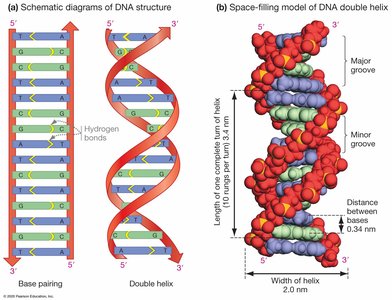
Tertiary Structure: DNA Compaction
In cells, DNA is further compacted into three-dimensional structures:
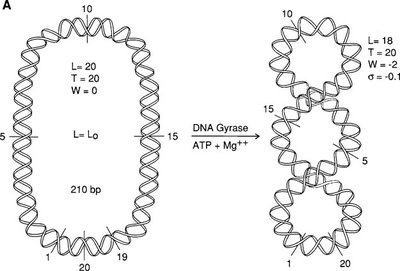
Supercoiling: DNA twists upon itself when overwound or underwound.
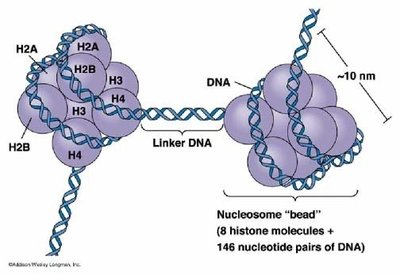
Chromatin: In eukaryotes, DNA wraps around histone proteins to form nucleosomes, which further coil to form chromatin.
DNA as an Information-Containing Molecule
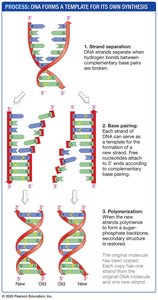
Watson and Crick's model revealed that DNA stores the information necessary for growth and reproduction. DNA replication involves:
Strand separation by breaking hydrogen bonds.
Free deoxyribonucleotides form hydrogen bonds with complementary bases on the template strand.
Phosphodiester linkages form, creating a new complementary strand.
This process ensures that genetic information is copied accurately for cell division.
Stability of the DNA Double Helix
The double helix is highly stable due to phosphodiester linkages, hydrogen bonds, and hydrophobic interactions. This stability is crucial for reliable information storage, but DNA alone is unlikely to have been the first self-replicating molecule.
RNA Structure and Function
Primary Structure
RNA's primary structure is a sequence of ribonucleotides (A, U, G, C). RNA contains ribose and uracil, making it less stable than DNA.
Secondary Structure: Hairpins and Loops
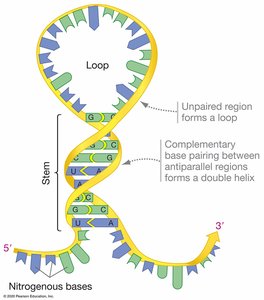
RNA strands fold upon themselves, forming hairpin structures through complementary base pairing (A-U, G-C) within the same strand. The two regions of the strand are antiparallel.
Tertiary Structure and Catalytic Activity
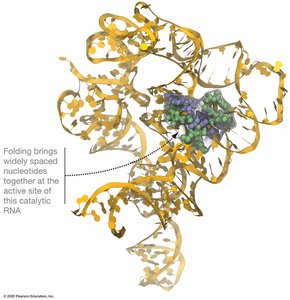
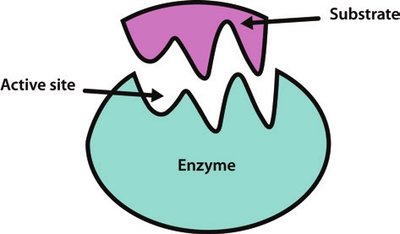
RNA molecules can fold into complex three-dimensional shapes, allowing them to perform diverse functions, including catalysis. Ribozymes are RNA molecules with catalytic activity, similar to protein enzymes, and their three-dimensional structure is essential for their function.
Summary Table: DNA and RNA Structure
Level of Structure | DNA | RNA |
|---|---|---|
Primary | Sequence of deoxyribonucleotides; bases are A, T, G, C | Sequence of ribonucleotides; bases are A, U, G, C |
Secondary | Two antiparallel strands twist into a double helix, stabilized by hydrogen bonding, hydrophobic interactions, and van der Waals interactions | Most commonly, a single strand folds back on itself to form a double-helical "stem" and an unpaired "loop" |
Tertiary | Double helical DNA forms compact structures by wrapping around histone proteins or by twisting into supercoils | Secondary structures fold to form a wide variety of distinctive three-dimensional shapes |
RNA's Versatility and the RNA World Hypothesis
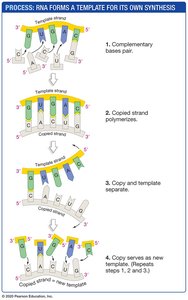
RNA is highly versatile due to its ability to fold into complex shapes, act as an information carrier (mRNA), regulate gene expression, and catalyze reactions (ribozymes). The RNA World hypothesis suggests that RNA was the first self-replicating molecule, capable of both storing genetic information and catalyzing its own replication.
Experiments have demonstrated that RNA can catalyze the formation of phosphodiester bonds and replicate itself under certain conditions.
Modern ribozymes are essential for protein synthesis, supporting the idea that RNA preceded proteins in evolution.
Conclusion: The Origin of Life and the Role of RNA
The theory of chemical evolution posits that life began as a naked self-replicator, likely an RNA molecule capable of providing a template for copying and catalyzing its own replication. The three hallmarks of life—information processing, replication, and evolution—were likely established in the RNA World, setting the stage for the evolution of DNA and proteins.
