Back
Nucleic Acids and the RNA World: Structure and Function of DNA and RNA
Study Guide - Smart Notes
 Tailored notes based on your materials, expanded with key definitions, examples, and context.
Chapter 4: Nucleic Acids and an RNA World
4.1 What is a Nucleic Acid?
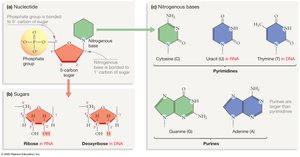
Nucleic acids are essential biological macromolecules that store and transmit genetic information. They are polymers composed of monomers called nucleotides. The two main types of nucleic acids are DNA (deoxyribonucleic acid) and RNA (ribonucleic acid).
Nucleotide Structure: Each nucleotide consists of three components:
A phosphate group
A five-carbon sugar (ribose in RNA, deoxyribose in DNA)
A nitrogenous base (purine or pyrimidine)
Nitrogenous Bases:
Pyrimidines: Cytosine (C), Uracil (U, in RNA), Thymine (T, in DNA)
Purines: Guanine (G), Adenine (A)
How Do Nucleotides Polymerize to Form Nucleic Acids?
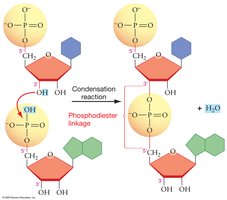
Nucleic acids are synthesized by linking nucleotides through condensation reactions, forming a phosphodiester linkage between the 3'-hydroxyl group of one nucleotide and the 5'-phosphate group of the next. This process requires energy and is catalyzed by enzymes.
Ribonucleotides polymerize to form RNA.
Deoxyribonucleotides polymerize to form DNA.
Sugar–Phosphate Backbone and Directionality
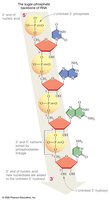
The backbone of nucleic acids is formed by repeating sugar and phosphate groups, creating a directional chain (5' to 3').
One end has an unlinked 5' phosphate group.
The other end has an unlinked 3' hydroxyl group.
New nucleotides are always added to the 3' end.
Activated Nucleotides and Polymerization
Nucleotides are stable in water and must be "activated" before polymerization. Activation involves the addition of two extra phosphates, creating a molecule with high potential energy (e.g., ATP). The energy released from cleaving these phosphates drives the formation of the phosphodiester bond.
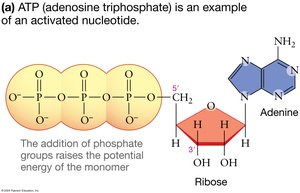
4.2 DNA Structure and Function
Secondary Structure of DNA
DNA's secondary structure was elucidated through several key discoveries:
DNA contains covalently linked sugar–phosphate backbones.
Chargaff's rules: In any DNA molecule, the number of adenines (A) equals thymines (T), and the number of cytosines (C) equals guanines (G).
X-ray crystallography data indicated a helical structure.
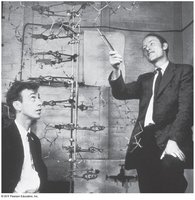
Antiparallel Double Helix
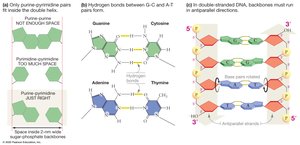
DNA consists of two strands running in opposite directions (antiparallel), held together by hydrogen bonds between complementary bases (A–T and G–C). The strands twist to form a double helix, with the sugar–phosphate backbone on the outside and nitrogenous bases on the inside.
3 hydrogen bonds between G and C
2 hydrogen bonds between A and T
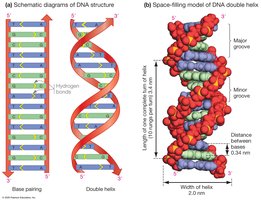
Tertiary Structure of DNA
To fit within the cell, DNA is further compacted:
The double helix forms supercoils.
DNA wraps around proteins called histones.
Function of DNA
The stable double helix structure of DNA allows it to store genetic information. The sequence of bases encodes genes, which direct the synthesis of proteins and determine traits. The double-stranded nature of DNA provides a mechanism for accurate replication during cell division.
DNA Replication
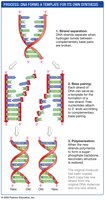
During replication, the two DNA strands separate, and each serves as a template for the synthesis of a new complementary strand. The result is two identical DNA molecules.
4.3 RNA Structure and Function
Primary Structure of RNA
RNA is a polymer of ribonucleotides, each containing ribose and the bases A, U, G, and C. RNA differs from DNA in three main ways:
Contains ribose instead of deoxyribose
Contains uracil (U) instead of thymine (T)
Has a 2'-OH group, making it more reactive
Secondary Structure of RNA
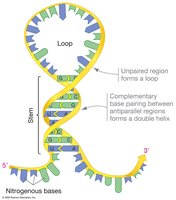
RNA can form secondary structures through complementary base pairing within the same strand, often resulting in hairpin loops. Base pairing occurs between A–U and G–C.
Tertiary Structure and Function of RNA
RNA molecules can fold into complex tertiary structures, making them more versatile than DNA. Types of RNA include:
mRNA (messenger RNA): Carries genetic information from DNA to ribosomes for protein synthesis.
rRNA (ribosomal RNA): Structural and catalytic component of ribosomes.
Ribozymes: RNA molecules with catalytic activity.
4.4 In Search of the First Life-Form
The theory of chemical evolution suggests that life began with a self-replicating molecule capable of serving as a template and catalyzing its own synthesis. Experimental evidence shows that some ribozymes can perform both functions, supporting the hypothesis that the first life-form was composed of RNA.
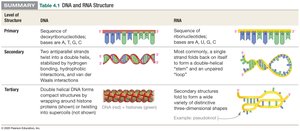
Summary Table: DNA and RNA Structure
The following table compares the primary, secondary, and tertiary structures of DNA and RNA:
Level of Structure | DNA | RNA |
|---|---|---|
Primary | Sequence of deoxyribonucleotides; bases are A, T, G, C | Sequence of ribonucleotides; bases are A, U, G, C |
Secondary | Two antiparallel strands form a double helix; stabilized by hydrogen bonding between complementary bases (A–T, G–C) and base stacking | Most commonly, a single strand folds back on itself to form a hairpin structure; stabilized by hydrogen bonding between complementary bases (A–U, G–C) |
Tertiary | Double helical DNA forms compact structures by wrapping around histone proteins or by supercoiling | Secondary structures fold into a wide variety of distinctive three-dimensional shapes |