 Back
Nucleic Acids, Carbohydrates, and Lipids: Structure and Function
Study Guide - Smart Notes
 Tailored notes based on your materials, expanded with key definitions, examples, and context.
Chapter 4: Nucleic Acids and the RNA World
DNA Structure: Primary, Secondary, and Tertiary Levels
Deoxyribonucleic acid (DNA) is the hereditary material in almost all living organisms. Its structure is organized into three hierarchical levels: primary, secondary, and tertiary.
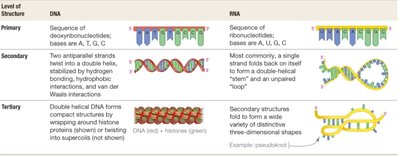
Primary Structure: The sequence of deoxyribonucleotides (A, T, C, G) linked by phosphodiester bonds.
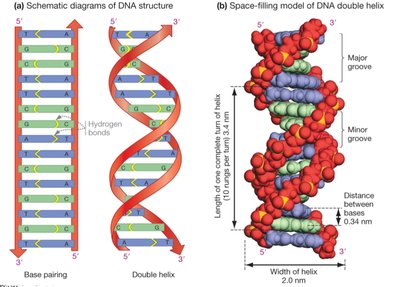
Secondary Structure: DNA forms a double helix, stabilized by hydrogen bonds between complementary bases (A pairs with T, C pairs with G). The two strands are antiparallel (5' to 3' and 3' to 5').
Tertiary Structure: DNA is further compacted by wrapping around histone proteins, forming chromatin and supercoils, allowing approximately 6 feet of DNA to fit inside a single cell nucleus.
Grooves: The double helix has major and minor grooves, which are important for protein binding and gene regulation.
Key Points:
Complementary base pairing is based on hydrogen bonding: A with T (2 hydrogen bonds), C with G (3 hydrogen bonds).
Hydrophobic interactions between bases cause the double helix to twist.
Strands are not identical but are complementary.
RNA Structure and Function
Ribonucleic acid (RNA) plays multiple roles in the cell, including acting as a messenger (mRNA), a catalyst (ribozymes), and a structural molecule. RNA structure is also organized into primary, secondary, and tertiary levels.
Primary Structure: Sequence of ribonucleotides (A, U, C, G) with ribose sugar and uracil instead of thymine.
Secondary Structure: Single-stranded RNA folds back on itself, forming hairpin loops through complementary base pairing (A with U, G with C).
Tertiary Structure: Complex three-dimensional shapes allow RNA to act as a catalyst (e.g., ribozymes).
Key Differences between DNA and RNA:
RNA is single-stranded and less stable than DNA.
RNA contains ribose sugar; DNA contains deoxyribose.
RNA uses uracil (U) instead of thymine (T).
The 2' -OH group in ribose makes RNA more reactive and less stable than DNA.
Similarities: Both DNA and RNA are polymers of nucleotides and can form secondary structures through base pairing.
Example: mRNA transmits genetic information from DNA to ribosomes for protein synthesis; some RNA molecules (ribozymes) catalyze chemical reactions.
Chapter 5: An Introduction to Carbohydrates
Carbohydrate Structure and Function
Carbohydrates are organic molecules with the general formula (CH2O)n. They serve as energy sources, structural materials, and cell identity markers.
Monosaccharides: Simple sugars (e.g., glucose, fructose).
Oligosaccharides: Short chains of monosaccharides.
Polysaccharides: Long chains (e.g., starch, cellulose, glycogen).
Key Functions:
Provide chemical energy (e.g., glucose is used to make ATP).
Serve as building blocks for nucleotides and amino acids.
Form fibrous structural materials (e.g., cellulose in plants).
Indicate cell identity (e.g., glycoproteins and glycolipids).
Formation of Polysaccharides:
Disaccharides are formed by condensation reactions between two monosaccharides, creating a glycosidic linkage (covalent bond).
Hydrolysis reactions break glycosidic linkages.
Example: Glycoproteins (proteins with attached carbohydrates) and glycolipids (lipids with attached carbohydrates) are important for cell recognition.
Chapter 6: Lipids, Membranes, and the First Cells
Lipid Structure and Types
Lipids are hydrophobic, carbon-containing compounds that are insoluble in water due to their high proportion of nonpolar bonds. They do not share a common chemical structure but are unified by their hydrophobic nature.
Hydrocarbons: Nonpolar molecules containing only carbon and hydrogen.
Fatty Acids: Hydrocarbon chains with a polar carboxyl group.
Saturated Fatty Acids: Only single bonds; solid at room temperature (e.g., butter).
Unsaturated Fatty Acids: One or more double bonds; liquid at room temperature (e.g., oil).
Three Major Types of Lipids in Cells:
Steroids: Four-ring structure; examples include cholesterol and hormones.
Fats (Triglycerides): Glycerol linked to three fatty acids.
Phospholipids: Glycerol, two fatty acids, and a phosphate group; form cell membranes.
Amphipathic Nature and Membrane Structure
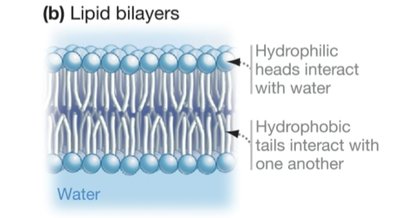
Phospholipids are amphipathic, containing both hydrophilic (polar) heads and hydrophobic (nonpolar) tails. This property drives the formation of biological membranes.
In water, amphipathic lipids spontaneously form structures such as micelles and lipid bilayers.
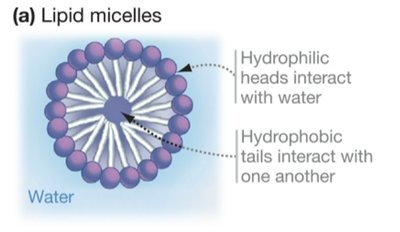
Micelles: Spherical structures with hydrophilic heads facing outward and hydrophobic tails inward.
Lipid Bilayers: Double-layered sheets with hydrophilic heads facing water on both sides and hydrophobic tails sandwiched in the middle; fundamental to cell membranes.
Membrane Permeability and Transport
The lipid bilayer is selectively permeable:
Small, nonpolar molecules can diffuse through easily.
Charged ions and large molecules require protein assistance.
Permeability is influenced by hydrocarbon tail length, saturation, and cholesterol content.
Types of Membrane Proteins:
Integral Proteins: Span the membrane.
Peripheral Proteins: Attach to the membrane surface.
Transport Mechanisms:
Diffusion: Movement from high to low concentration; no energy required.
Facilitated Diffusion: Proteins help substances cross the membrane; still passive.
Active Transport: Movement against the concentration gradient; requires energy (e.g., ATP).
Example: Aquaporins are channel proteins that facilitate water transport across the membrane.
Additional info: The presence of proteins in the membrane can significantly alter its permeability and function, allowing cells to regulate their internal environments efficiently.
