 Back
Nucleic Acids: Structure and Function
Study Guide - Smart Notes
 Tailored notes based on your materials, expanded with key definitions, examples, and context.
Nucleic Acids: Structure and Function
Introduction to Nucleic Acids
Nucleic acids, including DNA (deoxyribonucleic acid) and RNA (ribonucleic acid), are essential biomolecules that store and transmit genetic information in all living organisms. They are polymers made up of repeating monomer units called nucleotides. DNA is primarily responsible for storing hereditary information, while RNA plays various roles in gene expression and protein synthesis.
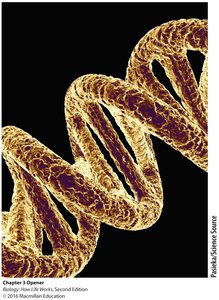
Central Dogma of Molecular Biology
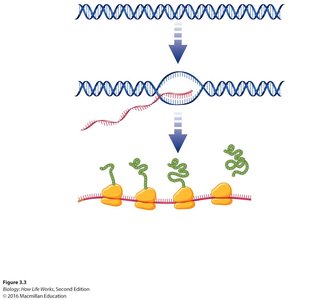
The flow of genetic information in cells follows the central dogma: DNA is transcribed into RNA, which is then translated into protein. Proteins perform most cellular functions, including structural roles and catalyzing biochemical reactions.
Transcription: The process by which a segment of DNA is copied into messenger RNA (mRNA).
Translation: The process by which ribosomes synthesize proteins using the sequence encoded in mRNA.
Structure of Nucleic Acids
Nucleotides: The Monomers of Nucleic Acids
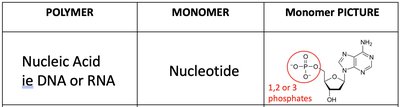
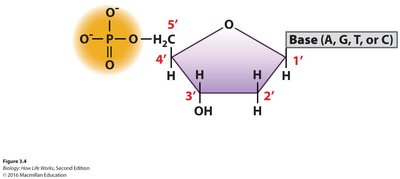
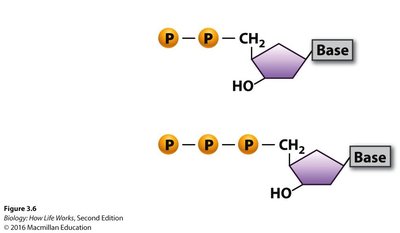
Each nucleotide consists of three components: a phosphate group, a five-carbon sugar (either ribose or deoxyribose), and a nitrogenous base. Nucleotides are linked together by phosphodiester bonds to form the nucleic acid polymer.
POLYMER | MONOMER | Monomer PICTURE |
|---|---|---|
Nucleic Acid i.e. DNA or RNA | Nucleotide |
|
Directionality of Nucleic Acids
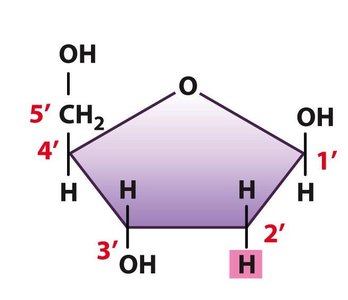
The sugars in DNA and RNA have directionality, with carbons numbered 1' to 5'. The 5' carbon is attached to the phosphate group, and the 3' carbon has a hydroxyl group where the next nucleotide attaches. This gives nucleic acids a 5' to 3' directionality, which is critical for replication and transcription.
Dehydration Synthesis and Phosphodiester Bonds
Nucleotides are joined together by dehydration synthesis (condensation reaction), forming phosphodiester bonds between the 3' hydroxyl of one nucleotide and the 5' phosphate of the next. This linkage creates the sugar-phosphate backbone of nucleic acids.
Types of Nucleic Acids: DNA and RNA
RNA Structure
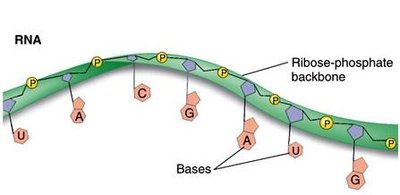
RNA is typically single-stranded and contains the sugar ribose. It is less stable than DNA and can fold into various secondary and tertiary structures, allowing it to perform diverse functions such as catalysis (ribozymes) and regulation.
Sugar: Ribose
Bases: Adenine (A), Guanine (G), Cytosine (C), Uracil (U)
Structure: Single-stranded, can form loops and complex 3D shapes
DNA Structure
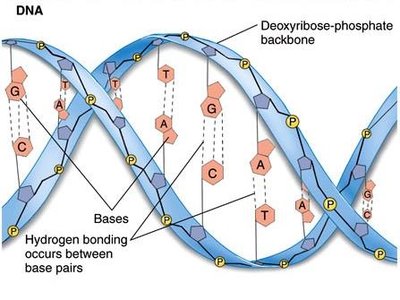
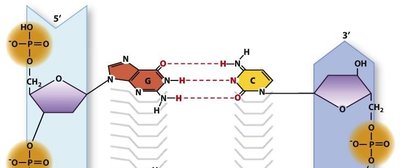
DNA is a double-stranded helix with the sugar deoxyribose. It is more stable than RNA and can wrap around proteins to form compact structures (chromatin). The two strands are antiparallel and held together by hydrogen bonds between complementary bases.
Sugar: Deoxyribose
Bases: Adenine (A), Guanine (G), Cytosine (C), Thymine (T)
Structure: Double-stranded helix, antiparallel orientation
Comparison of Ribose and Deoxyribose
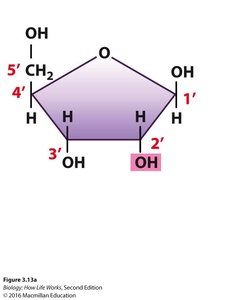
The key difference between ribose (in RNA) and deoxyribose (in DNA) is the presence of a hydroxyl group at the 2' carbon in ribose, which is replaced by a hydrogen in deoxyribose. This difference contributes to the greater stability of DNA.
Ribose (RNA): 2' carbon has an –OH group
Deoxyribose (DNA): 2' carbon has an –H
Summary Table: DNA vs. RNA
Feature | DNA | RNA |
|---|---|---|
Sugar | Deoxyribose | Ribose |
Strands | Double-stranded | Single-stranded |
Bases | A, G, C, T | A, G, C, U |
Stability | More stable | Less stable |
Nitrogenous Bases and Base Pairing
Types of Nitrogenous Bases
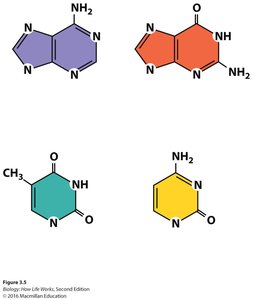
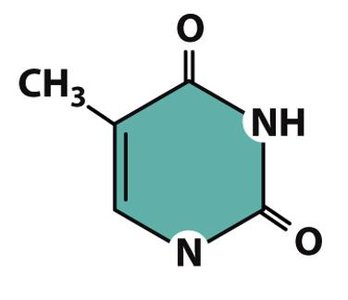
Nitrogenous bases are classified as purines (adenine and guanine) and pyrimidines (cytosine, thymine, and uracil). In DNA, adenine pairs with thymine, and guanine pairs with cytosine. In RNA, uracil replaces thymine.
Purines: Adenine (A), Guanine (G)
Pyrimidines: Cytosine (C), Thymine (T), Uracil (U)
Base Pairing Rules
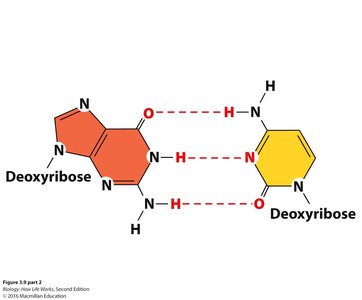
Base pairing in DNA is highly specific due to hydrogen bonding:
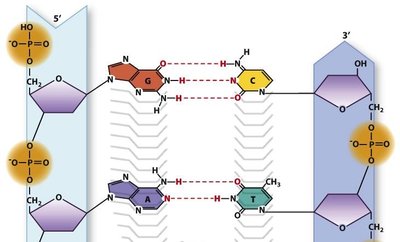
Adenine (A) pairs with Thymine (T): 2 hydrogen bonds
Guanine (G) pairs with Cytosine (C): 3 hydrogen bonds
This complementarity ensures accurate DNA replication and transcription. In RNA, uracil (U) replaces thymine and pairs with adenine.
Chargaff's Rules
In double-stranded DNA, the amount of adenine equals thymine (%A = %T), and the amount of guanine equals cytosine (%G = %C). This is known as Chargaff's rules and is a consequence of base pairing.
Antiparallel Structure and Phosphodiester Bonds
Antiparallel Orientation
The two strands of DNA run in opposite directions (antiparallel), one from 5' to 3' and the other from 3' to 5'. This orientation is essential for replication and function.
Phosphodiester Bonds
Phosphodiester bonds link the 3' carbon of one sugar to the 5' phosphate of the next, forming the sugar-phosphate backbone of nucleic acids. This backbone provides structural stability and directionality.
DNA Replication
Mechanism of Replication
During DNA replication, the two strands of the parental DNA separate, and each serves as a template for the synthesis of a new complementary strand. Base pairing rules ensure accurate copying of genetic information.
Replication fork: The region where the DNA is unwound and new strands are synthesized.
Semiconservative replication: Each new DNA molecule consists of one parental and one newly synthesized strand.

Other Functions of Nucleotides
Adenosine Triphosphate (ATP)
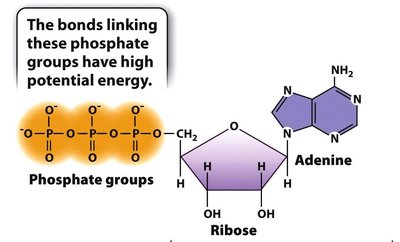
Nucleotides also serve as energy carriers in the cell. ATP (adenosine triphosphate) is the primary energy currency, providing energy for many cellular processes. The high-energy bonds between phosphate groups are hydrolyzed to release energy.
Summary Table: Key Features of Nucleic Acids
Feature | DNA | RNA |
|---|---|---|
Sugar | Deoxyribose | Ribose |
Strands | Double | Single |
Bases | A, G, C, T | A, G, C, U |
Base Pairing | A-T, G-C | A-U, G-C |
Stability | High | Lower |
Main Function | Genetic information storage | Gene expression, catalysis |
Additional info: The versatility of RNA is due to its ability to form complex secondary and tertiary structures, enabling it to act as a catalyst (ribozymes) and play regulatory roles in the cell. DNA's double helix structure and complementary base pairing are critical for the accurate transmission of genetic information during cell division.
