 Back
Nucleic Acids: Structure and Function
Study Guide - Smart Notes
 Tailored notes based on your materials, expanded with key definitions, examples, and context.
Nucleic Acids
The Nucleic Acids DNA and RNA are Information-Rich Polymers of Nucleotides
Nucleic acids are essential biomolecules that store and transmit genetic information in all living organisms. The two main types, DNA (deoxyribonucleic acid) and RNA (ribonucleic acid), are polymers made up of nucleotide monomers. These molecules play a central role in heredity, cell function, and the synthesis of proteins.
Monomers of Nucleic Acids
Nucleic acids are composed of repeating units called nucleotides. Each nucleotide consists of three components:
Phosphate group
Five-carbon sugar (deoxyribose in DNA, ribose in RNA)
Nitrogenous base (adenine, guanine, cytosine, thymine in DNA; uracil replaces thymine in RNA)
The sequence of these nucleotides encodes genetic information.
Nucleotide Structure
Nucleotides are linked together by covalent bonds between the phosphate group of one nucleotide and the sugar of the next, forming a sugar-phosphate backbone. The nitrogenous bases project from this backbone and participate in hydrogen bonding.
Pyrimidines: Single-ring structures (cytosine, thymine, uracil)
Purines: Double-ring structures (adenine, guanine)
Base pairing is specific: in DNA, adenine pairs with thymine, and guanine pairs with cytosine.
Structure of DNA and RNA
DNA is typically a double helix, with two strands running in opposite directions and held together by hydrogen bonds between complementary bases. RNA is usually single-stranded and can fold into various shapes for its functions.
DNA: Double-stranded, contains deoxyribose, bases A, T, G, C
RNA: Single-stranded, contains ribose, bases A, U, G, C
Base pairing in DNA: A-T and G-C; in RNA: A-U and G-C.
Functions of Nucleic Acids
Nucleic acids are responsible for storing genetic information, guiding protein synthesis, and regulating cellular activities. DNA serves as the genetic blueprint, while RNA acts as a messenger and functional molecule in protein synthesis.
DNA: Stores genetic information, transmits heredity
RNA: Carries instructions from DNA to ribosomes, catalyzes reactions, regulates gene expression
Mutations in nucleic acids can lead to changes in protein structure and function, affecting organismal traits.
Summary Table: DNA vs. RNA
Feature | DNA | RNA |
|---|---|---|
Strands | Double | Single |
Sugar | Deoxyribose | Ribose |
Bases | A, T, G, C | A, U, G, C |
Function | Genetic storage | Protein synthesis, regulation |
Key Equations
The number of purines equals the number of pyrimidines in DNA:
Base pairing:
Relevant Images
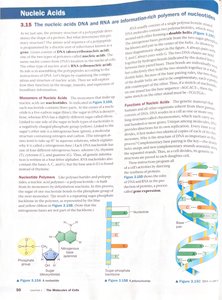
The following image visually illustrates the structure of DNA, including the double helix and base pairing:
Example: The sequence of nucleotides in DNA determines the sequence of amino acids in proteins, which in turn determines protein structure and function.
