 Back
Nucleic Acids: Structure and Function (DNA & RNA)
Study Guide - Smart Notes
 Tailored notes based on your materials, expanded with key definitions, examples, and context.
Nucleic Acids: Structure and Function
Overview of Nucleic Acids
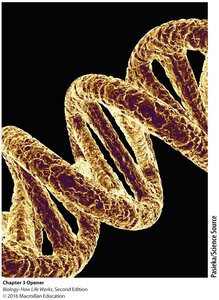
Nucleic acids, including DNA and RNA, are essential biomolecules that store and transmit genetic information in all living organisms. They are responsible for the instructions that guide cellular activities and heredity.
DNA (Deoxyribonucleic Acid): Stores genetic information and is heritable.
RNA (Ribonucleic Acid): Functions in protein synthesis and regulation.
Both DNA and RNA are classified as nucleic acids.
Central Dogma: Information Flow
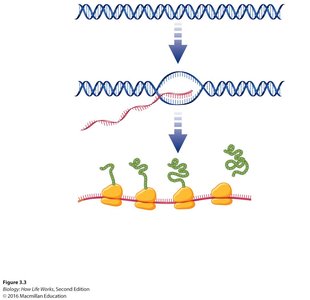
The central dogma of molecular biology describes the flow of genetic information from DNA to RNA to protein. This process involves two main steps: transcription and translation.
Transcription: DNA is used as a template to synthesize messenger RNA (mRNA).
Translation: mRNA is decoded by ribosomes to produce proteins.
Proteins provide structure and carry out essential cellular functions.
Structure of Nucleic Acids
Nucleic Acid Polymers and Monomers
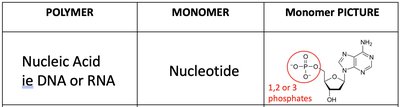
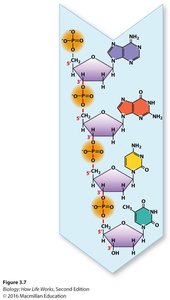
Nucleic acids are long polymers made up of repeating monomer units called nucleotides. Each nucleotide consists of three components: a phosphate group, a five-carbon sugar, and a nitrogenous base.
Polymer: Nucleic acid (DNA or RNA)
Monomer: Nucleotide
Polymer | Monomer | Monomer Picture |
|---|---|---|
Nucleic Acid (DNA or RNA) | Nucleotide | Phosphate, sugar, base (see image) |
Nucleotide Structure and Directionality
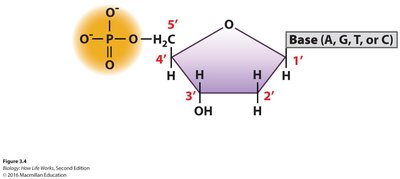
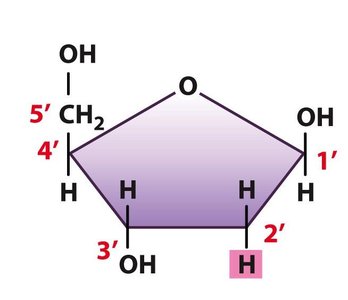
Each nucleotide contains a five-carbon sugar (ribose in RNA, deoxyribose in DNA), a phosphate group attached to the 5' carbon, and a nitrogenous base attached to the 1' carbon. The 3' carbon has a hydroxyl group, which is the site for the addition of the next nucleotide, giving the nucleic acid strand directionality (5' to 3').
5' Carbon: Attached to phosphate group
1' Carbon: Attached to nitrogenous base
3' Carbon: Attached to hydroxyl group (site for polymerization)
Nucleotide Triphosphates
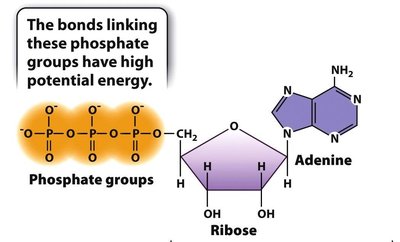
Nucleotides can exist as mono-, di-, or triphosphates. Nucleotide triphosphates (such as ATP) are important for energy transfer in cells.
ATP (Adenosine Triphosphate): Energy currency of the cell
High-energy bonds between phosphate groups
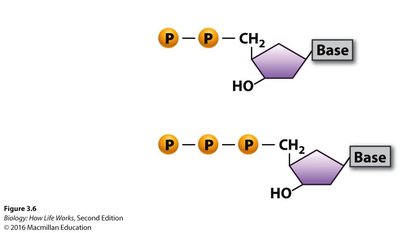
Polymerization: Dehydration Synthesis
Nucleotides are linked together by phosphodiester bonds through dehydration synthesis (condensation reaction). This forms the sugar-phosphate backbone of nucleic acids.
Phosphodiester bonds connect the 3' hydroxyl of one nucleotide to the 5' phosphate of the next.
Directionality: 5' to 3'
Types of Nucleic Acids: DNA vs. RNA
Structural Differences
DNA and RNA differ in their structure, stability, and function.
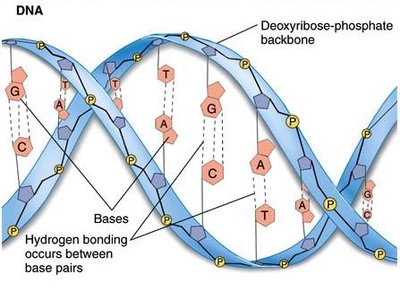
DNA: Double-stranded helix, more stable, deoxyribose sugar, bases A, G, C, T
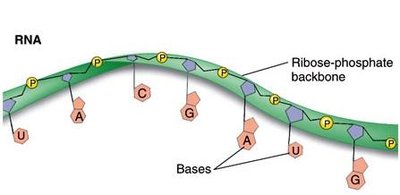
RNA: Single-stranded, less stable, ribose sugar, bases A, G, C, U
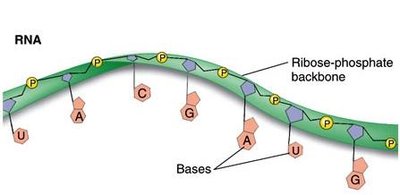
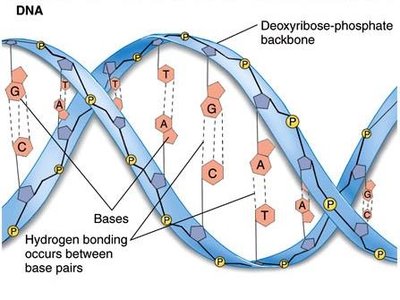
Sugar Differences: Ribose vs. Deoxyribose
The sugar in RNA is ribose, which has a hydroxyl group at the 2' carbon. In DNA, the sugar is deoxyribose, which has a hydrogen at the 2' carbon.
Ribose: 2' carbon has –OH group (RNA)
Deoxyribose: 2' carbon has –H (DNA)
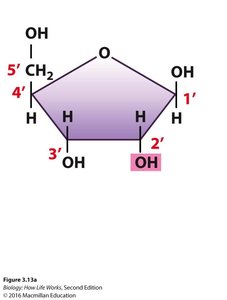
Summary Table: DNA vs. RNA
Feature | DNA | RNA |
|---|---|---|
Strands | Double-stranded | Single-stranded |
Sugar | Deoxyribose | Ribose |
Bases | A, G, C, T | A, G, C, U |
Stability | More stable | Less stable |
Nitrogenous Bases
Types of Bases
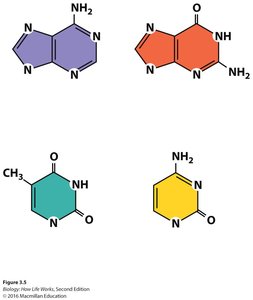
Nucleic acids contain two types of nitrogenous bases: purines and pyrimidines.
Purines: Adenine (A), Guanine (G)
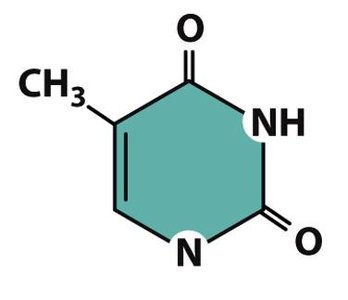
Pyrimidines: Cytosine (C), Thymine (T, in DNA), Uracil (U, in RNA)
Base Pairing and Hydrogen Bonds
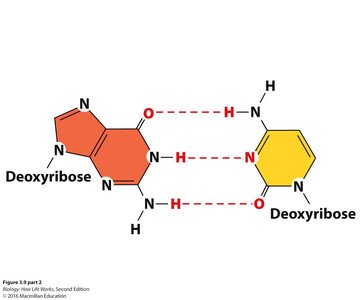
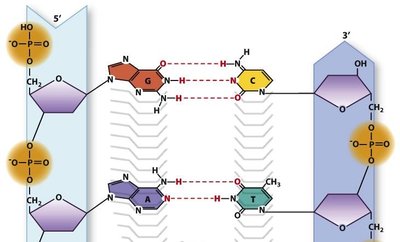
In DNA, bases pair via hydrogen bonds: A with T (two bonds), G with C (three bonds). In RNA, A pairs with U.
A–T: Two hydrogen bonds
G–C: Three hydrogen bonds
Base pairing ensures accurate replication and transcription.
Chargaff's Rules
Chargaff's rules state that in DNA, the amount of adenine equals thymine, and the amount of guanine equals cytosine.
%A = %T
%G = %C
DNA Structure and Replication
Antiparallel Strands
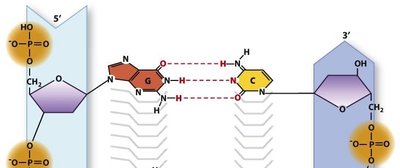
DNA consists of two antiparallel strands, meaning one strand runs 5' to 3' and the other runs 3' to 5'. This arrangement is crucial for replication and base pairing.
Phosphodiester Bonds
Phosphodiester bonds link the sugars in each chain, forming the backbone of DNA and RNA.
Conventional Notation
Nucleic acid sequences are written from the 5' to 3' direction, e.g., 5'-AGCT-3'.
DNA Replication
The structure of DNA allows for its replication. During replication, the two strands separate, and each serves as a template for the synthesis of a new strand, following base-pairing rules.
Replication fork forms as DNA unwinds.
New nucleotides are added according to base pairing.

Additional Functions of Nucleotides
Adenosine Triphosphate (ATP)
ATP is a nucleotide that serves as the primary energy currency in the cell. It is mostly produced in the mitochondria and contains high-energy phosphate bonds.
ATP hydrolysis releases energy for cellular processes.

Summary Table: Nucleic Acid Structure
Component | DNA | RNA |
|---|---|---|
Sugar | Deoxyribose | Ribose |
Strands | Double | Single |
Bases | A, G, C, T | A, G, C, U |
Stability | High | Low |
Function | Genetic storage | Protein synthesis, regulation |
Practice Question Example
In the DNA of certain bacterial cells, 20% of the nucleotides are thymine. What are the percentages of the other nucleotides?
According to Chargaff's rules: %A = %T = 20%, %G + %C = 60%, so %G = %C = 30%.
Answer: 20% adenine, 30% guanine, 30% cytosine.
Additional info: This study guide covers the structure and function of nucleic acids, including DNA and RNA, their monomers, base pairing, and the central dogma of molecular biology. It also includes the role of ATP as an energy carrier.
