 Back
Nucleic Acids: Structure and Function (DNA & RNA)
Study Guide - Smart Notes
 Tailored notes based on your materials, expanded with key definitions, examples, and context.
Chapter 4: Nucleic Acids
Introduction to Nucleic Acids
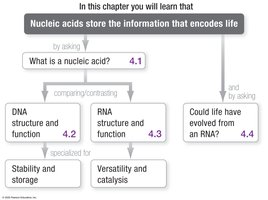
Nucleic acids are essential biomolecules that store and transmit genetic information in all living organisms. The two main types are deoxyribonucleic acid (DNA) and ribonucleic acid (RNA). The RNA world hypothesis suggests that RNA was the original molecule for both information storage and catalysis in early evolution, preceding the evolution of DNA and proteins.
Learning Objectives
Describe the structure and components of nucleotides and how they polymerize to form nucleic acids.
Distinguish between DNA and RNA at the molecular level.
Explain the primary, secondary, and tertiary structures of DNA and RNA and their functional implications.
Understand the versatility of RNA and its catalytic roles.
What is a Nucleic Acid?
Structure of Nucleotides
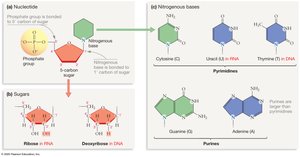
Nucleic acids are polymers made of nucleotide monomers. Each nucleotide consists of three components:
Phosphate group
Five-carbon sugar (ribose in RNA, deoxyribose in DNA)
Nitrogenous base (purine or pyrimidine)
The phosphate group and nitrogenous base are both bonded to the sugar molecule. The difference between ribose and deoxyribose is the presence of an –OH group at the 2′ carbon in ribose (RNA) and an –H in deoxyribose (DNA).
Nitrogenous Bases
Purines (two rings): Adenine (A), Guanine (G)
Pyrimidines (one ring): Cytosine (C), Uracil (U, only in RNA), Thymine (T, only in DNA)
Mnemonic: "C U T of P y" for pyrimidines (C, U, T).
Polymerization of Nucleic Acids
Formation of Phosphodiester Bonds
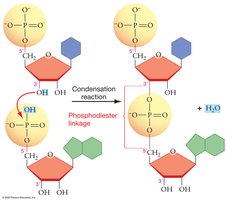
Nucleotides polymerize via condensation reactions, forming phosphodiester linkages between the 5′ phosphate group of one nucleotide and the 3′ hydroxyl group of another. This process creates the sugar-phosphate backbone of nucleic acids.
Directionality of Nucleic Acid Strands
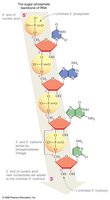
The backbone of nucleic acids is directional, running from the 5′ end (with a free phosphate group) to the 3′ end (with a free hydroxyl group). The sequence of nitrogenous bases is written from 5′ to 3′.
Energy for Polymerization
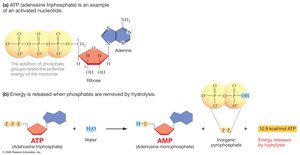
Polymerization of nucleic acids requires energy, which is provided by nucleoside triphosphates (e.g., ATP). Hydrolysis of the high-energy phosphate bonds releases energy, making the reaction spontaneous.
DNA Structure and Function
Primary Structure
The primary structure of DNA is the sequence of deoxyribonucleotides, each containing one of four bases: A, T, C, or G.
Secondary Structure: The Double Helix
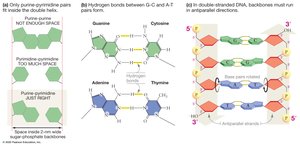
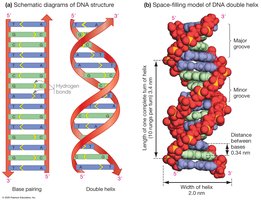
DNA's secondary structure is a double helix formed by two antiparallel strands held together by hydrogen bonds between complementary bases:
A pairs with T (two hydrogen bonds)
C pairs with G (three hydrogen bonds)
The sugar-phosphate backbones form the sides of the helix, while the bases form the rungs. The double helix has major and minor grooves, which are important for protein binding and regulation.
Tertiary Structure
DNA can form more compact three-dimensional structures, such as supercoils and nucleosomes (DNA wrapped around histone proteins), allowing efficient packaging within cells.
DNA as an Information-Containing Molecule
DNA stores genetic information in the sequence of its bases, which encode instructions for growth, development, and reproduction. The order of bases functions like letters in a language, with specific sequences coding for genes.
DNA Replication
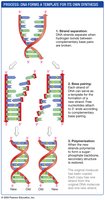
DNA replication involves three main steps:
Strand separation: Hydrogen bonds between bases are broken.
Base pairing: Free nucleotides pair with exposed bases on the template strand.
Polymerization: Phosphodiester bonds form, creating a new complementary strand.
This process ensures accurate copying of genetic information for cell division.
Stability of the DNA Double Helix
The double helix is stabilized by phosphodiester linkages, hydrogen bonds, and hydrophobic interactions. This stability is crucial for DNA's role as a reliable information-storage molecule.
RNA Structure and Function
Primary Structure
RNA consists of a sequence of ribonucleotides (A, U, C, G). It contains ribose sugar and uracil instead of thymine. The 2′-OH group in ribose makes RNA more reactive and less stable than DNA.
Secondary Structure
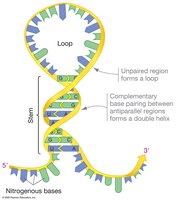
RNA strands often fold back on themselves, forming hairpin structures through complementary base pairing (A with U, G with C) within the same strand. These structures are stabilized by hydrogen bonds.
Tertiary Structure
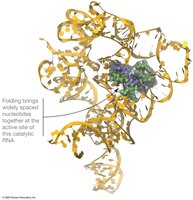
RNA molecules can fold into complex three-dimensional shapes, allowing them to perform diverse functions. Tertiary structure arises from interactions between secondary structure elements.
Comparison of DNA and RNA Structure
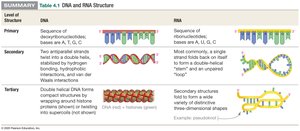
Level of Structure | DNA | RNA |
|---|---|---|
Primary | Sequence of deoxyribonucleotides; bases are A, T, C, G | Sequence of ribonucleotides; bases are A, U, C, G |
Secondary | Double helix stabilized by hydrogen bonding between complementary bases and by base stacking | Most commonly, a single strand folds back on itself to form a double-helical "stem" and an unpaired "loop" |
Tertiary | Double helical DNA forms compact structures by wrapping around histone proteins or by supercoiling | Secondary structures fold to form a wide variety of distinctive three-dimensional shapes |
RNA's Versatility and Catalytic Function
RNA is highly versatile due to its ability to fold into complex shapes. It serves as an intermediate in gene expression (mRNA), regulates gene expression, and can act as a catalyst (ribozyme). Ribozymes have active sites and catalyze specific biochemical reactions, such as peptide bond formation in ribosomes.
Additional info: The discovery of ribozymes provided evidence for the RNA world hypothesis, suggesting that early life forms may have relied on RNA for both genetic information storage and catalysis before the evolution of proteins and DNA.
