 Back
Nucleic Acids: Structure and Function of DNA and RNA
Study Guide - Smart Notes
 Tailored notes based on your materials, expanded with key definitions, examples, and context.
Nucleic Acids: Structure and Function
What Is a Nucleic Acid?
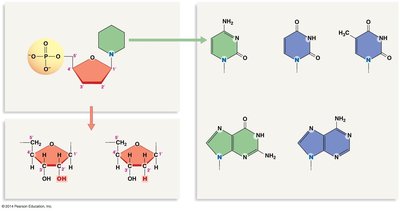
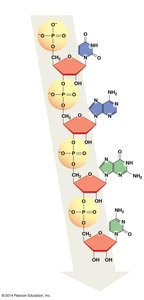
Nucleic acids are essential macromolecules that store and transmit genetic information in all living organisms. They are polymers made up of nucleotide monomers, each consisting of three components: a phosphate group, a five-carbon sugar, and a nitrogenous base. The phosphate group is bonded to the 5′ carbon of the sugar, while the nitrogenous base is bonded to the 1′ carbon of the sugar.
Nucleotide Components: Phosphate group, five-carbon sugar (ribose or deoxyribose), nitrogenous base (purines or pyrimidines).
Purines: Adenine (A) and Guanine (G) – larger, double-ring structures.
Pyrimidines: Cytosine (C), Thymine (T, in DNA), and Uracil (U, in RNA) – smaller, single-ring structures.
Ribonucleotides: Contain ribose sugar and form RNA.
Deoxyribonucleotides: Contain deoxyribose sugar and form DNA.
Polymerization of Nucleotides
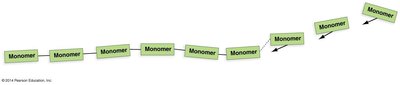
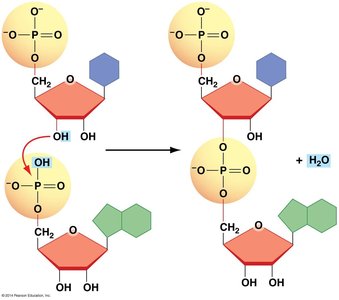
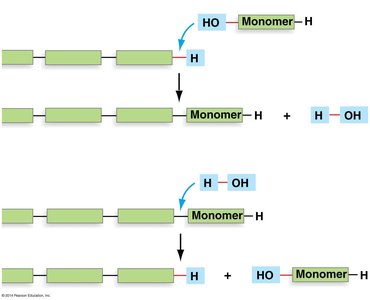
Nucleic acids are formed by the polymerization of nucleotide monomers. This process is endergonic and requires energy, typically catalyzed by enzymes. Monomers link together through condensation (dehydration) reactions, releasing a water molecule. The reverse process, hydrolysis, breaks polymers apart by adding water.
Condensation Reaction: Joins monomers, water is released.
Hydrolysis: Breaks polymers, water is added.
Phosphodiester Linkage: Bond between the phosphate group on the 5′ carbon of one nucleotide and the –OH group on the 3′ carbon of another.
The Sugar-Phosphate Backbone
The sugar-phosphate backbone of nucleic acids is directional, with polarity. One end has an unlinked 5′ phosphate, and the other has an unlinked 3′ hydroxyl. Nucleotide sequences are written in the 5′→3′ direction, reflecting the order of addition during polymerization. The backbone forms the primary structure of nucleic acids.
Directionality: 5′ end (phosphate) to 3′ end (hydroxyl).
Primary Structure: Sequence of nucleotides.
DNA vs. RNA: Structural Differences
DNA and RNA differ in their sugar component and nitrogenous bases. DNA contains deoxyribose and thymine, while RNA contains ribose and uracil. The presence of an –OH group on ribose makes RNA more reactive and less stable than DNA.
DNA: Deoxyribose sugar, bases A, T, G, C.
RNA: Ribose sugar, bases A, U, G, C.
Stability: DNA is more stable and less reactive; RNA is less stable and more reactive.
DNA Secondary Structure
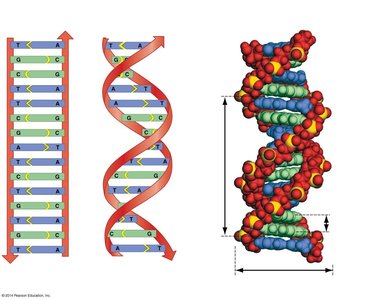
The secondary structure of DNA is a double helix, consisting of two antiparallel strands stabilized by hydrogen bonds between complementary base pairs (A-T and G-C) and hydrophobic interactions (base stacking). DNA has major and minor grooves, and its structure was elucidated by Watson and Crick, building on empirical rules and X-ray crystallography data.
Antiparallel Strands: Strands run in opposite directions.
Double Helix: Sugar-phosphate backbone faces exterior; base pairs face interior.
Base Pairing: Purines pair with pyrimidines (A-T, G-C).
Grooves: Major and minor grooves present.
Stabilization: Hydrogen bonds and hydrophobic interactions.
DNA Function
DNA stores and transmits biological information required for growth and reproduction. Its stability makes it a reliable genetic store, and it directs protein synthesis through the central dogma of molecular biology.
Information Storage: DNA encodes instructions for protein synthesis.
Stability: Less reactive, resistant to degradation.
RNA Structure and Function
RNA is typically single-stranded, but it can fold into secondary structures through complementary base pairing within the same strand, forming hairpins and loops. RNA can also adopt tertiary structures, enabling it to function as an information carrier and a catalyst (ribozyme).
Primary Structure: Sequence of ribonucleotides.
Secondary Structure: Hairpins and loops formed by internal base pairing.
Tertiary Structure: Complex three-dimensional shapes (e.g., tRNA).
Catalytic Function: Ribozymes catalyze biochemical reactions.
Summary Table: DNA and RNA Structure
The following table summarizes the structural differences between DNA and RNA at the primary, secondary, and tertiary levels.
Level of Structure | DNA | RNA |
|---|---|---|
Primary | Sequence of deoxyribonucleotides; bases are A, T, G, C | Sequence of ribonucleotides; bases are A, U, G, C |
Secondary | Two antiparallel strands form double helix, stabilized by hydrogen bonding between complementary bases (A-T, G-C) and hydrophobic interactions | Most common are hairpins, formed when a single strand folds back on itself to form a double-helix "stem" and a single-stranded "loop" |
Tertiary | None* | Folds that form distinctive three-dimensional shapes |
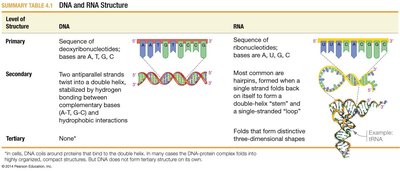
*In cells, DNA coils around proteins to form the double helix. In many cases, the DNA-protein complex folds into highly organized, compact structures, but DNA does not form tertiary structure on its own.
Additional info:
DNA's double helix structure is crucial for its function in replication and information storage.
RNA's versatility allows it to act as both a genetic material (in some viruses) and a catalyst (ribozymes).
Phosphodiester bonds are essential for the stability and integrity of nucleic acid polymers.
