 Back
Nucleic Acids: Structure, Function, and Biological Applications
Study Guide - Smart Notes
 Tailored notes based on your materials, expanded with key definitions, examples, and context.
Macromolecules: Nucleic Acids
Overview of Nucleic Acids
Nucleic acids are essential macromolecules that store, transmit, and help express hereditary information in all living organisms. They are central to the processes of inheritance and gene expression.
Nucleic acids include DNA (deoxyribonucleic acid) and RNA (ribonucleic acid).
DNA contains instructions for making proteins and is the unit of inheritance (gene).
RNA is involved in the expression of genetic information.
Gene Expression: DNA → RNA → Protein
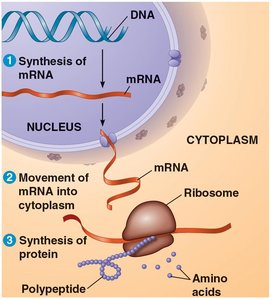
Gene expression is the process by which information from a gene is used to synthesize a functional gene product, typically a protein.
Each gene in DNA directs the synthesis of messenger RNA (mRNA).
mRNA carries instructions from DNA to the cell's protein-synthesizing machinery (ribosomes).
The flow of genetic information is summarized as: DNA → RNA → Protein.
Structure of Nucleic Acids
Nucleotides: Building Blocks of Nucleic Acids
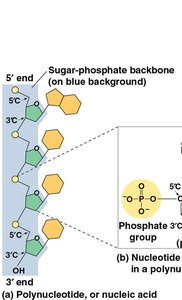
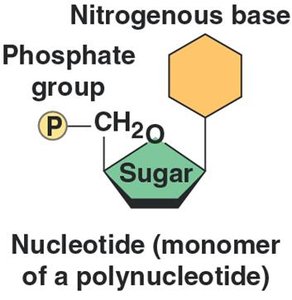
Nucleic acids are polymers called polynucleotides, made up of monomers called nucleotides.
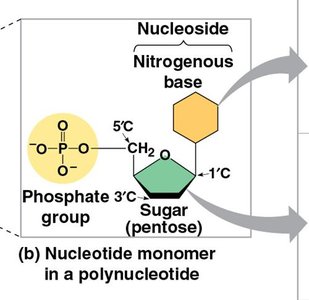
Each nucleotide consists of:
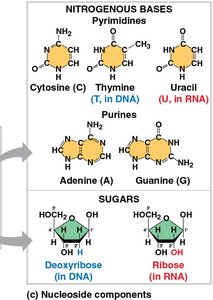
A nitrogenous base
A pentose sugar (ribose or deoxyribose)
One or more phosphate groups
A nucleoside is a nucleotide without the phosphate group (nitrogenous base + sugar).
Nitrogenous Bases and Sugars
There are two families of nitrogenous bases:
Pyrimidines: Cytosine (C), Thymine (T), and Uracil (U) – single six-membered ring.
Purines: Adenine (A) and Guanine (G) – six-membered ring fused to a five-membered ring.
DNA contains deoxyribose sugar; RNA contains ribose sugar.
Thymine is found only in DNA; Uracil is found only in RNA.
Nucleotide Polymerization
Nucleotides are linked by phosphodiester bonds to form polynucleotides.
Phosphodiester linkage: phosphate group links the sugars of two nucleotides.
Creates a sugar-phosphate backbone with nitrogenous bases as appendages.
The sequence of bases is unique for each gene.
DNA Structure
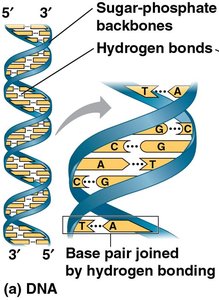
DNA is composed of two polynucleotide strands forming a double helix.
Strands run in opposite 5’ → 3’ directions (antiparallel).
Base pairing: Adenine (A) pairs with Thymine (T); Guanine (G) pairs with Cytosine (C).
Hydrogen bonds hold the base pairs together.
This structure allows DNA replication and inheritance.
RNA Structure
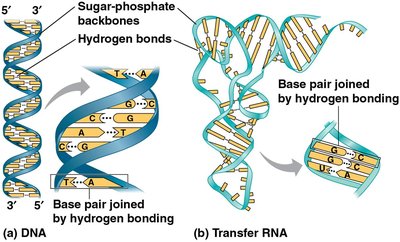
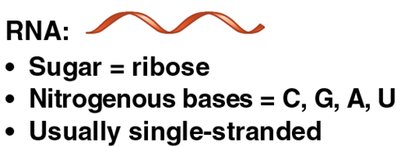
RNA is usually single-stranded but can form complex structures through complementary base pairing.
In RNA, Adenine (A) pairs with Uracil (U).
RNA molecules are more variable in form compared to DNA.
Transfer RNA (tRNA) is an example of folded RNA with internal base pairing.
Comparison of DNA and RNA
Feature | DNA | RNA |
|---|---|---|
Sugar | Deoxyribose | Ribose |
Nitrogenous Bases | C, G, A, T | C, G, A, U |
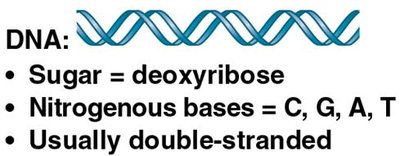
Strandedness | Usually double-stranded | Usually single-stranded |
Function | Stores genetic information | Various functions in gene expression |
Genomics and Proteomics
DNA Sequencing and the Human Genome Project
Advances in DNA sequencing technology have revolutionized biological research.
The Human Genome Project aimed to sequence the entire human genome.
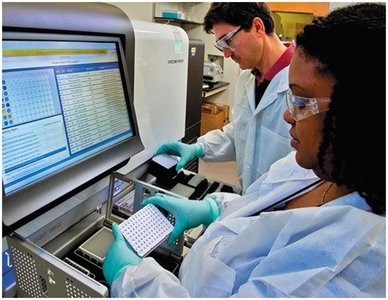
Modern sequencing machines and computing power enable rapid sequencing of genes and genomes.
Genomics and Proteomics: Applications
Genomics: Analysis and comparison of whole genomes across species.
Proteomics: Analysis of large sets of proteins, including their sequences and functions.
Bioinformatics uses computational tools to manage and analyze sequencing data.
These fields help us understand evolution and biological diversity.
Summary Table: Nucleic Acids
Sub-type | Components | Functions |
|---|---|---|
DNA | Deoxyribose sugar, C/G/A/T bases, phosphate group | Stores genetic information, directs replication and gene expression |
RNA | Ribose sugar, C/G/A/U bases, phosphate group | Various functions in gene expression, including carrying instructions from DNA to ribosomes |
Key Terms and Concepts
Gene: Unit of inheritance, segment of DNA encoding a protein.
Nucleotide: Monomer of nucleic acids, composed of a nitrogenous base, sugar, and phosphate group.
Polynucleotide: Polymer of nucleotides.
Phosphodiester bond: Covalent bond linking nucleotides in a nucleic acid.
Antiparallel: Orientation of DNA strands running in opposite directions.
Complementary base pairing: Specific pairing of bases (A-T, G-C in DNA; A-U, G-C in RNA).
Genomics: Study of whole genomes.
Proteomics: Study of protein sets and their functions.
Equations and Structural Formulas
Phosphodiester bond formation:
Base pairing: (DNA), (DNA/RNA), (RNA)
Review Questions
Which is NOT a difference between DNA and RNA? (Review the comparison table above.)
Which sequence could be found in either DNA or RNA? (Consider the bases present in each.)
Additional info: Academic context was added to clarify the structure and function of nucleic acids, the process of gene expression, and the applications of genomics and proteomics.
