 Back
Nucleic Acids: Structure, Function, and Comparison of DNA and RNA (Chapter 4)
Study Guide - Smart Notes
 Tailored notes based on your materials, expanded with key definitions, examples, and context.
Nucleic Acids: Structure and Function
What is a Nucleic Acid?
Nucleic acids are essential macromolecules in all living organisms, responsible for storing and transmitting genetic information. They are polymers made of nucleotide monomers, each consisting of three components: a phosphate group, a 5-carbon sugar, and a nitrogenous base.
Nucleotide Structure: Each nucleotide contains a phosphate group, a pentose sugar (ribose in RNA, deoxyribose in DNA), and a nitrogenous base.
Numbering: The 3’ and 5’ refer to the carbon positions in the sugar molecule, which are important for the directionality of nucleic acids.
Nitrogenous Bases: There are two groups:
Pyrimidines: Cytosine (C), Thymine (T, only in DNA), Uracil (U, only in RNA)
Purines: Adenine (A), Guanine (G)
Polymerization: Nucleotides polymerize via condensation reactions, forming covalent phosphodiester bonds between the 5’ phosphate and 3’ hydroxyl groups.
Directionality: The sugar-phosphate backbone is directional; nucleotide sequences are written from 5’ to 3’.
Primary Structure: The sequence of nucleotides in a nucleic acid.
Polymerization Energy: Polymerization is endergonic (requires energy), catalyzed by enzymes, and driven by phosphorylation of nucleotides.
Phosphorylation: The transfer of phosphate groups to a substrate molecule, often catalyzed by kinases; removal is done by phosphatases.
ATP: Adenosine triphosphate is an activated nucleotide that drives cellular reactions.
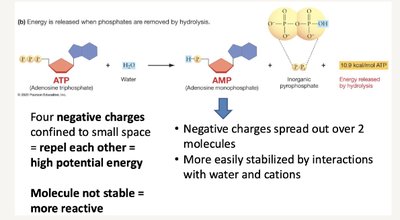
Example: ATP hydrolysis releases energy due to the repulsion of negative charges in the phosphate groups, making ATP highly reactive and unstable. When hydrolyzed, the negative charges are spread out and stabilized, releasing energy for cellular processes.
DNA: Structure and Properties
What is DNA?
Deoxyribonucleic acid (DNA) is the hereditary material in organisms, containing information for growth and reproduction. Nearly every cell in an organism contains the same DNA, except for germ cells.
Secondary Structure: DNA forms a double helix, as revealed by Rosalind Franklin's X-ray diffraction images and modeled by Watson and Crick (1953).
Double Helix: Two antiparallel strands are connected by complementary base pairing (A-T and C-G).
Chargaff's Rule: In double-stranded DNA, the ratio of adenine to thymine and cytosine to guanine is 1:1.
Tertiary Structure: DNA can form more compact 3D structures, such as wrapping around histone proteins.
DNA Replication: DNA is replicated in a semiconservative manner, producing two identical copies from one original molecule.
Stability: DNA is stable due to its double-stranded nature, lack of a 2’-OH group, and hydrophobic interactions between bases.
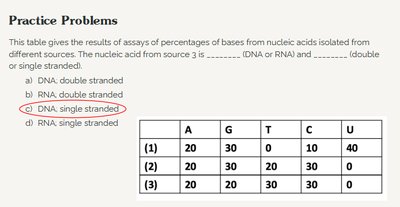
Example: Practice problems often involve identifying DNA or RNA and their strandedness based on base composition. For instance, single-stranded DNA does not follow Chargaff's rule, as shown in the table.
Source | A | G | T | C | U |
|---|---|---|---|---|---|
(1) | 20 | 30 | 0 | 10 | 40 |
(2) | 20 | 30 | 20 | 30 | 0 |
(3) | 20 | 30 | 30 | 20 | 0 |
Additional info: The table is used to determine the type and strandedness of nucleic acids based on the presence and ratios of bases.
RNA: Structure and Function
What is RNA?
Ribonucleic acid (RNA) is a versatile molecule involved in protein synthesis and regulation of gene expression. It differs from DNA in several key ways:
Primary Structure: RNA has a sugar-phosphate backbone formed by phosphodiester linkages, with four types of nitrogenous bases (A, U, G, C).
Differences from DNA:
RNA contains ribose instead of deoxyribose.
RNA contains uracil instead of thymine.
RNA is single-stranded and less stable due to the presence of a 2’-OH group.
Secondary Structure: RNA can fold into hairpin structures via complementary base pairing (A-U, G-C) within the same strand.
Tertiary Structure: Secondary structures can fold into more complex shapes, such as tRNA.
Functions:
RNA serves as an intermediate between DNA and proteins (mRNA).
RNA can catalyze reactions (ribozymes), such as peptide bond formation and splicing (spliceosomes).
Ribosomes, which synthesize proteins, consist of rRNA and protein.
Example: tRNA carries amino acids to ribosomes during translation, and ribozymes catalyze peptide bond formation.
Additional info: RNA's versatility allows it to archive and process genetic information, though it is less efficient and stable than DNA.
Comparison of DNA and RNA
Key Differences
Sugar: DNA contains deoxyribose; RNA contains ribose.
Base: DNA contains thymine; RNA contains uracil.
Strandedness: DNA is typically double-stranded; RNA is single-stranded.
Stability: DNA is more stable due to its double-stranded nature and lack of 2’-OH group; RNA is more reactive.
Function: DNA stores genetic information; RNA transmits and processes information, and catalyzes reactions.
Example: DNA's double helix is ideal for long-term storage, while RNA's single-stranded structure allows for diverse functions in the cell.
