 Back
Nucleic Acids: Structure, Function, and Evolution
Study Guide - Smart Notes
 Tailored notes based on your materials, expanded with key definitions, examples, and context.
Nucleic Acids: Structure and Function
Overview of Nucleic Acids
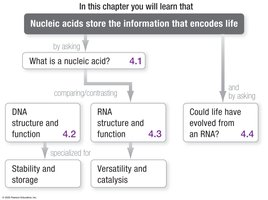
Nucleic acids are essential biomolecules that store and transmit genetic information in all living organisms. The two main types are DNA (deoxyribonucleic acid) and RNA (ribonucleic acid). This chapter explores their structure, function, and evolutionary significance.
What is a Nucleic Acid?
A nucleic acid is a polymer composed of nucleotide monomers. Each nucleotide consists of three components:
Phosphate group
Five-carbon sugar (ribose in RNA, deoxyribose in DNA)
Nitrogenous base (purines or pyrimidines)
The phosphate group and nitrogenous base are both bonded to the sugar molecule, forming the nucleotide structure.
The Sugar in Nucleotides
The type of sugar distinguishes DNA from RNA:
Ribonucleotides (RNA): Contain ribose, which has an –OH group bonded to the 2′ carbon.
Deoxyribonucleotides (DNA): Contain deoxyribose, which has an H instead of an –OH at the 2′ carbon.
Both sugars have an –OH group bonded to the 3′ carbon.
Nitrogenous Bases in Nucleic Acids
Nitrogenous bases are classified into two groups:
Purines: Two rings, nine atoms (adenine, guanine)
Pyrimidines: One ring, six atoms (cytosine, thymine in DNA, uracil in RNA)
Nucleotide Polymerization
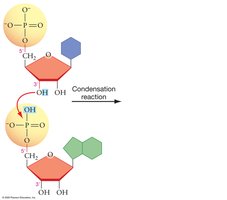
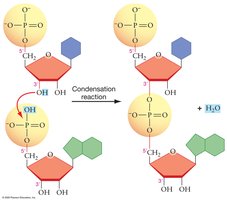
Nucleotides polymerize via condensation reactions to form nucleic acids. The bond formed is called a phosphodiester linkage, which occurs between the phosphate group on the 5′ carbon of one nucleotide and the –OH group on the 3′ carbon of another.
Monomers of Nucleic Acids
Ribonucleotides polymerize to form RNA.
Deoxyribonucleotides polymerize to form DNA.
DNA and RNA Strands
Nucleic acid strands have a sugar–phosphate backbone and are directional:
One end has an unlinked 5′ phosphate group.
The other end has an unlinked 3′ hydroxyl group.
The sequence of nucleotides forms the primary structure and is written in the 5′ → 3′ direction.
Polymerization Requires Energy
Polymerization is catalyzed by enzymes and requires energy, which comes from adding two extra phosphate groups to nucleotides. The resulting activated nucleotides have high-energy bonds due to repulsion between negatively charged phosphate groups.
DNA Structure and Function
Discovery of the Double-Helix Structure
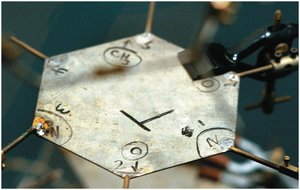
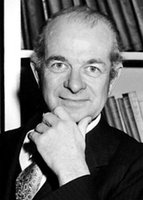
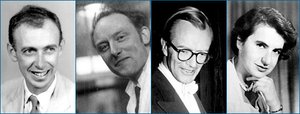
The double-helix structure of DNA was proposed in 1953 by James Watson and Francis Crick, based on X-ray crystallography data from Rosalind Franklin and Maurice Wilkins, and modeling techniques inspired by Linus Pauling.
Base Pairing – Chargaff’s Rules
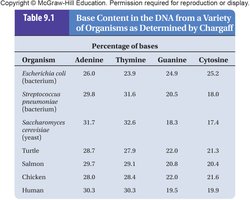
Erwin Chargaff discovered that in DNA:
Amount of adenine (A) = amount of thymine (T)
Amount of cytosine (C) = amount of guanine (G)
Double-Helix Structure
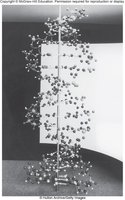
DNA is a double-stranded helix with:
Complementary base pairing (A with T, G with C)
Antiparallel strands
Sugar–phosphate backbone facing the exterior
Nitrogenous base pairs facing the interior
DNA Secondary Structure
One turn of the helix occurs every 10 base pairs.
Hydrophobic interactions between bases cause DNA to twist into a helix.
Negatively charged phosphate groups face outward, making DNA hydrophilic.
DNA has major and minor grooves.
DNA Tertiary Structure
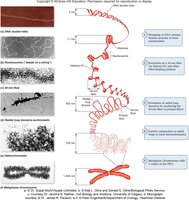
DNA can form more compact three-dimensional structures, such as supercoils and wrapping around proteins. This compaction allows DNA to fit inside the nucleus and contributes to its function during cell division.
DNA as the Informational Molecule
DNA stores and transmits biological information, serving as the blueprint for growth and reproduction. Its primary structure acts as a template for synthesizing complementary strands, enabling accurate copying of genetic information.
Stability of DNA
DNA is highly stable and resistant to chemical degradation, making it reliable for storing genetic information. However, its stability makes it a poor catalyst, and DNA has never been observed to catalyze reactions.
RNA Structure and Function
RNA Structure
RNA has a primary structure similar to DNA, consisting of a sugar–phosphate backbone and four types of nitrogenous bases. Key differences include:
RNA contains ribose (with a 2′ –OH group) instead of deoxyribose.
RNA contains uracil instead of thymine.
RNA is less stable than DNA.
RNA Secondary Structure
RNA often forms hairpin structures through complementary base pairing (A with U, G with C) within the same strand. The bases align with an antiparallel segment, creating loops and folds.
RNA Tertiary Structure and Catalysis
RNA molecules can fold into complex tertiary structures, making them highly versatile. Some RNA molecules, called ribozymes, can catalyze reactions. RNA is capable of self-replication and can serve as both an information carrier and a catalyst.
Comparison of DNA and RNA Structure
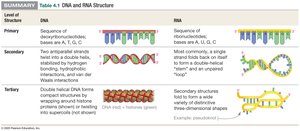
The following table summarizes the structural differences between DNA and RNA:
Level of Structure | DNA | RNA |
|---|---|---|
Primary | Sequence of deoxyribonucleotides; bases are A, T, G, C | Sequence of ribonucleotides; bases are A, U, G, C |
Secondary | Double helix stabilized by base pairing (A-T, G-C) and hydrophobic interactions | Most commonly, a single strand folds to form a double-helical "stem" and an unpaired "loop" |
Tertiary | Double helical DNA forms compact structures by wrapping around histone proteins and supercoiling | Secondary structures fold to form a wide variety of three-dimensional shapes |
Evolutionary Significance: The RNA World Hypothesis
RNA World Hypothesis
The RNA world hypothesis suggests that in prebiotic times, RNA stored genetic information and catalyzed its own replication. This theory is supported by RNA's ability to act as both an information carrier and a catalyst, unlike DNA.
Learning Outcomes
Describe the three components of nucleotides.
Explain the various levels of organization in DNA.
Distinguish between the structures and functions of DNA and RNA.
Practice Questions
If the guanine content of a certain segment of double-stranded DNA is 28%, what is the adenine content?
A certain DNA molecule is determined to have a guanine content of 40%. If an RNA molecule is synthesized from this DNA, what percentage of uracil will be in the RNA?
What determines the primary structure of RNA? (Answer: the sequence of ribonucleotides)
DNA is described as being far less capable of catalytic activity than RNA or protein. Why? (Answer: A, B, and C: Lack of the –OH group on each 2′ carbon of the deoxyribose sugar decreases its reactivity; the double-stranded nature increases stability; the hydrophobic interior is difficult to disrupt.)
Additional info:
DNA's stability is due to its double-stranded nature and hydrophobic interactions between bases.
RNA's versatility is due to its ability to form diverse secondary and tertiary structures.
