 Back
Nucleic Acids: Structure, Function, and Evolutionary Significance
Study Guide - Smart Notes
 Tailored notes based on your materials, expanded with key definitions, examples, and context.
Chapter 4: Nucleic Acids and the RNA World
Introduction to Nucleic Acids
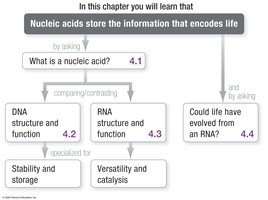
Nucleic acids are essential biomolecules that store and transmit genetic information in all living organisms. The two main types are deoxyribonucleic acid (DNA) and ribonucleic acid (RNA). The RNA world hypothesis suggests that early life may have relied on RNA for both information storage and catalytic functions before the evolution of DNA and proteins.
Learning Objectives
Analyze the characteristics of nucleotides and the bonds that link them in nucleic acids.
Differentiate between nucleotides in RNA and DNA.
Describe the structural levels of DNA and RNA and relate them to their functions.
Explain how RNA structure enables its functional versatility.
What is a Nucleic Acid?
Nucleotide Structure
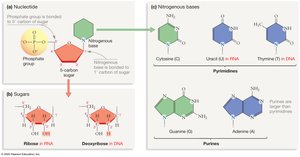
Nucleic acids are polymers of nucleotide monomers. Each nucleotide consists of three components:
Phosphate group
Five-carbon sugar (ribose in RNA, deoxyribose in DNA)
Nitrogenous base (purine or pyrimidine)
The phosphate group and nitrogenous base are both bonded to the sugar molecule.
Types of Nucleotides
Ribonucleotides (RNA): Contain ribose sugar with an –OH group at the 2′ carbon.
Deoxyribonucleotides (DNA): Contain deoxyribose sugar with an H at the 2′ carbon (lacking oxygen).
Nitrogenous bases are classified as:
Purines: Adenine (A), Guanine (G) – two rings, nine atoms.
Pyrimidines: Cytosine (C), Uracil (U, only in RNA), Thymine (T, only in DNA) – one ring, six atoms.
Polymerization of Nucleic Acids
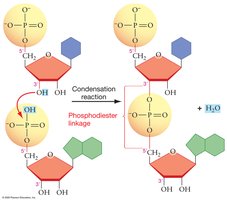
Nucleic acids are formed by condensation reactions that create phosphodiester linkages between the 5′ phosphate of one nucleotide and the 3′ hydroxyl of another.
Directionality of Nucleic Acid Strands
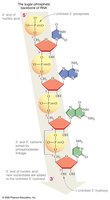
The sugar-phosphate backbone of nucleic acids is directional, running from the 5′ to 3′ end. The sequence of nitrogenous bases encodes genetic information, typically written from 5′ to 3′.
Energy for Polymerization
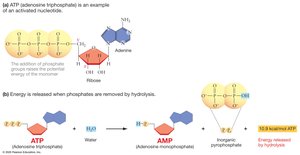
Polymerization of nucleic acids requires energy, which is provided by nucleoside triphosphates (e.g., ATP). Hydrolysis of the high-energy phosphate bonds releases energy, making the reaction spontaneous.
DNA Structure and Function
Primary, Secondary, and Tertiary Structure
Primary structure: Linear sequence of nucleotides.
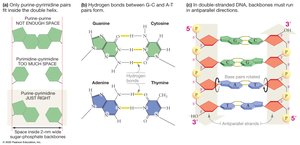
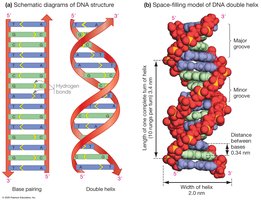
Secondary structure: Double helix formed by complementary base pairing (A-T, C-G) and antiparallel strands.
Tertiary structure: Further folding and supercoiling, including wrapping around histone proteins in eukaryotes.
Complementary Base Pairing and Double Helix
DNA strands are held together by hydrogen bonds between complementary bases: A pairs with T (two hydrogen bonds), and C pairs with G (three hydrogen bonds). The strands run antiparallel, forming a double helix with major and minor grooves.
DNA Replication
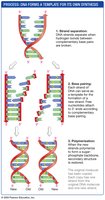
DNA replication involves three main steps:
Strand separation by breaking hydrogen bonds.
Base pairing with free deoxyribonucleotides to the template strand.
Formation of phosphodiester linkages to create new complementary strands.
This process ensures accurate copying of genetic information.
Stability and Function of DNA
The double helix is stabilized by phosphodiester bonds, hydrogen bonds, and hydrophobic interactions. This stability makes DNA an effective long-term information storage molecule, resistant to degradation.
RNA Structure and Function
Primary and Secondary Structure
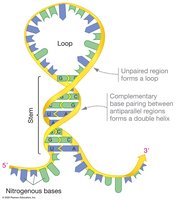
RNA is typically single-stranded and contains ribose and uracil. Its secondary structure arises from complementary base pairing (A-U, G-C) within the same strand, forming structures like hairpins.
Tertiary Structure and Functional Versatility
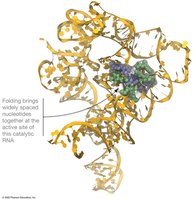
RNA can fold into complex three-dimensional shapes, allowing it to perform diverse functions, including catalysis (ribozymes), regulation, and information transfer (mRNA).
Comparison of DNA and RNA Structure
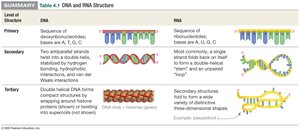
Level of Structure | DNA | RNA |
|---|---|---|
Primary | Sequence of deoxyribonucleotides; bases are A, T, G, C | Sequence of ribonucleotides; bases are A, U, G, C |
Secondary | Double helix stabilized by hydrogen bonds and base stacking | Most commonly, a single strand folds back on itself to form a double-helical "stem" and unpaired "loop" |
Tertiary | Double helical DNA forms compact structures by wrapping around histone proteins or supercoiling | Secondary structures fold to form a wide variety of distinctive three-dimensional shapes |
RNA as a Catalytic Molecule
Some RNA molecules, called ribozymes, have catalytic activity. Their three-dimensional structure forms active sites that catalyze specific biochemical reactions, such as peptide bond formation in ribosomes.
Summary
Nucleic acids are polymers of nucleotides, essential for genetic information storage and transfer.
DNA is highly stable and forms a double helix, making it ideal for long-term information storage.
RNA is structurally versatile, capable of catalysis and regulatory functions, supporting the RNA world hypothesis.
