 Back
Nucleic Acids: Structure, Function, and Gene Expression
Study Guide - Smart Notes
 Tailored notes based on your materials, expanded with key definitions, examples, and context.
CONCEPT 5.5: Nucleic Acids Store, Transmit, and Help Express Hereditary Information
The Roles of Nucleic Acids
Nucleic acids are essential biomolecules that store and transmit genetic information, enabling the expression of hereditary traits. The two main types are deoxyribonucleic acid (DNA) and ribonucleic acid (RNA).
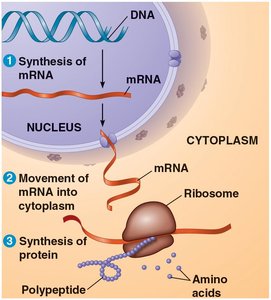
DNA provides instructions for its own replication and directs the synthesis of messenger RNA (mRNA).
RNA acts as an intermediary, carrying genetic instructions from DNA to the cell's protein-synthesizing machinery.
This process, known as gene expression, follows the central dogma: DNA → mRNA → Protein.
Genes, composed of DNA, program the amino acid sequence of polypeptides.
Example: The flow of genetic information from DNA to protein is fundamental to all living organisms.
Inheritance and Replication of DNA
Organisms inherit DNA from their parents, and each DNA molecule can carry hundreds or more genes. Before cell division, DNA is replicated, ensuring genetic continuity across generations.
DNA replication produces identical copies for daughter cells.
Each gene directs the synthesis of a specific mRNA, which is then translated into a protein.
Flow of Genetic Information
The central dogma of molecular biology describes the directional flow of genetic information:
Transcription: DNA is transcribed to mRNA in the nucleus (eukaryotes).
Translation: mRNA is translated into protein at ribosomes in the cytoplasm.
In prokaryotes, mRNA carries messages from DNA to ribosomes in the cytoplasm, as they lack a nucleus.
The Components of Nucleic Acids
Nucleic Acids and Their Structure
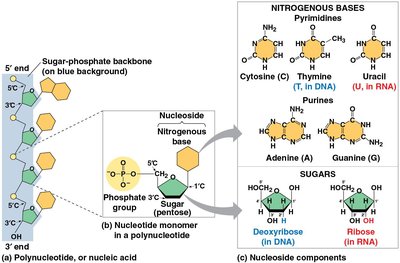
Nucleic acids are polymers called polynucleotides, made up of monomers known as nucleotides.
Each nucleotide consists of a nitrogenous base, a pentose sugar (5-carbon sugar), and one or more phosphate groups.
A nucleoside is a nitrogenous base plus a sugar (no phosphate).
A nucleotide is a nucleoside plus a phosphate group.
Nitrogenous Bases
Nitrogenous bases are classified into two groups:
Pyrimidines (single 6-membered ring): Cytosine (C), Thymine (T, DNA only), Uracil (U, RNA only)
Purines (6-membered ring fused to a 5-membered ring): Adenine (A), Guanine (G)
Pentose Sugars
Ribose is found in RNA.
Deoxyribose is found in DNA and lacks an oxygen atom at the 2′ carbon.
Carbons in the sugar are labeled with a prime (′) to distinguish them from atoms in the base.
Nucleotide Polymers and Phosphodiester Linkages
Nucleotides are linked by phosphodiester linkages, forming a sugar-phosphate backbone with nitrogenous bases as appendages.
A phosphodiester linkage is a covalent bond between the phosphate group of one nucleotide and the 3′ carbon of another nucleotide's sugar.
The backbone provides structural stability, while the sequence of bases encodes genetic information.
Directionality of Nucleic Acid Strands
5′ end: Phosphate group attached to the 5′ carbon.
3′ end: Hydroxyl group attached to the 3′ carbon.
Base Sequence and Genetic Information
The linear order of nitrogenous bases specifies the order of amino acids in a protein, determining its structure and function.
The Structures of DNA and RNA Molecules
Structure of the DNA Molecule
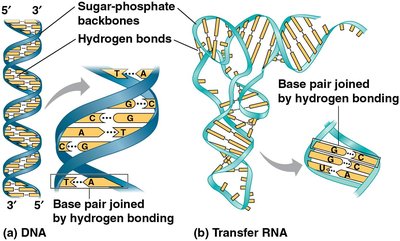
DNA consists of two polynucleotide strands that spiral around an axis, forming a double helix. The sugar-phosphate backbones are on the outside, and the strands run antiparallel (5′ → 3′ and 3′ → 5′).
Complementary Base Pairing and Hydrogen Bonds
Hydrogen bonds hold the two DNA strands together.
Adenine (A) pairs with Thymine (T).
Guanine (G) pairs with Cytosine (C).
Base pairing rules allow prediction of the complementary strand.
DNA Replication
Each strand serves as a template for a new complementary strand.
Replication produces two identical DNA molecules, ensuring genetic continuity.
RNA Structure Overview
RNA is typically single-stranded, allowing it to fold into complex 3D shapes.
Complementary base pairing can occur between different RNA molecules or within the same molecule (e.g., tRNA).
In RNA, Adenine (A) pairs with Uracil (U); Thymine (T) is absent.
Example: Transfer RNA (tRNA)
tRNA brings amino acids to the ribosome during protein synthesis.
Its functional shape is formed by internal base pairing, creating antiparallel regions and a 3D structure.
DNA vs. RNA: Structural Differences
Feature | DNA | RNA |
|---|---|---|
Strandedness | Double-stranded | Single-stranded |
Helix Structure | Double helix | Variable shapes |
Sugar | Deoxyribose | Ribose |
Base Pairing | A-T, G-C | A-U, G-C |
Presence of Thymine | Yes | No (Uracil instead) |
Sample Exam Questions
In which pair does the first molecule determine the structure of the second?
a. DNA, protein
b. RNA, carbohydrate
c. Lipid, DNA
d. DNA, RNA
e. a and d
Which of the following options best depicts the flow of information when a gene directs the synthesis of a cellular component?
a. RNA to DNA to RNA to protein
b. DNA to amino acid to RNA to protein
c. DNA to RNA to protein
d. protein to RNA to DNA
How does RNA differ from DNA?
a) DNA encodes hereditary information; RNA does not.
b) DNA contains deoxyribose sugar; RNA contains ribose sugar.
c) DNA contains thymine; RNA contains uracil.
d) DNA forms duplexes; RNA does not
e) b and c
f) a and d
A region along one DNA strand has this sequence of nitrogenous bases: 5′-TAGGCCT-3′. What will be its complementary strand?
a) 3′-ATCCGGA-5′
b) 3'-AGGCCTA-5′
c) 5′-ATCCGGA-3′
d) 5′-CGTTAAC-3′
Nucleic acids are chains of 5-carbon sugars linked by ____ bonds with an organic base protruding from each sugar.
a) Amino
b) Phosphodiester
c) Carboxyl
d) Phosphate
If you swapped a methyl group for every phosphate group in a DNA molecule,
a) the molecule would fall apart.
b) no significant change would occur.
c) the DNA would become RNA.
d) none of the above would occur.
Double helix describes the structure of a molecule of
a) protein
b) disaccharide
c) starch
d) monosaccharide
e) DNA
The two strands of a DNA double helix are held together by:
a) ionic bonds.
b) hydrogen bonds.
c) nonpolar covalent bonds.
d) polar covalent bonds.
e) hydrophobic exclusions.
Key Equations and Concepts
Phosphodiester linkage:
Central Dogma:
Additional info: The notes expand on the original content by providing definitions, examples, and a comparison table for DNA and RNA, ensuring completeness and academic quality for exam preparation.
