 Back
BackBio 100 LEC Chapter 5 Part 3 UPDATED
Study Guide - Smart Notes
 Tailored notes based on your materials, expanded with key definitions, examples, and context.
Bio 100 LEC Chapter 5 Part 3
The Structure and Function of Large Biological Molecules
Introduction to Nucleic Acids
Nucleic acids are one of the four major classes of large biological molecules essential for life. They play a central role in storing, transmitting, and expressing hereditary information. The two main types of nucleic acids are deoxyribonucleic acid (DNA) and ribonucleic acid (RNA).
Gene: A unit of inheritance that programs the amino acid sequence of a polypeptide.
Nucleic acid: A polymer made of monomers called nucleotides.
Genes consist of DNA, which is a type of nucleic acid.
Nucleic acids are composed of two major types: DNA and RNA.
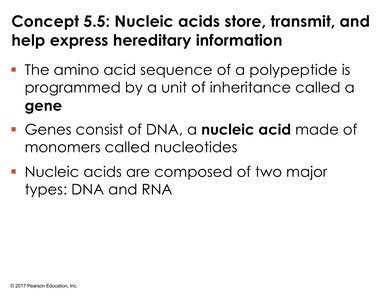
The Central Dogma of Molecular Biology
The flow of genetic information in cells follows the central dogma: DNA → RNA → Protein. This process involves two main steps: transcription and translation.
Transcription: The synthesis of messenger RNA (mRNA) from a DNA template in the nucleus.
Translation: The synthesis of a polypeptide (protein) at the ribosome, using the information carried by mRNA.
mRNA carries genetic instructions from DNA in the nucleus to ribosomes in the cytoplasm, where proteins are synthesized.
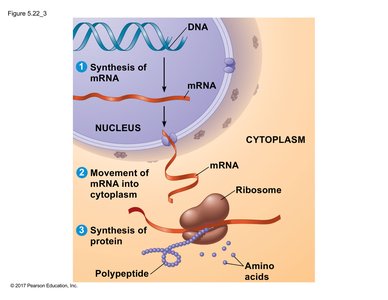
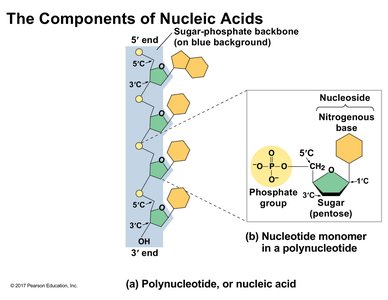
Structure of Nucleic Acids
Nucleotide Structure
Nucleic acids are polymers called polynucleotides, made up of monomers called nucleotides. Each nucleotide consists of three components:
Nitrogenous base
Pentose sugar (five-carbon sugar)
Phosphate group
A nucleoside consists of only the nitrogenous base and the sugar, without the phosphate group.
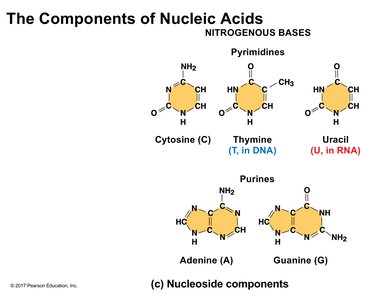
Nitrogenous Bases
Nitrogenous bases are categorized into two families:
Pyrimidines: Single six-membered ring. Includes cytosine (C), thymine (T, in DNA), and uracil (U, in RNA).
Purines: Double ring structure (six-membered fused to a five-membered ring). Includes adenine (A) and guanine (G).
Thymine is found only in DNA, while uracil is found only in RNA. Cytosine, adenine, and guanine are found in both DNA and RNA.
Pentose Sugars
The sugar component of a nucleotide distinguishes DNA from RNA:
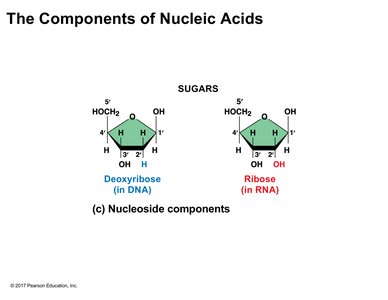
Deoxyribose: Found in DNA; lacks an oxygen atom at the 2' carbon (has a hydrogen instead).
Ribose: Found in RNA; has a hydroxyl group at the 2' carbon.
ATP: An Example of a Nucleotide
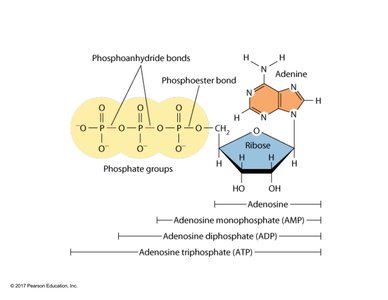
Adenosine triphosphate (ATP) is a nucleotide that serves as the primary energy currency of the cell. It consists of the nitrogenous base adenine, a ribose sugar, and three phosphate groups. The bonds between the phosphate groups (phosphoanhydride bonds) store significant energy, especially the outermost bonds.
Adenosine: Adenine + ribose (a nucleoside)
AMP, ADP, ATP: Adenosine with one, two, or three phosphate groups, respectively
Phosphoester bond links the first phosphate to the sugar; phosphoanhydride bonds link additional phosphates.
Formation of Polynucleotides
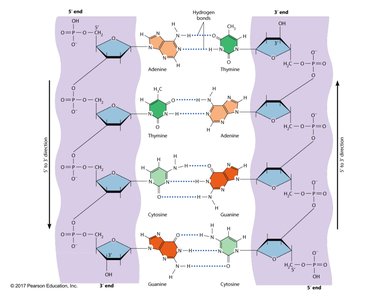
Nucleotides are joined together by phosphodiester linkages to form the backbone of nucleic acids. This linkage connects the 5' carbon of one nucleotide's sugar to the 3' carbon of the next, creating a sugar-phosphate backbone with directionality (5' to 3'). The sequence of nitrogenous bases encodes genetic information.
DNA Structure and Base Pairing
Double Helix and Complementary Base Pairing
DNA typically exists as a double-stranded helix, with two polynucleotide strands running in opposite (antiparallel) directions. The strands are held together by hydrogen bonds between complementary nitrogenous bases:
Adenine (A) pairs with thymine (T) via two hydrogen bonds.
Guanine (G) pairs with cytosine (C) via three hydrogen bonds.
The sugar-phosphate backbone is hydrophilic and faces outward, while the nitrogenous bases are hydrophobic and stack inside the helix.
Comparison of DNA and RNA
DNA and RNA differ in structure and function:
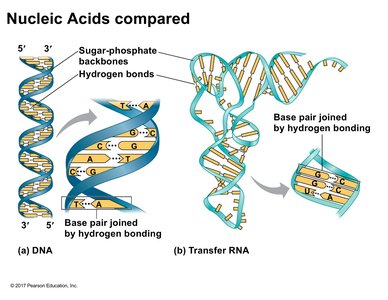
DNA: Usually double-stranded, with antiparallel strands and complementary base pairing (A-T, G-C).
RNA: Usually single-stranded, but can form regions of complementary base pairing (e.g., in tRNA). Uses uracil (U) instead of thymine (T).
Some viruses have double-stranded RNA genomes.
Summary Table: Key Differences Between DNA and RNA
Feature | DNA | RNA |
|---|---|---|
Strands | Double-stranded (usually) | Single-stranded (usually) |
Sugar | Deoxyribose | Ribose |
Nitrogenous Bases | A, T, C, G | A, U, C, G |
Location | Nucleus (mainly) | Nucleus and cytoplasm |
Function | Genetic information storage | Protein synthesis, gene regulation, catalysis (some types) |
