 Back
BackNucleic Acids: Structure, Function, and Quantitative Analysis
Study Guide - Smart Notes
 Tailored notes based on your materials, expanded with key definitions, examples, and context.
Nucleic Acids: DNA and RNA
Structure and Types of Nucleic Acids
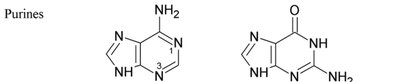
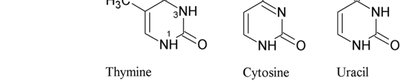
Nucleic acids are essential biomolecules responsible for the storage, transmission, and expression of genetic information. The two primary types are DNA (deoxyribonucleic acid) and RNA (ribonucleic acid). DNA is typically double-stranded and contains the bases adenine (A), guanine (G), cytosine (C), and thymine (T), while RNA is single-stranded and contains adenine (A), guanine (G), cytosine (C), and uracil (U).
DNA: Double-stranded, contains deoxyribose sugar, bases A, G, C, T.
RNA: Single-stranded, contains ribose sugar, bases A, G, C, U.
Types of RNA: mRNA (messenger), tRNA (transfer), rRNA (ribosomal).
Nucleotides and Nucleosides
Nucleic acids are polymers of nucleotides. Each nucleotide consists of a phosphate group, a pentose sugar (ribose or deoxyribose), and a nitrogenous base.
Nucleotide: Nitrogenous base + sugar + phosphate group
Nucleoside: Nitrogenous base + sugar
Examples: AMP (adenosine monophosphate), ATP (adenosine triphosphate)
Base Pairing and Hydrogen Bonds
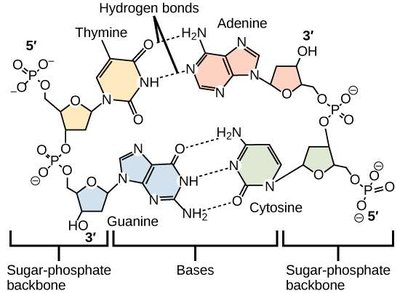
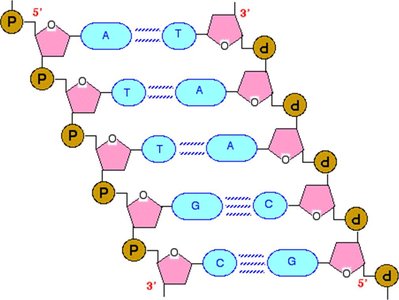
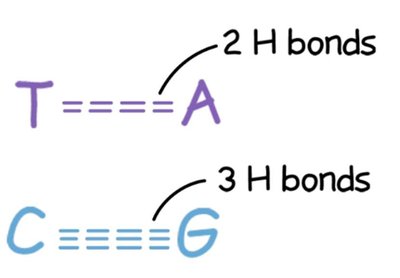
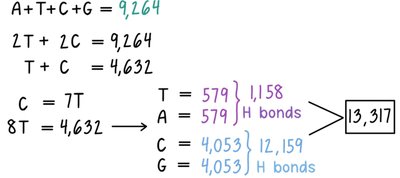
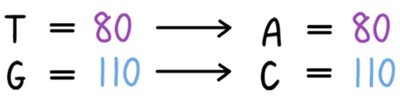
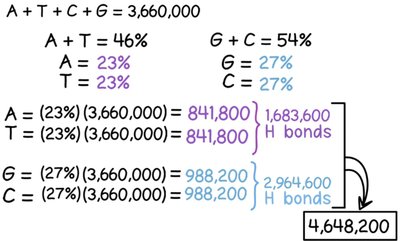
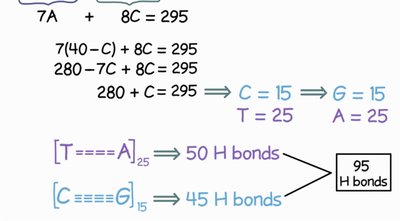
The double helix structure of DNA is stabilized by hydrogen bonds between complementary bases: A pairs with T via two hydrogen bonds, and G pairs with C via three hydrogen bonds. This specificity allows for accurate replication and transcription.
A-T: 2 hydrogen bonds
G-C: 3 hydrogen bonds
Complementary Strands and Sequence Determination
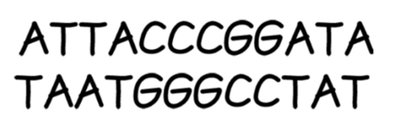
Knowing the sequence of one DNA strand allows determination of the complementary strand due to base pairing rules.
Example: If one strand is ATTACCGGGATA, the complementary strand is TAATGGGCCCTAT.
Central Dogma of Molecular Biology
Information Flow: DNA → RNA → Protein
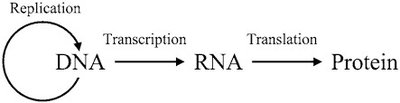
The central dogma describes the flow of genetic information: DNA is replicated, transcribed into RNA, and translated into protein.
Replication: DNA makes copies of itself.
Transcription: DNA is used as a template to synthesize RNA.
Translation: RNA directs the synthesis of proteins.
Quantitative Analysis of DNA and RNA
Calculating Nitrogen Atoms and Hydrogen Bonds
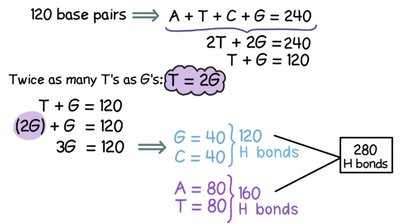
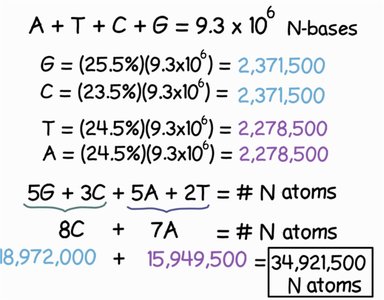
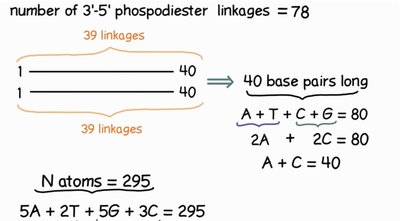
The number of nitrogen atoms in a DNA fragment can be calculated based on the number and type of bases present. Each base contains a specific number of nitrogen atoms:
Adenine (A): 5 N atoms
Thymine (T): 2 N atoms
Cytosine (C): 3 N atoms
Guanine (G): 5 N atoms
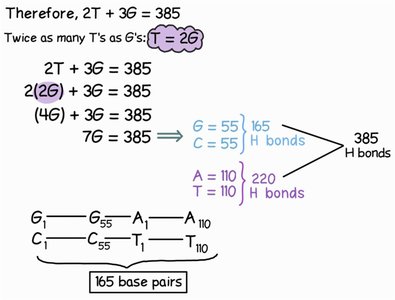
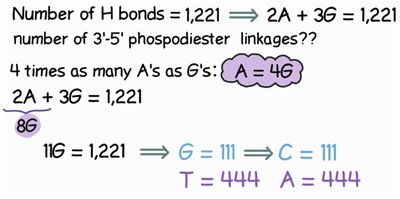
The total number of hydrogen bonds is determined by the number of A-T and G-C pairs. 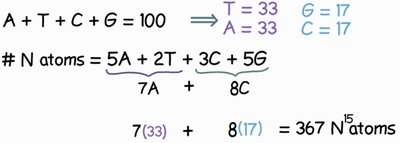


Phosphodiester Linkages
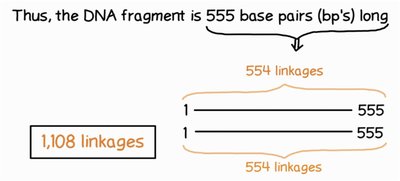
The backbone of nucleic acids is formed by phosphodiester bonds between the 3' and 5' carbons of adjacent sugars. The number of linkages is one less than the number of nucleotides in a strand.
For a double-stranded DNA fragment with n base pairs, each strand has (n-1) linkages.
Total linkages = 2(n-1) for double-stranded DNA.
Nucleotides Identification and Existence
Recognizing Nucleotide Structures
Nucleotides are identified by their base, sugar, and phosphate group. Not all possible combinations exist in nature; for example, thymidine nucleotides are found only in DNA, and uridine nucleotides only in RNA. 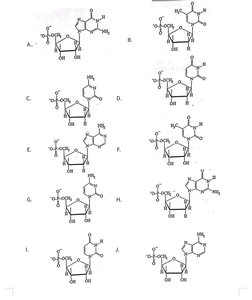
Summary Table: Nucleosides and Nucleotides
Comparison of DNA and RNA Nucleotides
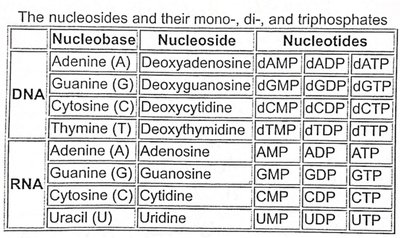
Nucleobase | Nucleoside | Nucleotides |
|---|---|---|
Adenine (A) | Deoxyadenosine (DNA), Adenosine (RNA) | dAMP, dADP, dATP (DNA); AMP, ADP, ATP (RNA) |
Guanine (G) | Deoxyguanosine (DNA), Guanosine (RNA) | dGMP, dGDP, dGTP (DNA); GMP, GDP, GTP (RNA) |
Cytosine (C) | Deoxycytidine (DNA), Cytidine (RNA) | dCMP, dCDP, dCTP (DNA); CMP, CDP, CTP (RNA) |
Thymine (T) | Deoxythymidine (DNA) | dTMP, dTDP, dTTP (DNA) |
Uracil (U) | Uridine (RNA) | UMP, UDP, UTP (RNA) |
Key Equations
Calculating Nitrogen Atoms
For a DNA fragment:
For a labeled fragment: Multiply by the number of N-15 atoms for additional neutrons.
Calculating Hydrogen Bonds
For a DNA fragment:
Calculating Phosphodiester Linkages
For n base pairs: linkages in double-stranded DNA
Conclusion
Understanding the structure and quantitative relationships in nucleic acids is fundamental to molecular biology. These concepts underpin genetic inheritance, replication, and expression, and are essential for advanced study in biochemistry and genetics. Review the provided diagrams and calculations for mastery of these topics.
