 Back
BackOrca Speciation: Applying Species Concepts
Study Guide - Smart Notes
 Tailored notes based on your materials, expanded with key definitions, examples, and context.
Q1. For each of the following species concepts, use the facts on the prior pages to form an argument for or against the speciation of orcas. For each, explain briefly.
Background
Topic: Species Concepts and Speciation
This question is testing your understanding of how different species concepts (biological, ecological, morphological, phylogenetic) are applied to real-world cases, specifically the orca ecotypes, and how evidence from behavior, genetics, morphology, and ecology can support or refute speciation.
Key Terms:
Biological Species Concept: Defines species based on ability to interbreed and produce viable offspring.
Ecological Species Concept: Defines species based on their ecological niche and adaptations.
Morphological Species Concept: Defines species based on physical characteristics.
Phylogenetic Species Concept: Defines species based on evolutionary history and genetic data.
Step-by-Step Guidance
Start by summarizing the main evidence for each concept from the provided materials. For the biological species concept, consider reproductive isolation, gene flow, and hybrid viability.
For the ecological species concept, examine differences in diet, habitat use, and behavior among ecotypes. Think about how these differences might lead to niche separation.
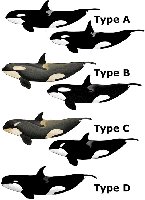
For the morphological species concept, review the physical differences between ecotypes, such as body size, coloration, and jaw structure. Use the provided descriptions and images to identify key traits.
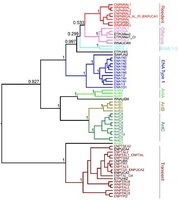
For the phylogenetic species concept, analyze the genetic data and phylogenetic tree. Look for evidence of long-term divergence and unique genetic lineages among ecotypes.
Formulate an argument for or against speciation for each concept, using the evidence you have gathered. Be sure to explain your reasoning clearly for each concept.
Try solving on your own before revealing the answer!
Final Answer:
Biological species concept: Evidence suggests partial reproductive isolation, but rare gene flow and viable hybrids indicate incomplete speciation.
Ecological species concept: Distinct ecological niches and behaviors support the argument for speciation.
Morphological species concept: Significant physical differences among ecotypes support speciation.
Phylogenetic species concept: Genetic divergence and unique lineages support the existence of multiple species.
Each concept provides different levels of support for orca speciation, with the phylogenetic and ecological concepts offering the strongest evidence.
Q2. Considering your answers above, do orca whale ecotypes represent a single species or more than one species? Which species definition did your group decide was most useful in drawing this conclusion? Why?
Background
Topic: Integrating Species Concepts
This question asks you to synthesize your arguments from the previous question and decide which species concept is most useful for classifying orca ecotypes.
Key Terms:
Ecotype: A population adapted to a specific environment or niche.
Species Definition: The criteria used to delineate species boundaries.
Step-by-Step Guidance
Review your arguments for and against speciation from each concept.
Compare the strengths and weaknesses of each concept in the context of orca ecotypes.
Discuss which concept provides the most comprehensive or practical framework for classifying orca ecotypes.
Consider the implications of your choice for conservation and research.
Try solving on your own before revealing the answer!
Final Answer:
Orca ecotypes likely represent more than one species, with the phylogenetic and ecological species concepts being most useful for drawing this conclusion. These concepts account for genetic divergence and ecological specialization, which are strongly supported by the evidence.
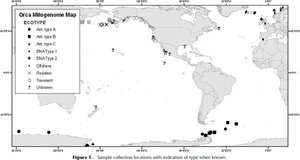
Q3. One of the expert handouts above contains a phylogenetic tree for orcas that was created with mitochondrial DNA sequences. Below is a map showing the locations where these samples were obtained from orcas. Write the name of each orca ecotype (from the phylogenetic tree) on the map where these populations occur.
Background
Topic: Phylogeography and Ecotype Distribution
This question tests your ability to interpret phylogenetic and geographic data to identify the distribution of orca ecotypes.
Key Terms:
Phylogenetic Tree: Diagram showing evolutionary relationships.
Ecotype Distribution: Geographic locations where each ecotype is found.
Step-by-Step Guidance
Examine the phylogenetic tree and identify the ecotypes listed.
Look at the map and match the symbols to the ecotypes using the legend.
Write the name of each ecotype in the corresponding geographic region on the map.
Check for overlap or unique distributions among ecotypes.
Try solving on your own before revealing the answer!
Final Answer:
Ecotype names should be placed in the regions indicated by the map legend: Antarctic types A, B, C, and D in the Southern Ocean; Resident, Transient, and Offshore in the North Pacific; other ecotypes in their respective locations as shown by the map symbols.
Q4. Describe the general pattern between geographic location and phylogenetic relatedness. Use a specific example. Explain what might be driving this relationship.
Background
Topic: Phylogeography and Evolution
This question asks you to analyze the relationship between geographic distribution and genetic divergence among orca ecotypes.
Key Terms:
Phylogenetic Relatedness: Degree of evolutionary similarity.
Geographic Isolation: Physical separation leading to divergence.
Step-by-Step Guidance
Review the phylogenetic tree and map to identify patterns of relatedness and distribution.
Choose a specific example (e.g., North Pacific Transients vs. Residents) and describe their geographic and genetic separation.
Discuss possible drivers of this relationship, such as ecological specialization or geographic barriers.
Try solving on your own before revealing the answer!
Final Answer:
There is a strong correlation between geographic location and phylogenetic relatedness; ecotypes in different regions show greater genetic divergence. For example, North Pacific Transients are genetically distinct from Residents and Offshores, likely due to long-term geographic and ecological isolation.
Q5. In the Pacific Northwest, three ecotypes coexist. If these ecotypes are gradually diverging, what might be driving this? Explain.
Background
Topic: Speciation Drivers
This question tests your understanding of the mechanisms that drive speciation, such as ecological specialization and behavioral isolation.
Key Terms:
Ecological Specialization: Adaptation to specific diets or habitats.
Behavioral Isolation: Differences in communication or mating rituals.
Step-by-Step Guidance
Identify the three ecotypes in the Pacific Northwest (Resident, Transient, Offshore).
Discuss differences in diet, behavior, and social structure among these ecotypes.
Explain how these differences could lead to reproductive isolation and divergence.
Try solving on your own before revealing the answer!
Final Answer:
Divergence is likely driven by ecological specialization (different diets and hunting strategies) and behavioral isolation (distinct vocalizations and social structures), which reduce gene flow and promote speciation.
Q6. In those same three Pacific Northwest ecotypes, one is more distantly related than the other two. Which is it, and what might explain this observation?
Background
Topic: Genetic Divergence
This question asks you to interpret phylogenetic data to identify the most divergent ecotype and explain possible reasons.
Key Terms:
Divergence: Genetic separation over time.
Ecotype: Distinct population adapted to a specific niche.
Step-by-Step Guidance
Examine the phylogenetic tree to identify which ecotype is most distantly related.
Consider ecological and behavioral differences that might explain this divergence.
Discuss possible historical or geographic factors contributing to the separation.
Try solving on your own before revealing the answer!
Final Answer:
The Transient ecotype is most distantly related, likely due to long-term ecological and behavioral isolation from Residents and Offshores, as well as historical separation.
Q7. According to the phylogeny, which population shares a most recent common ancestor with the offshore and resident whales? Explain how this might be possible (hint: look up the Northwest Passage).
Background
Topic: Phylogenetic Relationships and Biogeography
This question tests your ability to interpret phylogenetic trees and understand biogeographic connections.
Key Terms:
Common Ancestor: The most recent shared ancestor between populations.
Northwest Passage: Arctic route connecting Pacific and Atlantic Oceans.
Step-by-Step Guidance
Identify the populations on the phylogenetic tree that are closely related to Offshore and Resident whales.
Consider geographic routes, such as the Northwest Passage, that could facilitate gene flow.
Explain how historical migration or environmental changes might have enabled this relationship.
Try solving on your own before revealing the answer!
Final Answer:
The Eastern North Atlantic population shares a most recent common ancestor with Offshore and Resident whales, possibly due to historical migration through the Northwest Passage connecting the Pacific and Atlantic.
Q8. If these orcas are indeed speciating, make an educated guess which ecotypes will become independent species. Explain your reasoning.
Background
Topic: Predicting Speciation
This question asks you to use evidence from genetics, ecology, and morphology to predict which ecotypes are most likely to become independent species.
Key Terms:
Speciation: The process by which new species arise.
Ecotype Divergence: Separation of populations based on adaptation.
Step-by-Step Guidance
Review evidence for reproductive isolation, genetic divergence, and ecological specialization among ecotypes.
Identify which ecotypes show the greatest differences and least gene flow.
Make a reasoned prediction based on the data.
Try solving on your own before revealing the answer!
Final Answer:
Antarctic B and C, and North Pacific Transients are most likely to become independent species due to strong genetic, ecological, and morphological divergence.
Q9. Is the divergence of these orcas more similar to what happened to Darwin’s finches on the Galapagos, or to what happened to squirrels that were divided by the Grand Canyon? Explain your reasoning.
Background
Topic: Modes of Speciation
This question tests your understanding of sympatric vs. allopatric speciation and asks you to compare orca divergence to classic examples.
Key Terms:
Sympatric Speciation: Speciation occurring within the same geographic area.
Allopatric Speciation: Speciation due to geographic separation.
Step-by-Step Guidance
Review the evidence for geographic overlap or separation among orca ecotypes.
Compare the orca case to Darwin’s finches (sympatric) and Grand Canyon squirrels (allopatric).
Explain which mode of speciation best fits the orca case and why.
Try solving on your own before revealing the answer!
Final Answer:
Orca divergence is more similar to Darwin’s finches, as ecotypes coexist in the same geographic area but diverge due to ecological and behavioral specialization (sympatric speciation).
Q10. Watch this video: Searching for Type D: A New Species of Killer Whale. Where on the map above would you draw in the location for Type D orcas? And which ecotypes do you think it will most likely share a common ancestor with?
Background
Topic: Mapping Ecotype Distribution and Phylogenetic Relationships
This question asks you to use information from the video and map to identify the location and likely relatives of Type D orcas.
Key Terms:
Type D Orcas: A distinct ecotype found in the Southern Ocean.
Common Ancestor: The most recent shared ancestor between ecotypes.
Step-by-Step Guidance
Locate the Southern Ocean region on the map for Type D orcas.
Review the phylogenetic tree to identify which ecotypes are closely related to Type D.
Explain your reasoning based on geographic and genetic evidence.
Try solving on your own before revealing the answer!
Final Answer:
Type D orcas are found in the Southern Ocean, near the Kerguelen and Crozet Islands. They most likely share a common ancestor with Antarctic types B and C.
Q11. Why is it important to determine whether this is a separate species of orca?
Background
Topic: Conservation and Species Classification
This question tests your understanding of the implications of species classification for conservation, research, and management.
Key Terms:
Conservation Value: Importance of preserving distinct species.
Species Status: Legal and scientific recognition of species boundaries.
Step-by-Step Guidance
Consider how species classification affects conservation priorities and legal protections.
Discuss the importance of recognizing genetic, ecological, and behavioral diversity.
Explain how accurate classification can guide research and management strategies.
Try solving on your own before revealing the answer!
Final Answer:
Determining species status is crucial for conservation, as it ensures protection of unique genetic lineages and ecological adaptations, and guides effective management and research efforts.
Q12. Results from the Type D research were published in 2023. Find the abstract of the research article (hint: it was published in the Journal of Heredity and the lead author is Dr. Andrew D. Foote). Carefully read the abstract of the article. There will be many unfamiliar terms, some of which I have defined below, but some you may have to look up yourself so that you can understand the research. Once you are comfortable with the terminology in the abstract, answer the following questions in your own words. Do NOT copy from the abstract (or from AI!).
Background
Topic: Scientific Research and Interpretation
This question tests your ability to interpret scientific abstracts and apply terminology to summarize findings and limitations.
Key Terms:
Recombination cross-over events: Exchange of chromosome segments during meiosis.
Haplotypes: Linked genes inherited together.
Covariance: Similarity in allele frequencies across genomes.
Identity-by-state of alleles: Genetic similarity between alleles from different individuals.
Nonindependence: Samples from closely related individuals.
Recent coalescence time: Recent common ancestor for genetic variation.
Non equilibrium population history: Population not at Hardy-Weinberg equilibrium.
Long-range linkage disequilibrium: Linked alleles across long chromosome regions.
Extensive runs of homozygosity: Long regions of identical alleles from both parents.
Step-by-Step Guidance
Read the abstract carefully and identify the source and sample size for Type D orca research.
Summarize the main findings, focusing on genetic diversity, population history, and evolutionary relationships.
Identify the evidence used to support the conclusions, such as genetic analyses and comparisons.
Discuss the main shortcomings of the study, such as sample size or nonindependence.
Determine whether the authors draw conclusions about evolutionary relationships with other ecotypes, and summarize or explain why not.
Try solving on your own before revealing the answer!
Final Answer:
a) Samples were obtained from museum specimens and modern individuals; sample size was limited.
b) Main findings included low genetic diversity, evidence of inbreeding, and recent population bottlenecks.
c) Conclusions were based on genetic analyses, including haplotype structure and runs of homozygosity.
d) Main shortcomings were small sample size and nonindependence of samples.
e) The authors did not draw strong conclusions about evolutionary relationships with other ecotypes, likely due to limited data and sample size.
