 Back
Organic Compounds and Macromolecules: Structure, Function, and Key Terms
Study Guide - Smart Notes
 Tailored notes based on your materials, expanded with key definitions, examples, and context.
Organic Compounds & Macromolecules
Introduction to Organic Molecules
Organic molecules are the foundation of all living organisms, primarily composed of carbon atoms bonded with hydrogen, oxygen, nitrogen, and other elements. These molecules form the basis of carbohydrates, lipids, proteins, and nucleic acids, each with unique structures and functions essential for life.
Organic compound: Any chemical compound containing carbon, typically found in living systems.
Macromolecule: Large, complex molecules with high molecular weight, such as proteins, nucleic acids, carbohydrates, and lipids.
Monomer: A small molecular subunit that can join with others to form polymers.
Polymer: A large molecule composed of repeating monomer units.
Dehydration synthesis: A chemical reaction that joins monomers by removing a molecule of water.
Hydrolysis: A chemical reaction that breaks polymers into monomers by adding water.
Carbohydrates
Structure and Types of Carbohydrates
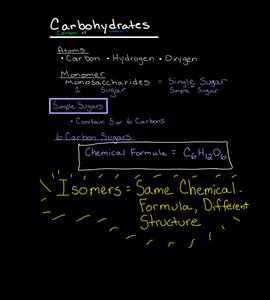
Carbohydrates are organic molecules composed of carbon, hydrogen, and oxygen, typically in a 1:2:1 ratio. They serve as energy sources and structural components in cells. The simplest carbohydrates are monosaccharides, which can combine to form more complex sugars.
Monosaccharide: The simplest form of carbohydrate (single sugar unit), e.g., glucose.
Disaccharide: Two monosaccharides joined together, e.g., sucrose.
Polysaccharide: Long chains of monosaccharide units, e.g., starch, glycogen, cellulose, chitin.
Isomer: Compounds with the same chemical formula but different structural arrangements.
Example: Glucose and fructose are isomers with the formula .
Pentose Sugars and Dehydration Synthesis
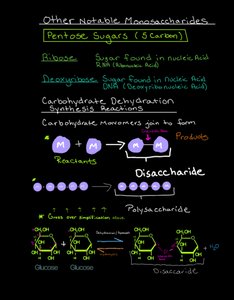
Pentose sugars, such as ribose and deoxyribose, are important components of nucleic acids. Carbohydrate monomers join via dehydration synthesis to form disaccharides and polysaccharides, releasing water as a byproduct.
Ribose: A five-carbon sugar found in RNA.
Deoxyribose: A five-carbon sugar found in DNA.
Dehydration synthesis: Joins two monosaccharides, forming a glycosidic bond and releasing water.
Lipids
Structure and Types of Lipids
Lipids are hydrophobic molecules that include fats, oils, phospholipids, and steroids. They are important for energy storage, membrane structure, and signaling. Lipids are not true polymers but are formed from smaller molecules through dehydration reactions.
Fatty acid: Long hydrocarbon chain with a carboxyl group at one end.
Glycerol: A three-carbon alcohol that forms the backbone of triglycerides.
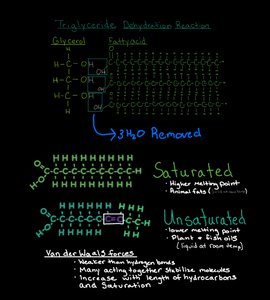
Triglyceride: Formed by joining three fatty acids to glycerol via dehydration synthesis.
Saturated fatty acid: Contains no double bonds; solid at room temperature (e.g., animal fats).
Unsaturated fatty acid: Contains one or more double bonds; liquid at room temperature (e.g., plant oils).
Phospholipid: Major component of cell membranes, with hydrophilic head and hydrophobic tails.
Steroid: Lipid with four fused carbon rings, e.g., cholesterol.
Example: Triglyceride formation involves the removal of three water molecules (dehydration synthesis).
Proteins & Nucleic Acids
Key Terms and Concepts
Proteins and nucleic acids are essential macromolecules with diverse functions. Proteins are polymers of amino acids, while nucleic acids (DNA and RNA) are polymers of nucleotides.
Amino acid: Building block of proteins, containing an amino group, carboxyl group, and side chain (R group).
Peptide bond: Covalent bond linking amino acids in a protein.
Primary/Secondary/Tertiary structure: Levels of protein structure, from amino acid sequence to 3D folding.
Nucleotide: Building block of nucleic acids, composed of a sugar, phosphate group, and nitrogenous base.
DNA/RNA: Types of nucleic acids responsible for genetic information storage and transfer.
Additional info: Understanding the structure and function of these macromolecules is essential for topics such as gene expression, metabolism, and cell structure.
Summary Table: Key Terms in Organic Compounds & Macromolecules
General | Carbohydrates | Lipids | Proteins & Nucleic Acids |
|---|---|---|---|
Organic compound Macromolecule Monomer Polymer Dehydration synthesis Hydrolysis | Monosaccharide Disaccharide Polysaccharide Starch Glycogen Cellulose Chitin | Fatty acid Glycerol Triglyceride Phospholipid Saturated/unsaturated Steroid Wax | Amino acid Peptide bond Enzyme Primary/Secondary/Tertiary structure Nucleotide DNA/RNA |
Note: You are expected to use these terms correctly in explanations and reasoning, not just memorize their definitions.
