Back
BackOrganic Macromolecules: Structure, Function, and Biological Importance
Study Guide - Smart Notes
 Tailored notes based on your materials, expanded with key definitions, examples, and context.
Organic Macromolecules
Overview of Organic Macromolecules
Organic macromolecules are large, complex molecules essential for life, composed primarily of carbon, hydrogen, oxygen, and nitrogen. These molecules form the basis of cellular structure and function, and include carbohydrates, lipids, proteins, and nucleic acids.
Key Elements: Carbon (C), Hydrogen (H), Oxygen (O), Nitrogen (N) make up 96.3% of the human body due to their versatile bonding properties and ability to form stable, complex molecules.
Major Classes: Carbohydrates, Lipids, Proteins, Nucleic Acids
Organic Compounds: Defined by the presence of both carbon and hydrogen atoms.
Carbon: The Foundation of Organic Chemistry
Carbon’s Bonding Properties and Versatility
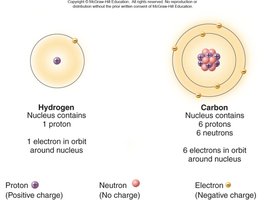
Carbon’s electron configuration allows it to form four covalent bonds, enabling the construction of a vast array of molecular structures. This versatility is fundamental to the diversity of organic molecules.
Electron Configuration: Carbon has four electrons in its valence shell, allowing for four bonds.
Bonding: Can bond with other carbons, hydrogen, oxygen, nitrogen, and more.
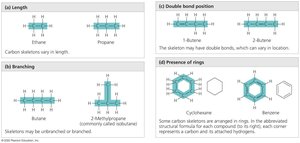
Structural Diversity: Carbon skeletons can vary in length, branching, double bond position, and ring formation.
Isomers: Structural Diversity in Organic Molecules
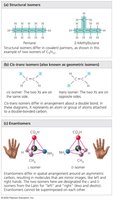
Isomers are compounds with the same chemical formula but different structures, leading to distinct properties and biological functions.
Structural Isomers: Differ in covalent arrangement of atoms.
Cis-Trans Isomers: Differ in spatial arrangement around double bonds.
Enantiomers: Mirror images, not superimposable, often with different biological activities.
Functional Groups in Organic Compounds
Chemical groups attached to carbon skeletons confer specific chemical properties and reactivity to organic molecules. Functional groups are critical in determining the behavior of biomolecules.
Hydroxyl (-OH): Alcohols, polar
Carboxyl (-COOH): Acids, can donate H+
Amino (-NH2): Bases, can accept H+
Phosphate (-PO4): Energy transfer, acidic
Methyl (-CH3): Hydrophobic, affects gene expression
Polymers and Monomers
Polymerization: Building Biological Macromolecules
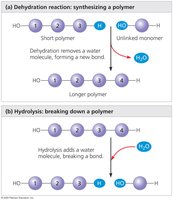
Many organic macromolecules are polymers, constructed from repeating monomer units. The formation and breakdown of polymers are essential biochemical processes.
Polymer: Large molecule made of many similar or identical monomers.
Monomer: The building block of a polymer.
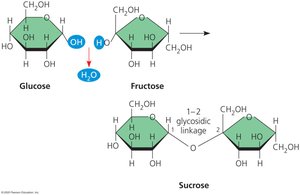
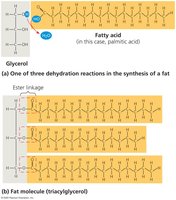
Dehydration Synthesis: Joins monomers by removing water.
Hydrolysis: Breaks polymers into monomers by adding water.

Carbohydrates
Structure and Function of Carbohydrates
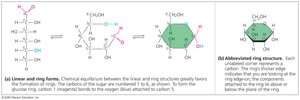
Carbohydrates are organic molecules composed of carbon, hydrogen, and oxygen, serving as energy sources and structural components in cells.
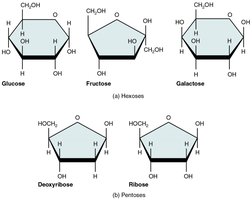
Monosaccharides: Simple sugars (e.g., glucose, fructose), general formula
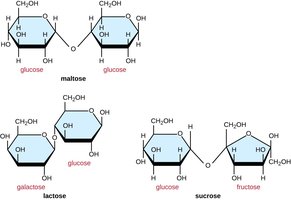
Disaccharides: Two monosaccharides joined by dehydration synthesis (e.g., sucrose, lactose)
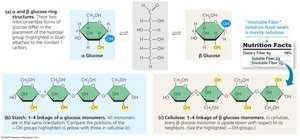
Polysaccharides: Long chains of monosaccharides, used for energy storage (starch, glycogen) or structure (cellulose, chitin)
Polysaccharides: Storage and Structure
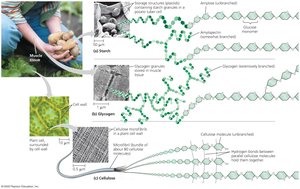
Polysaccharides serve as energy reserves and structural materials in organisms. Their properties depend on the type of monomer and glycosidic linkage.
Starch: Storage in plants (amylose, amylopectin)
Glycogen: Storage in animals
Cellulose: Structural component in plant cell walls; indigestible by most animals
Chitin: Structural polysaccharide in fungi and arthropods
Lipids
Types and Properties of Lipids
Lipids are hydrophobic, non-polar molecules that include fats, phospholipids, steroids, and waxes. They play roles in energy storage, membrane structure, and signaling.
Fats (Triglycerides): Composed of glycerol and three fatty acids; primary energy storage
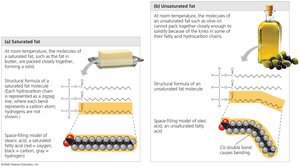
Saturated Fatty Acids: No double bonds, solid at room temperature
Unsaturated Fatty Acids: One or more double bonds, liquid at room temperature
Trans Fats: Industrially produced, associated with health risks
Phospholipids and Steroids
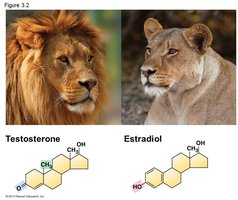
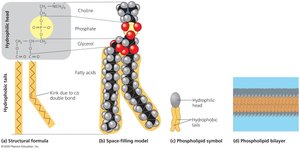
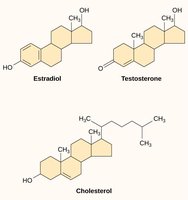
Phospholipids are major components of cell membranes, characterized by amphipathic properties. Steroids have a structure of four fused carbon rings and include hormones such as cholesterol, testosterone, and estradiol.
Phospholipids: Glycerol, two fatty acids, phosphate group; amphipathic
Steroids: Four fused rings; cholesterol stabilizes membranes, hormones regulate physiology
Proteins
Structure and Function of Proteins
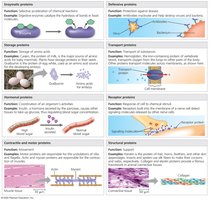
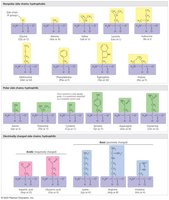
Proteins are polymers of amino acids, essential for nearly every cellular function. Their structure is determined by the sequence and chemical properties of amino acids.
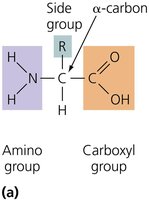
Amino Acid Structure: Central carbon, amino group, carboxyl group, R group (side chain), hydrogen
Essential Amino Acids: Cannot be synthesized by humans; must be obtained from diet
Peptide Bonds: Formed by dehydration reactions between amino acids
Levels of Protein Structure
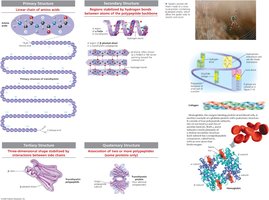
Proteins have four levels of structure, each contributing to their function. The final shape is critical for biological activity.
Primary: Sequence of amino acids
Secondary: Local folding (α-helix, β-sheet)
Tertiary: Overall 3D shape
Quaternary: Association of multiple polypeptide chains
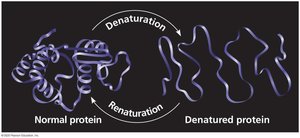
Denaturation: Loss of structure due to environmental changes (temperature, pH, salt)
Nucleic Acids
DNA and RNA: Structure and Function
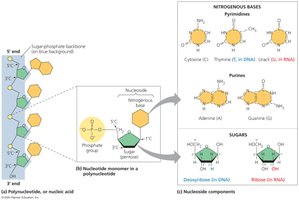
Nucleic acids store and transmit hereditary information. DNA and RNA are polymers of nucleotides, each consisting of a sugar, phosphate group, and nitrogenous base.
DNA: Double helix, deoxyribose sugar, bases: adenine, thymine, cytosine, guanine
RNA: Single strand, ribose sugar, bases: adenine, uracil, cytosine, guanine
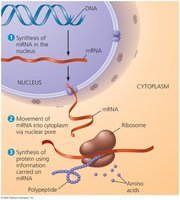
Central Dogma: DNA → RNA → Protein; describes the flow of genetic information
Antiparallel Strands: DNA strands run in opposite directions
Base Pairing: A-T (DNA), A-U (RNA), C-G