 Back
Organic Molecules of Life: Structure and Function of Carbohydrates
Study Guide - Smart Notes
 Tailored notes based on your materials, expanded with key definitions, examples, and context.
Organic Molecules of Life
Basic Properties of Carbon
Carbon is a fundamental element in biological molecules due to its ability to form four covalent bonds, resulting in a vast diversity of organic compounds. The structure, shape, and presence of isomers, as well as reactive functional groups, are key to carbon's role in life.
Carbon skeletons define organic compounds.
Functional groups contribute to reactivity and biological function.
Isomers are compounds with the same formula but different structures.
Macromolecules: The Four Classes
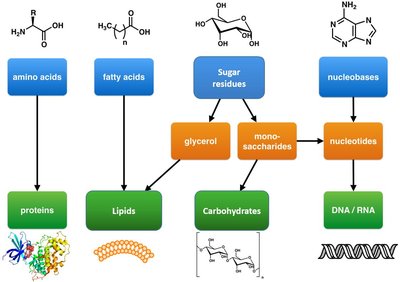
All living cells contain organic molecules, classified as macromolecules. There are four major classes: carbohydrates, proteins, nucleic acids, and lipids. The first three are polymers made from monomers.
Carbohydrates: sugars and their polymers
Proteins: polymers of amino acids
Nucleic acids: polymers of nucleotides
Lipids: not true polymers, but composed of fatty acids and glycerol
Polymer Formation: Dehydration Synthesis
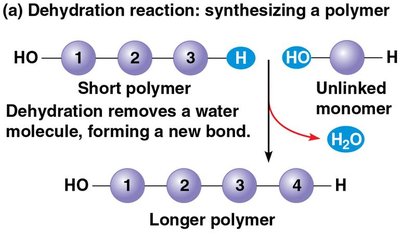
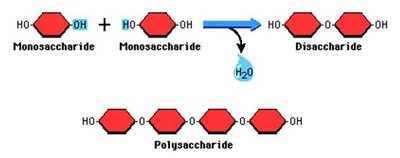
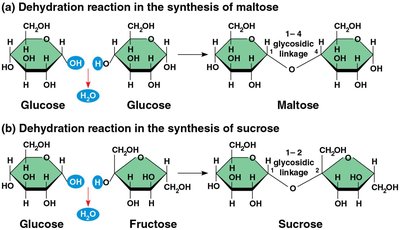
Polymers are synthesized by enzymes through dehydration reactions, where monomers are joined by removing a water molecule.
Dehydration reaction: Joins monomers, releases water.
Enzymes: Catalyze polymerization.
Polymer Breakdown: Hydrolysis
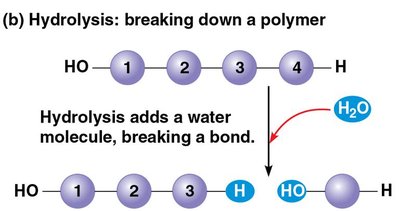
Polymers are broken down by hydrolysis, where enzymes add water to break bonds between monomers.
Hydrolysis: Adds water, breaks bonds.
Enzymes: Catalyze depolymerization.
Real World Application: Macromolecules in Food
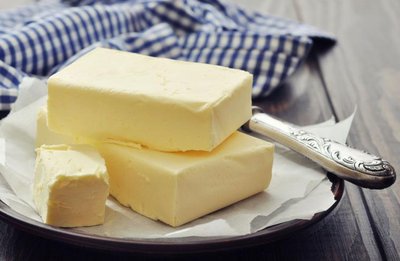
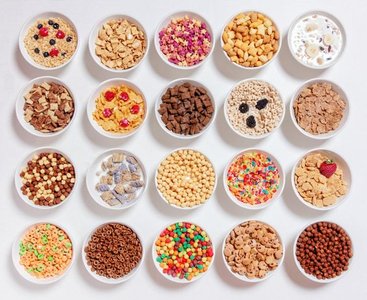
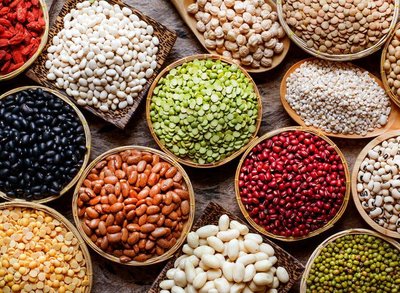
Different foods are rich in different macromolecules. For example, butter is predominantly composed of lipids, cereal is rich in carbohydrates, and beans are high in proteins.
Butter: Lipids
Cereal: Carbohydrates
Beans: Proteins
Carbohydrates
Structure and Function
Carbohydrates are organic compounds made of carbon, hydrogen, and oxygen. They serve as fuel and structural materials in living organisms. Simple sugars (monosaccharides) are the monomers for polysaccharide polymers.
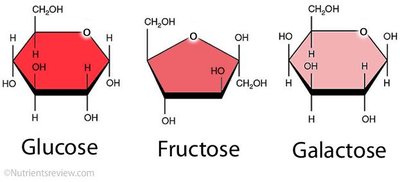
Monosaccharides: Simple sugars, e.g., glucose, fructose, galactose
Polysaccharides: Complex carbohydrates, e.g., starch, glycogen, cellulose
Monosaccharides: Classification and Structure
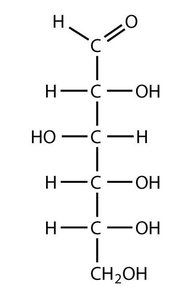
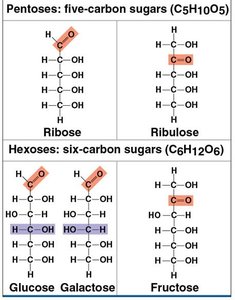
Monosaccharides are classified by the number of carbons and the location of the carbonyl group. The most common monosaccharide is glucose, with the formula .
Pentoses: Five-carbon sugars (e.g., ribose)
Hexoses: Six-carbon sugars (e.g., glucose, fructose)
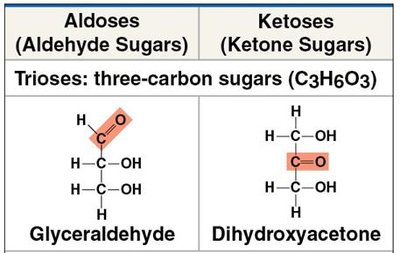
Aldoses: Carbonyl group at the end (aldehyde)
Ketoses: Carbonyl group in the middle (ketone)
Monosaccharide Interactions: Ring and Chain Forms
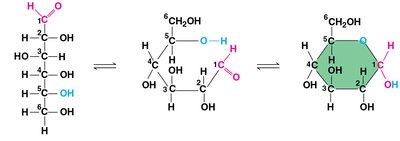
Monosaccharides exist in equilibrium between ring and chain forms, especially in aqueous solutions. This conversion is important for their biological function.
Disaccharides and Polysaccharides: Glycosidic Linkages
Two monosaccharides join via a glycosidic linkage (dehydration reaction) to form a disaccharide. Polysaccharides are formed by repeated glycosidic linkages.
Disaccharide: Two monosaccharides (e.g., sucrose, maltose)
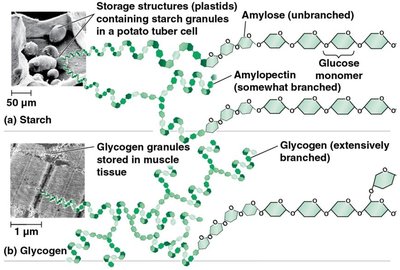
Polysaccharide: Many monosaccharides (e.g., starch, glycogen, cellulose)
Polysaccharide Functions
Polysaccharides serve as energy storage and structural materials. Starch is used by plants, glycogen by animals, and cellulose forms plant cell walls.
Starch: Storage in plants (amylose and amylopectin)
Glycogen: Storage in animals (liver and muscle)
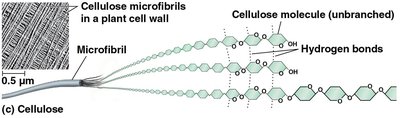
Cellulose: Structure in plant cell walls
Comparison of Plant-Based Polysaccharides
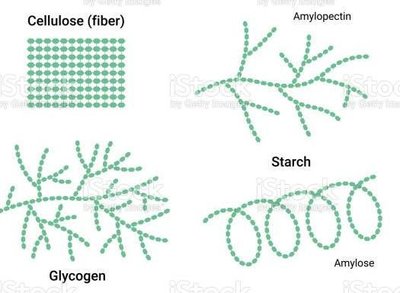
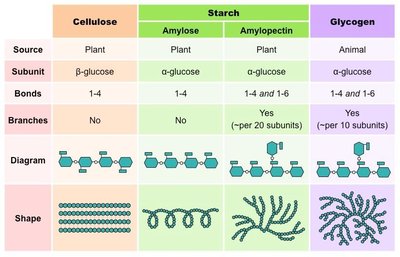
Starch, cellulose, and glycogen differ in their monomer subunits, bond types, branching, and shapes.
Polysaccharide | Source | Subunit | Bonds | Branches | Shape |
|---|---|---|---|---|---|
Cellulose | Plant | β-glucose | 1-4 | No | Straight, unbranched |
Starch (Amylose) | Plant | α-glucose | 1-4 | No | Helical |
Starch (Amylopectin) | Plant | α-glucose | 1-4, 1-6 | Yes | Branched |
Glycogen | Animal | α-glucose | 1-4, 1-6 | Yes | Extensively branched |
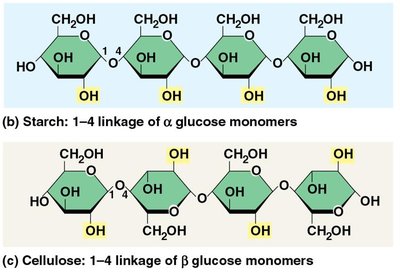
Polysaccharide Structure: Linkage Types
The type of glycosidic linkage (alpha or beta) determines the 3D structure and digestibility of polysaccharides. Alpha linkages form helical structures (starch), while beta linkages form straight, unbranched structures (cellulose).
Digestibility and Biological Importance
Enzymes that digest alpha linkages can break down starch, but not cellulose. Humans cannot digest cellulose, which acts as insoluble fiber, while some microorganisms and herbivores can digest it due to symbiotic relationships.
Chitin: A Structural Polysaccharide
Chitin is a glucose-based polysaccharide used by arthropods for exoskeletons and by fungi in cell walls. Its monomer is N-acetylglucosamine, a derivative of glucose.
Chitin: Structural polysaccharide in arthropods and fungi
N-acetylglucosamine: Chitin monomer
Summary: Macromolecules & Carbon
Four major classes of macromolecules: carbohydrates, proteins, nucleic acids, lipids
Carbohydrates are organic compounds made of carbon, hydrogen, and oxygen
Polysaccharides are carbohydrate polymers formed from monosaccharide monomers via glycosidic linkages
Polysaccharides function in energy storage and structure formation
