 Back
Organization of the Cell: Structure and Function of Prokaryotic and Eukaryotic Cells
Study Guide - Smart Notes
 Tailored notes based on your materials, expanded with key definitions, examples, and context.
Organization of the Cell
Introduction
The cell is the fundamental unit of life, and all living organisms are composed of one or more cells. Cells can be broadly classified into two types: prokaryotic and eukaryotic. Understanding the structure and function of these cells is essential for studying biology at the molecular and organismal levels.
Prokaryotic Cells
Structure of a Prokaryotic Cell
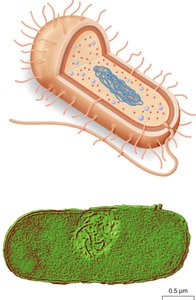
Prokaryotic cells include bacteria and archaea.
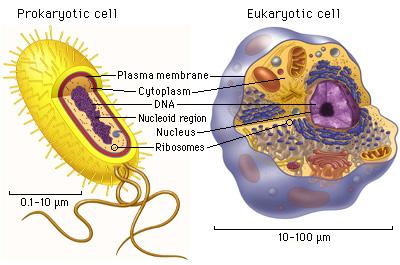
They are typically about 1/10 the diameter of eukaryotic cells.
DNA is located in a region called the nucleoid, not enclosed by a membrane.
They lack a true nucleus and membrane-bound organelles.
The cytoplasm includes all contents inside the plasma membrane.
Most have a cell wall outside the plasma membrane for structural support.
Many possess flagella for movement, which operate like propellers.
Contain ribosomes for protein synthesis and storage granules.
Prokaryotes are always unicellular.
Eukaryotic Cells
Structure of a Eukaryotic Cell
Eukaryotic cells are more complex and contain many membrane-bound organelles.
They have a nucleus that stores DNA.
The cytoplasm is the region between the nucleus and the plasma membrane.
The cytosol is the fluid component of the cytoplasm.
Specialized organelles and a cytoskeleton allow for larger cell size and complexity.
Eukaryotes can be unicellular or multicellular.
Eukaryotic Membranes and Compartmentalization
Membrane-enclosed organelles localize specific cellular activities, allowing for simultaneous processes.
Major organelles include the nucleus, endoplasmic reticulum (ER), Golgi complex, lysosomes, vacuoles, and vesicles.
Vesicles transport materials between organelles.
The Nucleus
Structure and Function
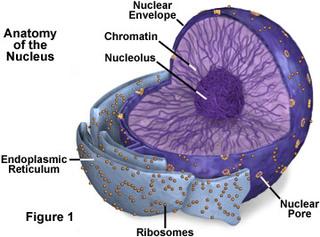
The nucleus is the control center of the cell, containing most of the cell's DNA.
The nuclear envelope is a double membrane that separates nuclear contents from the cytoplasm.
Nuclear pores regulate the passage of materials between the nucleus and cytoplasm.
Organization of DNA in the Nucleus
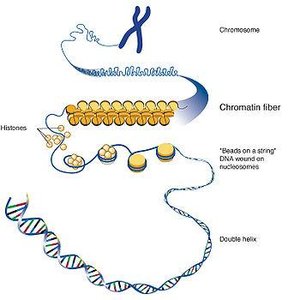
DNA is wrapped around proteins called histones, forming chromatin.
Chromatin can be further packaged into chromosomes during cell division.
Functions of DNA
DNA contains genes, sequences of nucleotides that encode instructions for protein synthesis.
The nucleus transcribes DNA into RNA, specifically messenger RNA (mRNA).
mRNA exits the nucleus and is used by ribosomes in the cytoplasm to synthesize proteins.
Ribosomes
Structure and Function
Ribosomes are found free in the cytoplasm or attached to membranes (e.g., rough ER).
Each ribosome consists of a large and a small subunit.
They join amino acids together to form polypeptides (proteins).
Endomembrane System
Vesicles
Vesicles are small membrane-bound sacs used to transport materials within the cell or to the cell surface for secretion.
Endoplasmic Reticulum (ER)
The endoplasmic reticulum is a network of flattened sacs and tubules.
The ER lumen is the internal space of the ER.
There are two types: rough ER (with ribosomes) and smooth ER (without ribosomes).
Smooth ER
Has a smooth appearance due to lack of ribosomes.
Main function is lipid synthesis.
Rough ER
Studded with ribosomes on the outer surface.
Site of synthesis for proteins destined for export or for other organelles.
Proteins are modified in the ER lumen (e.g., addition of carbohydrates to form glycoproteins).
Proteins are transported to other compartments via vesicles.
Golgi Complex
The Golgi complex consists of stacks of flattened membranous sacs called cisternae.
Receives proteins from the rough ER via transport vesicles.
Processes, sorts, and modifies proteins, then packages them into vesicles for secretion or delivery to other organelles.
Lysosomes
Lysosomes are small sacs containing about 40 different digestive enzymes.
They digest worn-out cell parts and invading microbes.
Vacuoles
In plant and fungal cells, vacuoles perform many functions similar to lysosomes in animal cells.
The central vacuole in plants stores water, food, salts, pigments, and wastes, and provides mechanical strength.
Enzymes in vacuoles break down wastes and unneeded cell components.
Energy-Transforming Organelles
Mitochondria and Chloroplasts
Both are specialized for energy conversion and contain their own DNA and ribosomes, supporting the endosymbiotic theory of their origin.
Mitochondria convert chemical energy from food into ATP via cellular respiration.
Chloroplasts convert light energy into chemical energy (glucose) via photosynthesis (in plants and algae).
Mitochondria
Site of cellular respiration.
Double membrane forms two compartments: intermembrane space and matrix.
Inner membrane folds (cristae) increase surface area for reactions.
Chloroplasts
Site of photosynthesis.
Contain chlorophyll, a pigment that captures light energy.
Disc-shaped with an inner membrane enclosing the stroma (fluid-filled space).
Thylakoids (flat sacs) are arranged in stacks (grana) and are the site of the light-dependent reactions of photosynthesis.
Cellular Respiration and Photosynthesis: Relationship
Cellular respiration and photosynthesis are complementary processes.
Photosynthesis stores energy in glucose; respiration releases energy from glucose to produce ATP.
Cytoskeleton
Structure and Function
The cytoskeleton is a dynamic network of protein fibers that provides mechanical strength, shape, and movement to cells.
It is involved in cell division and intracellular transport.
Composed of three main types of filaments: microtubules, microfilaments, and intermediate filaments.
Summary Table: Prokaryotic vs. Eukaryotic Cells
Feature | Prokaryotic Cells | Eukaryotic Cells |
|---|---|---|
Nucleus | Absent (DNA in nucleoid) | Present |
Membrane-bound Organelles | Absent | Present |
Cell Size | Small (0.1–10 μm) | Larger (10–100 μm) |
Cell Wall | Usually present | Present in plants, fungi, some protists |
Ribosomes | Present (smaller) | Present (larger) |
Unicellular/Multicellular | Always unicellular | Unicellular or multicellular |
