 Back
BackOsmoregulation and Excretion in Animals
Study Guide - Smart Notes
 Tailored notes based on your materials, expanded with key definitions, examples, and context.
Osmoregulation and Excretion
Overview of Osmoregulation and Excretion
Osmoregulation is the process by which organisms regulate the balance of water and solutes within their bodies, ensuring cellular function and overall homeostasis. Excretion refers to the removal of metabolic wastes, particularly nitrogenous wastes, from the body. In terrestrial organisms, these processes are closely linked due to the need to conserve water while eliminating toxic byproducts.
Osmoregulation: Maintains the concentration of solutes and water in body fluids.
Excretion: Eliminates metabolic wastes, especially nitrogenous compounds.
Key Organs: In mammals, the kidneys are the primary organs for both osmoregulation and excretion.
Homeostasis: The endocrine system (hormones) plays a critical role in regulating these processes.
Osmosis and Osmolarity
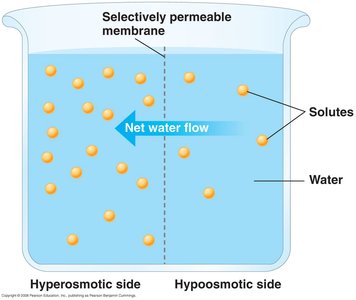
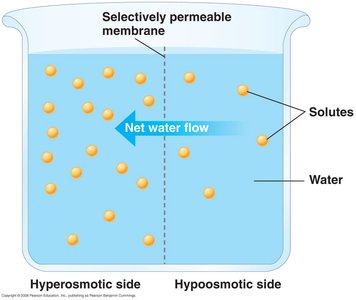
Osmosis is the movement of water across a selectively permeable membrane from regions of low solute concentration (high water potential) to regions of high solute concentration (low water potential). Osmolarity is a measure of solute concentration, expressed in milliosmoles per liter (mOsm/L).
Osmosis: Drives water movement in and out of cells and tissues.
Osmolarity: Blood (~300 mOsm/L), freshwater (~0-20 mOsm/L), seawater (~1000 mOsm/L).
Hyperosmotic: Solution with higher solute concentration.
Hypoosmotic: Solution with lower solute concentration.
Osmoconformers vs. Osmoregulators
Animals employ different strategies to manage osmotic balance depending on their environment:
Osmoconformers: Body fluids are isoosmotic with the environment (e.g., most marine invertebrates).
Osmoregulators: Actively regulate body fluid osmolarity, often at a cost of energy (e.g., vertebrates, freshwater and terrestrial animals).
Stenohaline: Tolerate only a narrow range of external osmolarities.
Euryhaline: Can tolerate a wide range of osmolarities.
Osmoregulation in Aquatic Vertebrates
Vertebrates display distinct osmoregulatory adaptations based on their habitats:
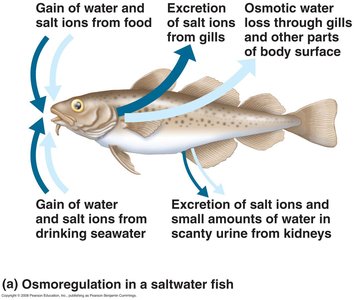
Marine Fish: Body fluids are hypoosmotic to seawater; lose water by osmosis and must drink seawater, excreting excess ions via gills and kidneys.
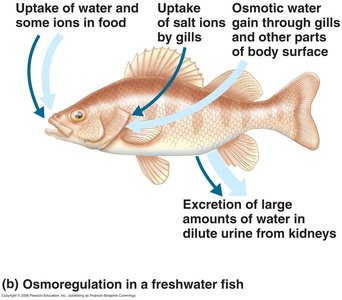
Freshwater Fish: Body fluids are hyperosmotic to freshwater; gain water by osmosis and excrete large volumes of dilute urine, actively taking up ions.
Osmoregulation in Terrestrial Vertebrates
Terrestrial animals face the constant threat of dehydration and have evolved adaptations to minimize water loss:
Water Conservation: Waterproof skin, behavioral adaptations, and efficient kidneys.
Water Loss: Occurs via urine, feces, evaporation, and sweating.
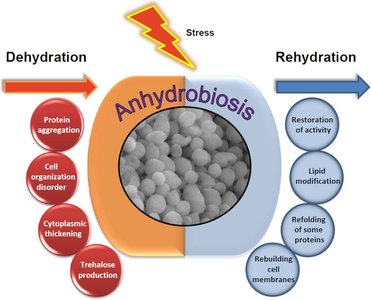
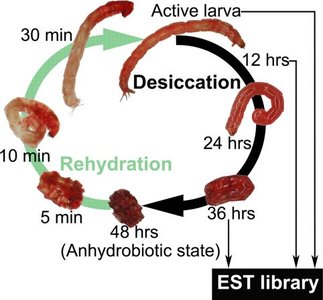
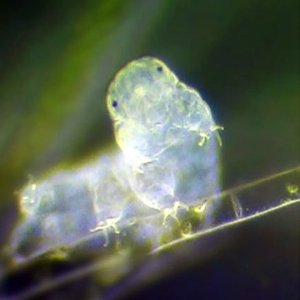
Anhydrobiosis: Some animals can survive extreme dehydration by entering a dormant state.
Nitrogenous Waste and Excretion
Types of Nitrogenous Waste
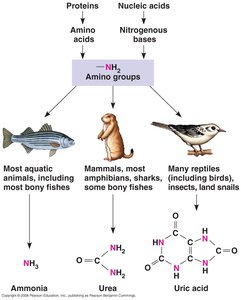
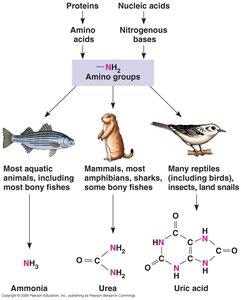
The metabolism of proteins and nucleic acids produces nitrogenous wastes, which must be excreted to prevent toxicity. The form of nitrogenous waste varies among taxa and is influenced by habitat and evolutionary history:
Ammonia (NH3): Highly toxic, highly soluble; excreted directly by aquatic animals.
Urea: Less toxic, more concentrated; produced by mammals, amphibians, and some fish. Requires energy to synthesize.
Uric Acid: Least toxic, insoluble; excreted as a paste by reptiles, birds, and most terrestrial invertebrates. Most energetically expensive to produce.
Excretory Systems and the Mammalian Kidney
General Structure of Excretory Systems
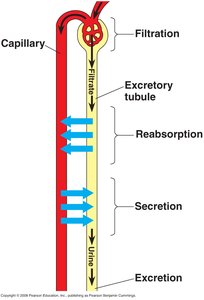
Most animal excretory systems share a common functional organization, involving the production of urine through four main steps:
Filtration: Body fluid is forced through a selectively permeable membrane; water and small solutes pass, large molecules are retained.
Reabsorption: Valuable substances are reclaimed from the filtrate back into the body fluids.
Secretion: Additional wastes are actively transported into the filtrate.
Excretion: The processed filtrate (urine) is eliminated from the body.
The Mammalian Kidney and Nephron Structure
The mammalian kidney is a complex organ composed of an outer cortex and inner medulla, containing millions of nephrons—the functional units of filtration and excretion.
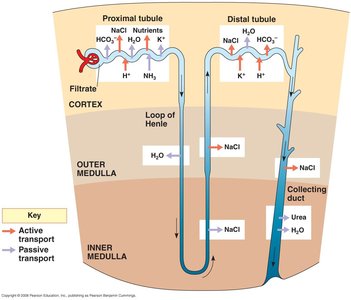
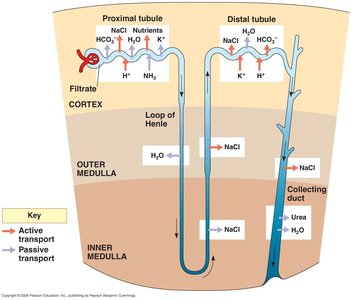
Nephron: Consists of a long tubule beginning with Bowman’s capsule (surrounding the glomerulus), followed by the proximal tubule, loop of Henle, distal tubule, and collecting duct.
Blood Supply: Each nephron is closely associated with blood vessels, including the glomerulus, peritubular capillaries, and vasa recta.
Filtration and Reabsorption in the Nephron
Kidney function relies on an osmolarity gradient and selective reabsorption of water and ions:
Bowman’s Capsule: Filtration of blood under pressure from the glomerulus.
Proximal Tubule: Active reabsorption of ions and water; wastes remain in the filtrate.
Loop of Henle: Descending limb is permeable to water (water reabsorbed), ascending limb is permeable to NaCl (NaCl reabsorbed).
Distal Tubule: Regulates NaCl and K+ exchange.
Collecting Duct: Final concentration of urine; permeability to water and urea is hormonally regulated.
Hormonal Regulation of Kidney Function
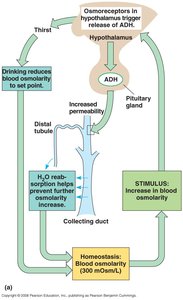
Antidiuretic Hormone (ADH) and Homeostasis
The volume and osmolarity of urine can be adjusted to maintain homeostasis, primarily through hormonal control:
ADH (Antidiuretic Hormone): Released in response to increased blood osmolarity; increases water reabsorption in the distal tubules and collecting ducts, concentrating urine and reducing blood osmolarity.
Negative Feedback: Drinking water and increased reabsorption lower blood osmolarity, reducing ADH release.
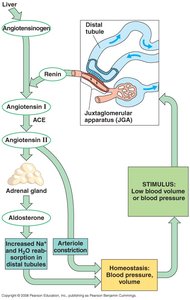
Renin-Angiotensin-Aldosterone System (RAAS)
The RAAS pathway helps maintain blood pressure and volume:
Low Blood Pressure: Triggers release of renin, initiating a cascade that produces angiotensin II, leading to arteriole constriction and aldosterone release.
Aldosterone: Increases Na+ and water reabsorption in the distal tubules, raising blood volume and pressure.
Summary Table: Nitrogenous Waste Types
Type | Example Organisms | Toxicity | Water Requirement | Energy Cost |
|---|---|---|---|---|
Ammonia | Most aquatic animals | High | High | Low |
Urea | Mammals, amphibians, sharks | Moderate | Moderate | Moderate |
Uric Acid | Reptiles, birds, insects | Low | Low | High |
Additional info: The balance between toxicity, water conservation, and energy expenditure determines the form of nitrogenous waste produced by different taxa.
