Back
Osmoregulation and Excretion in Animals
Study Guide - Smart Notes
 Tailored notes based on your materials, expanded with key definitions, examples, and context.
Osmoregulation: The Regulation of Water and Solutes
Introduction to Osmoregulation
Osmoregulation is the process by which organisms regulate the concentration of water and solutes (such as electrolytes) in their bodies. This process is essential for maintaining homeostasis and proper cellular function. Osmoregulation is closely linked to excretion, which is the removal of metabolic wastes, particularly nitrogenous wastes, from the body.
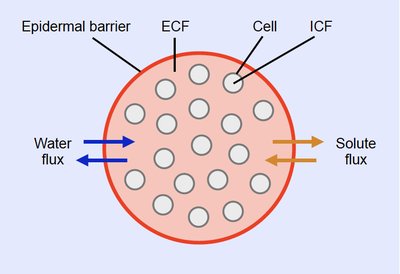
Osmolarity: The concentration of solutes in a solution, measured in osmoles (Osm) per liter. 1 Osm = 1 mole of dissolved particles per liter.
Osmotic stress: Occurs when the concentration of dissolved substances is abnormal, leading to water movement that can disrupt cell function.
Types of solutions:
Hyperosmotic: Higher solute concentration outside the cell.
Hyposmotic: Lower solute concentration outside the cell.
Isosmotic: Equal solute concentration inside and outside the cell.
Key Terminology in Osmoregulation
Excretion: Movement of unwanted substances out of the extracellular fluid (ECF).
Secretion: General movement of substances out of the ECF.
Absorption: Movement of substances into the ECF.
Reabsorption: Movement of substances back into the ECF after initial removal.
Filtration: Forcing a solution through a biological sieve to separate substances.
Nitrogenous Wastes: Types and Adaptations
Overview of Nitrogenous Wastes
Nitrogenous wastes are the end products of protein and nucleic acid metabolism. The form in which these wastes are excreted depends on the organism's habitat and evolutionary adaptations.
Compound | Solubility | Toxicity | Energy Loss |
|---|---|---|---|
Ammonia | High | High | Low |
Urea | Medium | Medium | Medium |
Uric Acid | Very low | Low | High |
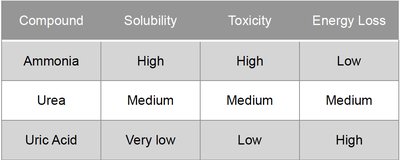
Ammonia: Highly toxic, requires large amounts of water for excretion; common in aquatic animals.
Urea: Less toxic, requires less water; common in mammals and amphibians.
Uric Acid: Least toxic, excreted as a paste or solid; common in birds, reptiles, and insects.
Osmoregulation in Aquatic Organisms
Osmoconformers vs. Osmoregulators
Marine invertebrates and cartilaginous fishes (such as sharks and rays) are often osmoconformers, maintaining internal osmolarity similar to seawater. Most bony fishes and all freshwater animals are osmoregulators, actively regulating their internal osmolarity.
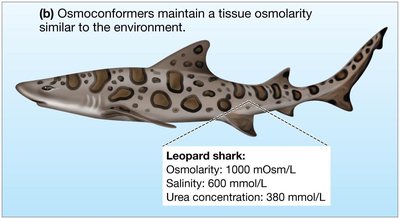
Osmoconformers: Match their internal osmolarity to the environment but may regulate specific ions.
Osmoregulators: Maintain internal osmolarity different from the environment, requiring active transport of solutes and water.
Osmoregulation in Marine Sharks
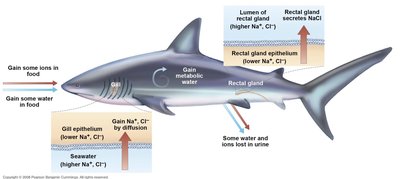
Sharks are isosmotic with seawater but have different ion compositions. They retain high concentrations of urea and trimethylamine N-oxide (TMAO) to balance osmolarity while keeping sodium levels lower than seawater.
Water flux: Limited influx through food and metabolism; water is excreted in urine.
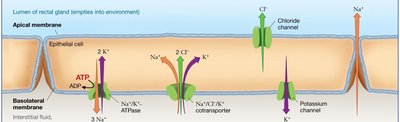
Ion flux: Main route of NaCl influx is through gills; efflux is through the rectal gland.
Rectal gland: Specialized organ for active excretion of NaCl using Na+/K+-ATPase.
Osmoregulation in Ray-Finned Fish
Freshwater Fish
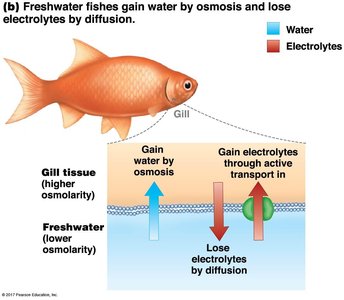
Freshwater fish are challenged by water influx and ion loss at the gills. They produce large amounts of dilute urine and rely on active uptake of ions from the environment.
Gain water by osmosis across gill tissue.
Lose electrolytes by diffusion.
Gain electrolytes through active transport in gills and from food.
Do not drink water.
Marine Fish
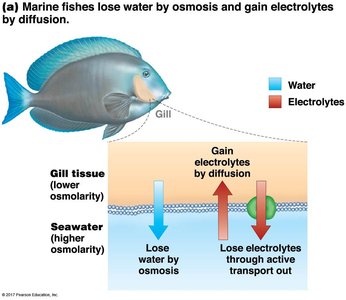
Marine fish are challenged by water loss and ion gain at the gills. They drink seawater and actively excrete excess ions through their gills, producing small amounts of concentrated urine.
Lose water by osmosis across gill tissue.
Gain electrolytes by diffusion.
Lose electrolytes through active transport out of gills.
Drink seawater to replace lost water.
Osmoregulation in Terrestrial Organisms
Challenges and Adaptations
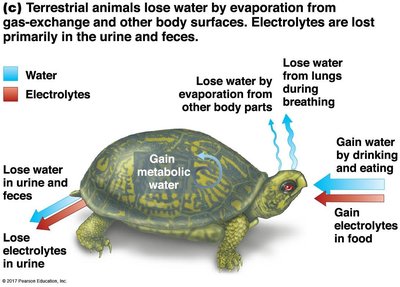
Terrestrial animals face the risk of dehydration due to evaporation and must conserve water while obtaining sufficient ions. Adaptations include internal respiratory surfaces, water-resistant integuments, and efficient excretory systems.
Water loss occurs mainly through evaporation from respiratory surfaces and body surfaces.
Electrolytes are lost primarily in urine and feces.
Herbivores may require additional salt intake due to low sodium in plants.
Excretion of nitrogenous wastes must minimize water loss (e.g., uric acid in reptiles and birds).
Osmoregulation in Insects
Minimizing Water Loss
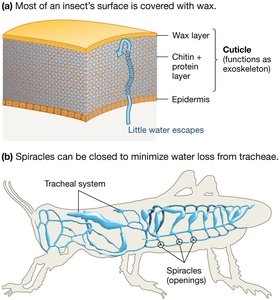
Insects have evolved several adaptations to minimize water loss, including a waxy cuticle and the ability to close spiracles (openings to the tracheal system) to reduce evaporation.
Cuticle: Composed of chitin and protein, covered by a wax layer to prevent water loss.
Spiracles: Can be opened or closed to regulate gas exchange and water loss.
Insect Excretory System: Malpighian Tubules
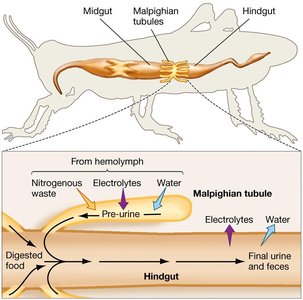
Insects use Malpighian tubules to excrete nitrogenous wastes and regulate water and electrolyte balance. These tubules produce a filtrate (pre-urine) that is modified in the hindgut, where most water and electrolytes are reabsorbed.
Active transport of K+ into the tubule lumen draws water and other solutes by osmosis.
Pre-urine empties into the hindgut, where selective reabsorption occurs.
Final urine and feces are excreted with minimal water loss.