 Back
Osmoregulation and Excretion in Animals
Study Guide - Smart Notes
 Tailored notes based on your materials, expanded with key definitions, examples, and context.
Osmoregulation: The Regulation of Water and Solutes
Introduction to Osmoregulation
Osmoregulation is the process by which organisms regulate the concentration of water and solutes (such as electrolytes) in their bodies. This regulation is essential for maintaining cellular function and overall homeostasis. Osmoregulation involves balancing water influx and efflux, controlling solute concentrations, and eliminating nitrogenous wastes.
Osmolarity: The concentration of solutes in a solution, measured in osmoles (Osm) per liter. 1 Osm = 1 mole of dissolved particles per liter; 1 Osm = 1000 mOsm.
ECF (Extracellular Fluid) and ICF (Intracellular Fluid): Compartments where water and solutes are regulated.
Osmotic Stress: Occurs when the concentration of dissolved substances is abnormal, leading to water movement that can disrupt cell function.
Key Terms:
Excretion: Removal of unwanted substances from ECF.
Secretion: General movement of substances out of ECF.
Absorption: Movement of substances into ECF.
Reabsorption: Return of substances to ECF after filtration.
Filtration: Forcing solution through a biological sieve.
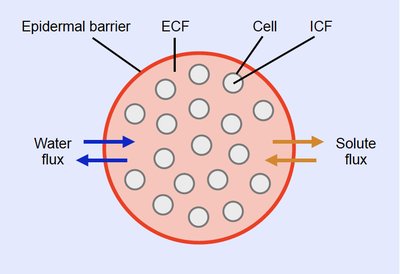
Osmoregulation Terminology
Hyperosmotic: Higher solute concentration outside the cell.
Hyposmotic: Lower solute concentration outside the cell.
Isosmotic: Equal solute concentration inside and outside the cell.
Nitrogenous Wastes
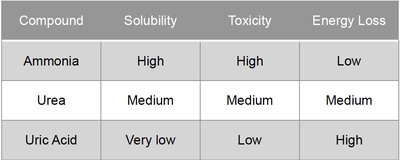
Nitrogenous wastes are byproducts of protein metabolism. The form of waste produced depends on the organism's environment and evolutionary adaptations.
Compound | Solubility | Toxicity | Energy Loss |
|---|---|---|---|
Ammonia | High | High | Low |
Urea | Medium | Medium | Medium |
Uric Acid | Very low | Low | High |
Osmoregulation in Aquatic Organisms
Osmoconformers vs. Osmoregulators
Osmoconformers: Animals (e.g., many marine invertebrates, sharks, rays) whose body fluids are isosmotic with their environment. They regulate specific ions but not overall osmolarity.
Osmoregulators: Animals (e.g., freshwater fish, many marine bony fish) that maintain internal osmolarity different from their environment.
Osmoregulation in Marine Sharks
Marine sharks are isosmotic with seawater but differ in the composition of their body fluids. They maintain high concentrations of urea and trimethylamine oxide (TMAO) to balance osmolarity while keeping lower sodium concentrations than seawater.
Shark ECF osmolarity ≈ Seawater osmolarity (about 1000–1050 mOsm).
Shark ECF [Na+] ≈ 300 mM; Seawater [Na+] ≈ 500 mM.
Major osmolytes: Urea and TMAO.
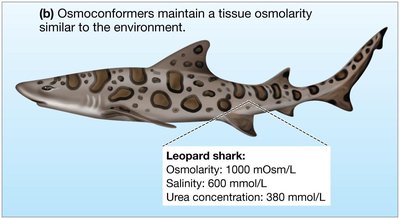
Water and Ion Flux in Marine Sharks
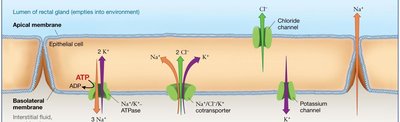
Sharks gain some water and ions from food and metabolism. The main route of NaCl influx is through the gills, while the main route of NaCl efflux is through the rectal gland. Water is excreted in urine produced by the kidneys.
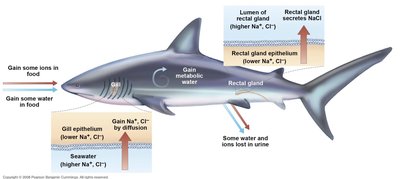
Rectal Gland Function in Sharks
The rectal gland is the primary organ for NaCl excretion in sharks. It uses active transport mechanisms, including the Na+/K+-ATPase pump, to move ions against their concentration gradients.
Active transport of Na+ and Cl- out of the body.
Helps maintain osmotic balance and prevents toxic ion accumulation.
Osmoregulation in Ray-Finned Fish
Freshwater Fish
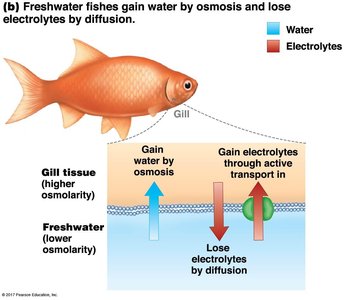
Freshwater fish are osmoregulators that face the challenge of water influx and ion loss due to the low osmolarity of their environment.
Gain water by osmosis across gill tissue.
Lose electrolytes by diffusion.
Produce large amounts of dilute urine to eliminate excess water.
Rely on food and active uptake at gills for ions.
Marine Fish
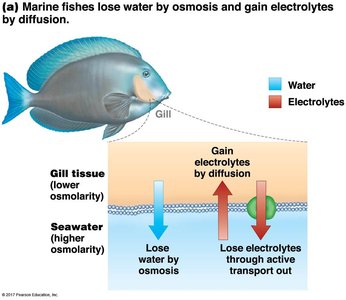
Marine fish are osmoregulators that face the challenge of water loss and ion gain due to the high osmolarity of seawater.
Lose water by osmosis across gill tissue.
Gain electrolytes by diffusion.
Drink seawater to replace lost water.
Excrete excess ions actively at the gills.
Produce small amounts of concentrated urine to conserve water.
Osmoregulation in Terrestrial Organisms
Challenges and Adaptations
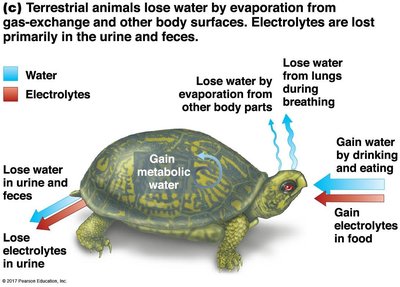
Terrestrial animals must minimize water loss and maintain ion balance in an environment where water is not freely available and cannot be gained by osmosis. Water loss occurs mainly through evaporation and excretion.
Internal respiratory surfaces (lungs) reduce water loss compared to gills.
Integument (skin, scales) is resistant to desiccation.
Formation of moderate to low urine volumes for ion and waste excretion.
Herbivores may require additional NaCl intake due to low salt in plants.
Elimination of nitrogenous wastes must avoid toxicity while conserving water.
Osmoregulation in Insects
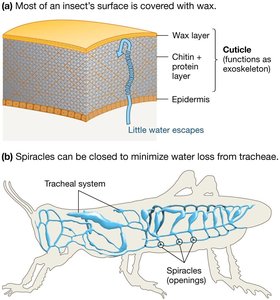
Insects have evolved several adaptations to minimize water loss and efficiently excrete wastes.
Cuticle: A waxy, chitinous exoskeleton that reduces water loss across the body surface.
Spiracles: Openings to the tracheal system that can be closed to minimize water loss during gas exchange.
Insect Excretory System: Malpighian Tubules
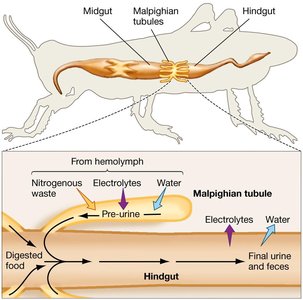
Insects use Malpighian tubules for excretion and osmoregulation. These tubules produce a filtrate (pre-urine) by actively pumping K+ into the lumen, followed by water and other solutes. Most water and electrolytes are reabsorbed in the hindgut, allowing insects to conserve water efficiently.
Large surface area in contact with hemolymph.
Active transport of ions and diffusion of wastes into the tubule lumen.
Reabsorption of 80–95% of water and electrolytes in the hindgut.
Summary Table: Nitrogenous Waste Types
Compound | Solubility | Toxicity | Energy Loss |
|---|---|---|---|
Ammonia | High | High | Low |
Urea | Medium | Medium | Medium |
Uric Acid | Very low | Low | High |
Additional info: Ammonia is typically excreted by aquatic animals, urea by mammals and amphibians, and uric acid by reptiles, birds, and insects. The choice reflects trade-offs between water availability, toxicity, and energy cost.
