 Back
Osmoregulation and Excretion in Animals
Study Guide - Smart Notes
 Tailored notes based on your materials, expanded with key definitions, examples, and context.
Osmoregulation & Excretion
Introduction to Osmoregulation
Osmoregulation is the process by which animals maintain the balance of water and electrolytes in their bodies, crucial for homeostasis and survival in various environments. Excretion is closely linked, as it removes nitrogenous wastes and helps regulate solute concentrations.
Osmoregulation: Regulation of solute concentrations and water balance by a cell or organism.
Excretion: Removal of metabolic wastes, especially nitrogenous wastes, from the body.
Animals face different osmoregulatory challenges in marine, freshwater, and terrestrial habitats.
Osmoregulation and Habitats
Environmental Challenges
Animals must maintain internal water and solute concentrations within narrow limits, despite varying external conditions.
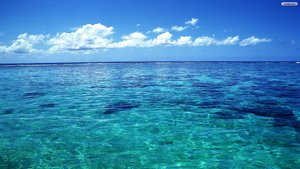
Marine environments: High salt, low water availability for animals.
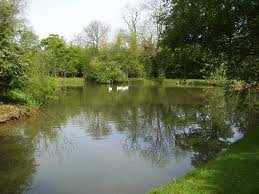
Freshwater environments: Low salt, high water availability.
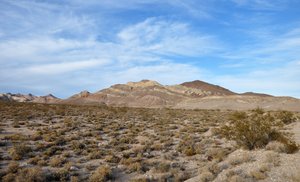
Terrestrial environments: Constant risk of dehydration due to evaporation and other losses.
Diffusion and Osmosis
Mechanisms of Water and Solute Movement
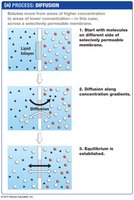
Water and electrolytes move through organisms by diffusion and osmosis, fundamental processes for maintaining internal balance.
Diffusion: Movement of molecules from high to low concentration.
Osmosis: Diffusion of water across a selectively permeable membrane from high to low water concentration.
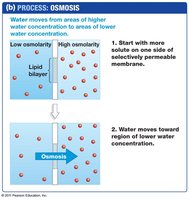
Osmolarity and Osmotic Stress
Definitions and Concepts
Osmolarity is the concentration of dissolved substances in a solution, measured in moles per liter. Osmotic stress occurs when the concentration of solutes in cells or tissues is abnormal.
Osmoconformers: Animals whose tissues are isotonic with their environment (e.g., many marine invertebrates).
Osmoregulators: Animals that actively regulate internal osmolarity, often against steep gradients.
Osmoregulation in Marine and Freshwater Fish
Marine Fish
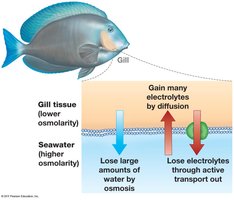
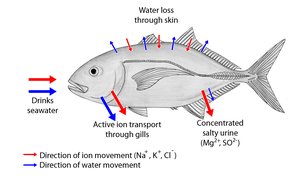
Marine fish are hypotonic to seawater, meaning their internal solute concentration is lower than the surrounding water. They lose water by osmosis and gain electrolytes by diffusion, requiring active osmoregulation.
Drink seawater to replace lost water.
Excrete excess salts via gills and urine.
Freshwater Fish
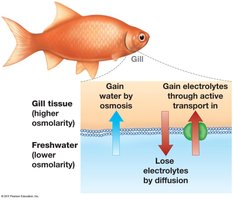
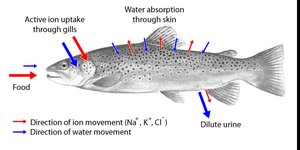
Freshwater fish are hypertonic to their environment, so they gain water by osmosis and lose electrolytes by diffusion.
Excrete large amounts of dilute urine.
Actively uptake salts through gills and from food.
Osmoregulation in Terrestrial Animals
Challenges and Adaptations
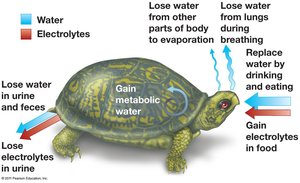
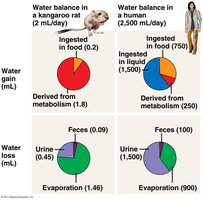
Terrestrial animals constantly lose water to the environment through evaporation, respiration, sweating, urination, and defecation. They have evolved various adaptations to minimize water loss.
Water-resistant body coverings (e.g., skin, scales, exoskeleton).
Behavioral adaptations (e.g., nocturnal activity).
Physiological adaptations (e.g., long loops of Henle in kidneys).
Transport Across Membranes
Passive and Active Transport
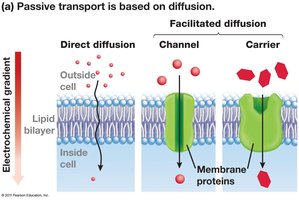
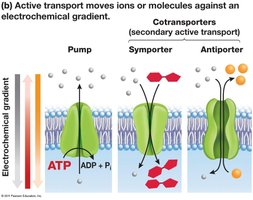
Cells use both passive and active transport mechanisms to move water and solutes across membranes.
Passive transport: Movement down a concentration gradient (diffusion, facilitated diffusion).
Active transport: Movement against a concentration gradient, requiring energy (ATP).
Salt-Excreting Glands and Specialized Adaptations
Salt Glands in Marine Animals
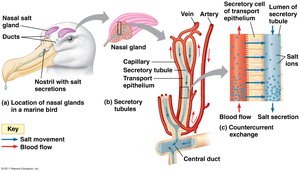
Many marine animals possess specialized salt-excreting glands to remove excess salt from their bodies, such as nasal glands in birds and reptiles, and rectal glands in sharks.
Salt glands use active transport to excrete NaCl.
Similar membrane proteins are found in various animal groups.
Osmoregulation in Anodromous Fish
Life Cycle Adaptations
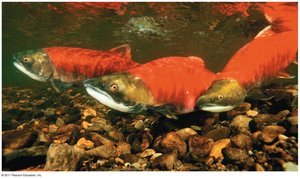
Anodromous fish, such as salmon, migrate between saltwater and freshwater, requiring physiological changes in gill cells to switch between salt excretion and salt uptake.
Specialized chloride cells in gills change function depending on environment.
Different forms of Na+/K+-ATPase are activated in different environments.
Osmoregulation in Insects
Desert Adaptations
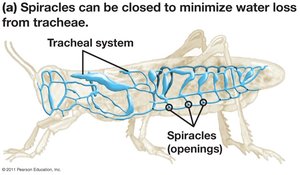
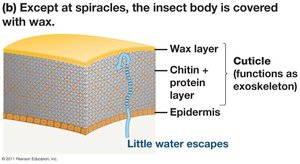
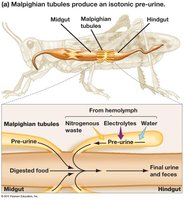
Insects minimize water loss through a waxy cuticle and by regulating spiracle opening. They also use Malpighian tubules for excretion and osmoregulation.
Chitinous exoskeleton with wax layer reduces evaporation.
Spiracles can be closed to limit respiratory water loss.
Malpighian Tubules and Hindgut
Malpighian tubules form filtrate from hemolymph, and the hindgut reabsorbs water and solutes, producing concentrated waste.
Active transport of K+ into tubules draws water and wastes in.
Selective reabsorption in hindgut conserves water and valuable ions.
Excretory Products
Types of Nitrogenous Wastes
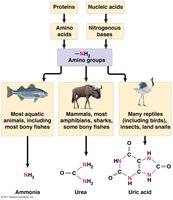
Animals excrete nitrogenous wastes in different forms, depending on their habitat and evolutionary history.
Ammonia (NH3): Highly toxic, excreted by aquatic animals.
Urea: Less toxic, excreted by mammals and amphibians.
Uric acid: Least toxic, excreted by birds, reptiles, and insects.
Kidney Structure and Function in Terrestrial Vertebrates
General Anatomy
The kidney is the main osmoregulatory organ in terrestrial vertebrates, responsible for water and electrolyte balance and excretion of nitrogenous wastes.
Paired organs located in the dorsal body cavity.
Blood enters via the renal artery and leaves via the renal vein.
Urine is formed in the kidney, transported by the ureter, stored in the bladder, and excreted via the urethra.
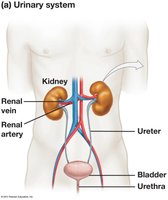
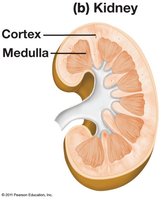
Major Kidney Structure
The kidney consists of an outer cortex and an inner medulla, each with distinct functions and structures.
Cortex: Contains renal corpuscles and convoluted tubules.
Medulla: Contains loops of Henle and collecting ducts.
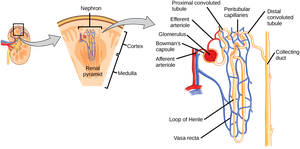
The Nephron: Functional Unit of the Kidney
Nephron Structure
Each nephron consists of several regions, each specialized for different aspects of filtration, reabsorption, and secretion.
Renal corpuscle: Filtration of blood.
Proximal convoluted tubule: Reabsorption of nutrients, ions, and water.
Loop of Henle: Establishes osmotic gradient.
Distal convoluted tubule: Regulates water and electrolyte balance.
Collecting duct: Final concentration of urine.
Renal Corpuscle
The renal corpuscle consists of the glomerulus (a capillary cluster) and Bowman's capsule. Blood pressure forces water and small solutes into the capsule, forming filtrate.
Filtration is non-selective; about 25% of blood plasma is filtered.
Filtrate contains water, ions, nutrients, and wastes.
Proximal Convoluted Tubule
Most reabsorption of valuable molecules occurs here, including glucose, amino acids, vitamins, and ions. Water follows by osmosis through aquaporins.
Microvilli increase surface area for reabsorption.
Active transport and cotransporters recover nutrients and ions.
Loop of Henle
The loop of Henle creates a strong osmotic gradient in the medulla, essential for water reabsorption.
Descending limb: Permeable to water, not solutes.
Ascending limb: Permeable to solutes (Na+, Cl-), not water.
Countercurrent flow maintains the gradient.
Distal Convoluted Tubule and Collecting Duct
These regions fine-tune water and electrolyte reabsorption, regulated by hormones such as aldosterone and antidiuretic hormone (ADH).
Distal tubule: Reabsorbs ions and water as needed.
Collecting duct: Adjusts urine concentration; permeability to water and urea is hormone-dependent.
Hormonal Regulation of Kidney Function
Aldosterone and ADH
Hormones play a critical role in regulating kidney function and maintaining homeostasis.
Aldosterone: Increases Na+ reabsorption in the distal tubule, conserving sodium.
ADH (antidiuretic hormone): Increases water reabsorption in the collecting duct by inserting aquaporins into the membrane.
ADH also increases urea permeability, enhancing the osmotic gradient.
Effects of ADH
When ADH is present, the collecting duct becomes highly permeable to water, resulting in concentrated (hypertonic) urine. In its absence, urine is dilute (hypotonic).
Defects in ADH signaling or aquaporin production can lead to diabetes insipidus (excessive urine production).
Summary Table: Types of Nitrogenous Wastes
Waste Type | Example Animals | Toxicity | Water Requirement |
|---|---|---|---|
Ammonia (NH3) | Most aquatic animals, bony fishes | High | High |
Urea | Mammals, amphibians, sharks | Moderate | Moderate |
Uric acid | Birds, reptiles, insects | Low | Low |
Additional info: The notes above include expanded academic context and explanations to ensure completeness and clarity for exam preparation.
