 Back
lecture 5 Osmoregulation and Excretion: Mechanisms and Adaptations in Animals
Study Guide - Smart Notes
 Tailored notes based on your materials, expanded with key definitions, examples, and context.
lecture 5 Osmoregulation and Excretion
Overview of Osmoregulation and Excretion
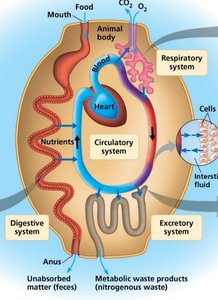
Osmoregulation is the process by which organisms regulate the balance of water and solutes within their bodies to maintain homeostasis. Excretion is the removal of metabolic waste products, particularly nitrogenous wastes, from the body. Together, these processes are essential for survival in diverse environments.
Osmoregulation: Maintains internal fluid balance and osmotic pressure.
Excretion: Eliminates nitrogenous wastes (ammonia, urea, uric acid) and other metabolic byproducts.
Diverse Excretory Systems: Include protonephridia, metanephridia, Malpighian tubules, and kidneys.
Osmoregulation in Aquatic Animals
Osmoregulation in Marine and Freshwater Fish
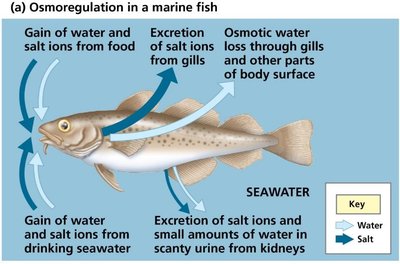
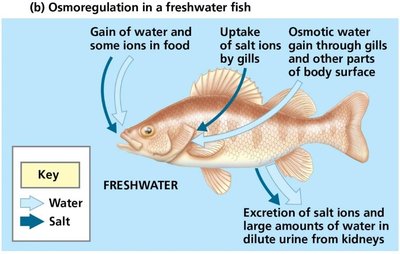
Fish face different osmoregulatory challenges depending on whether they inhabit marine or freshwater environments. Their physiological adaptations reflect the need to balance water and salt intake and loss.
Marine Fish: Lose water by osmosis and gain salts by diffusion and drinking seawater. They compensate by drinking large amounts of water, actively excreting salts through gills, and producing concentrated urine.
Freshwater Fish: Gain water by osmosis and lose salts by diffusion. They compensate by excreting large volumes of dilute urine and actively taking up salts through gills.
Euryhaline Osmoregulators: Can tolerate a wide range of salinities.
Stenohaline Osmoregulators: Can tolerate only a narrow range of salinities.
Osmoregulation in Marine Birds
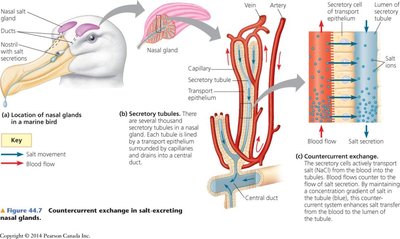
Marine birds, such as the albatross, drink seawater but maintain osmotic balance through specialized salt-excreting glands.
Transport Epithelia: Specialized cells in nasal glands actively transport excess sodium chloride from the blood into gland ducts, which is then excreted as a concentrated solution.
Countercurrent Exchange: Enhances the efficiency of salt removal.
Osmoregulation in Terrestrial Animals
Adaptations to Reduce Water Loss
Terrestrial animals have evolved various anatomical and behavioral adaptations to minimize water loss and maintain water balance.
Body Coverings: Waxy exoskeletons, shells, and layers of dead skin reduce evaporation.
Behavioral Adaptations: Nocturnal activity, burrowing, and water-conserving behaviors.
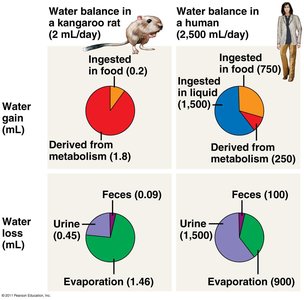
Water Acquisition: Drinking, eating moist food, and metabolic water production during cellular respiration.
Nitrogenous Wastes and Excretory Products
Types of Nitrogenous Wastes
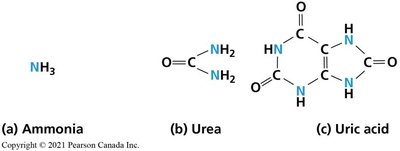
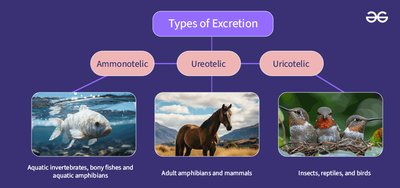
The form of nitrogenous waste excreted by an animal depends on its evolutionary history and habitat. The main types are ammonia, urea, and uric acid.
Ammonia (NH3): Highly toxic, requires large amounts of water for excretion; typical of aquatic animals.
Urea: Less toxic, requires moderate energy to produce, conserves water; typical of mammals and some amphibians.
Uric Acid: Least toxic, excreted as a semi-solid paste, conserves water but is energetically expensive; typical of insects, reptiles, and birds.
Excretory Systems in Invertebrates
Protonephridia
Protonephridia are networks of dead-end tubules found in flatworms and some other invertebrates. They function in osmoregulation and excretion.
Flame Bulbs: Specialized cells with cilia that draw interstitial fluid into the tubule system, where waste is filtered and excreted.

Metanephridia
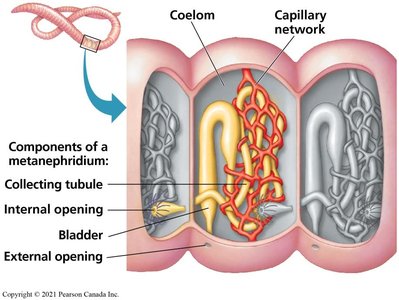
Metanephridia are excretory organs found in annelids (segmented worms). Each segment contains a pair of metanephridia that filter coelomic fluid.
Nephrostome: Internal opening that draws in coelomic fluid.
Reabsorption: Useful solutes are reabsorbed as fluid passes through the tubule; dilute urine is excreted.
Malpighian Tubules
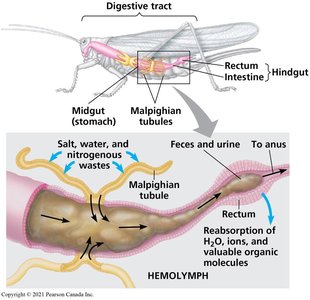
Malpighian tubules are the excretory organs of insects and some other arthropods. They remove nitrogenous wastes from hemolymph and function in osmoregulation.
Dry Uric Acid: Excreted as a semi-solid paste, conserving water.
Water Reabsorption: Occurs in the rectum, allowing insects to survive in dry environments.
The Mammalian Excretory System: Kidneys
Kidney Structure and Function
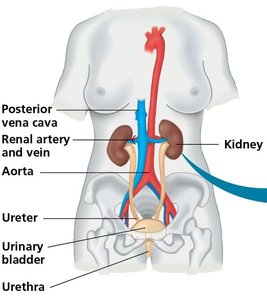
The kidneys are the main excretory organs in mammals, responsible for filtering blood, removing wastes, and regulating water and electrolyte balance.
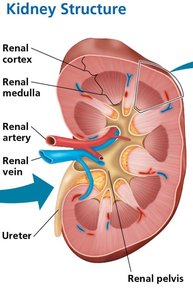
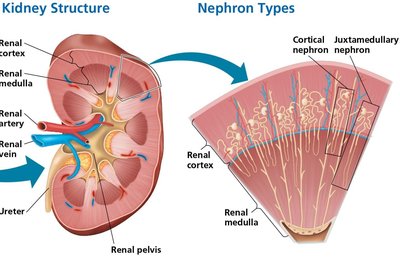
Renal Cortex and Medulla: The outer cortex and inner medulla contain millions of nephrons, the functional units of the kidney.
Blood Supply: Renal arteries deliver blood to the kidneys; renal veins drain filtered blood.
Urine Formation: Filtrate is produced in the nephrons, processed, and collected in the renal pelvis before passing to the bladder via the ureter.
Nephron Structure and Function
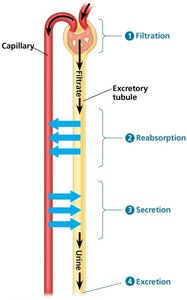
Each kidney contains about one million nephrons, which filter blood and form urine through a series of steps: filtration, reabsorption, secretion, and excretion.
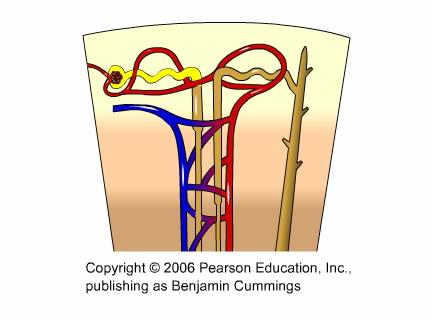
Cortical Nephrons: Located mostly in the cortex; short loops of Henle.
Juxtamedullary Nephrons: Extend deep into the medulla; essential for producing concentrated urine.

Steps of Urine Formation
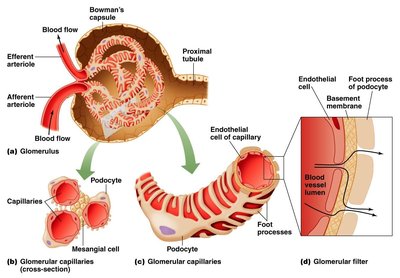
Filtration: Blood pressure forces water and small solutes from the glomerulus into Bowman’s capsule.
Reabsorption: Valuable solutes and water are reclaimed from the filtrate into the blood.
Secretion: Additional wastes and toxins are actively transported into the filtrate.
Excretion: Processed filtrate (urine) is eliminated from the body.
Proximal Tubule, Loop of Henle, and Collecting Duct
The nephron’s tubule system modifies the filtrate through selective reabsorption and secretion, concentrating urine and conserving water.
Proximal Tubule: Reabsorbs ions, water, and nutrients; secretes toxins.
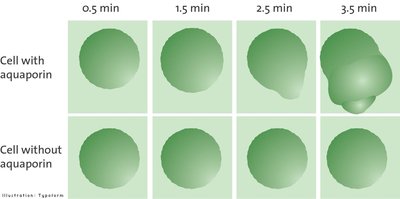
Loop of Henle: Descending limb reabsorbs water via aquaporins; ascending limb reabsorbs salt but not water.
Collecting Duct: Final concentration of urine; regulated by hormones such as ADH.
Countercurrent Multiplier System
The loop of Henle acts as a countercurrent multiplier, creating an osmotic gradient in the medulla that enables the kidney to produce urine that is hyperosmotic to blood.
Descending Limb: Permeable to water, not salt; water exits, concentrating filtrate.
Ascending Limb: Impermeable to water; salt is actively transported out, diluting filtrate.
Hormonal Regulation of Kidney Function
Antidiuretic Hormone (ADH)
ADH (vasopressin) is released when blood osmolarity rises, increasing water reabsorption in the collecting duct by promoting the insertion of aquaporin channels.
Effect: Concentrates urine and reduces water loss.
Inhibition: Alcohol inhibits ADH release, leading to increased urine output.
Disorders: Mutations affecting ADH or aquaporins can cause diabetes insipidus (excessive urination and dehydration).
Renin–Angiotensin–Aldosterone System (RAAS)
RAAS is activated by a drop in blood pressure or volume. The juxtaglomerular apparatus releases renin, leading to the formation of angiotensin II, which raises blood pressure and stimulates aldosterone release to increase sodium and water reabsorption.
Effect: Increases blood volume and pressure.
Atrial Natriuretic Peptide (ANP)
ANP is released in response to increased blood volume and opposes the actions of RAAS and ADH, promoting sodium and water excretion to lower blood volume.
Adaptations of the Vertebrate Kidney
Kidney Adaptations to Diverse Environments
Vertebrate kidneys show structural and functional adaptations to different habitats.
Juxtamedullary Nephrons: Longer loops of Henle in desert mammals allow for greater water conservation.
Reniculated Kidneys: Found in marine mammals and large terrestrial mammals, composed of multiple lobes for increased filtration capacity.
Hibernating Bears: Exhibit unique adaptations for recycling urea and regenerating kidney tissue during long periods without urination.
Summary Table: Forms of Nitrogenous Waste
Waste Type | Energy Cost | Toxicity | Water Requirement | Typical Animals |
|---|---|---|---|---|
Ammonia | Low | High | High | Aquatic invertebrates, bony fish |
Urea | Moderate | Moderate | Moderate | Mammals, amphibians |
Uric Acid | High | Low | Low | Birds, reptiles, insects |
