Back
BIO 102 Chapter 44_StudyGuide A
Study Guide - Smart Notes
 Tailored notes based on your materials, expanded with key definitions, examples, and context.
BIO 102 Chapter 44
Concept and Importance
Osmoregulation is the process by which organisms regulate the balance of water and solutes within their bodies to maintain homeostasis. This balance is crucial for cellular function and survival, as cells operate in an aqueous environment and require specific concentrations of ions and water.
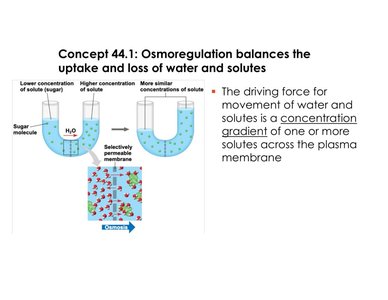
Key Point: The driving force for movement of water and solutes is the concentration gradient of one or more solutes across the plasma membrane.
Key Point: Maintaining proper osmolarity prevents detrimental effects such as dehydration or cell lysis.
Example: Sodium and potassium ions are vital for cell viability and are tightly regulated.
Key Vocabulary: Osmosis and Osmolarity
Definitions and Applications
Understanding the terminology is essential for grasping osmoregulation mechanisms.
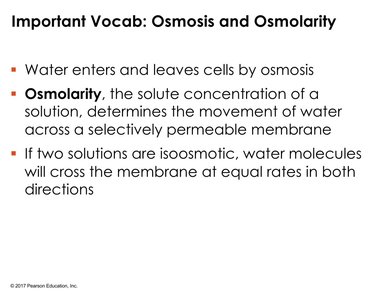
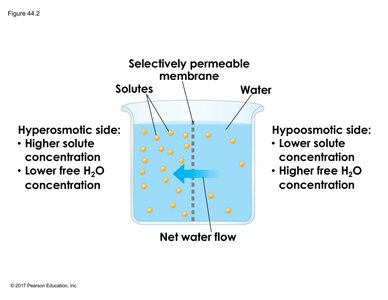
Osmosis: The movement of water across a selectively permeable membrane from an area of higher free water concentration to lower free water concentration.
Osmolarity: The solute concentration of a solution, measured as the number of osmotically active moles of solute per liter of solution.
Isosmotic: Two solutions with equal osmolarity; water moves across the membrane at equal rates in both directions.
Hyperosmotic: Higher solute concentration, lower free water concentration.
Hypoosmotic: Lower solute concentration, higher free water concentration.
Osmolarity and Water Movement
Mechanisms of Water Flow
Water moves in response to differences in osmolarity across membranes, seeking equilibrium.
Key Point: Water flows from areas of high free water concentration (hypoosmotic) to areas of low free water concentration (hyperosmotic).
Example: In a beaker separated by a selectively permeable membrane, water moves toward the side with higher solute concentration.
Osmoregulatory Strategies in Animals
Osmoconformers
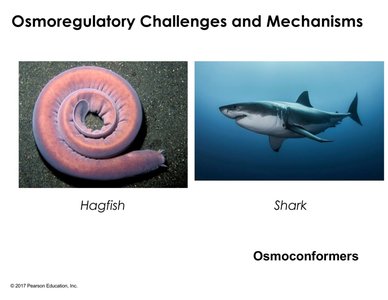
Osmoconformers maintain osmotic equilibrium with their environment, typically seen in marine invertebrates.
Key Point: The osmolarity of body fluids matches that of seawater, resulting in no net movement of water.
Example: Hagfish are true osmoconformers; sharks achieve isotonicity by retaining high levels of urea, tolerating nitrogenous waste.
Osmoregulators
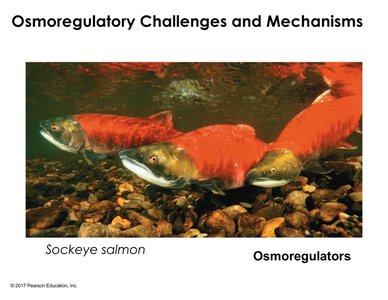
Osmoregulators actively control their internal osmolarity, allowing them to survive in environments with varying solute concentrations.
Key Point: Many marine vertebrates and some invertebrates are osmoregulators, maintaining constant blood osmolarity.
Example: Salmon migrate between freshwater and saltwater, adjusting their osmoregulatory mechanisms accordingly.
Osmoregulation in Marine and Freshwater Fish
Marine Fish
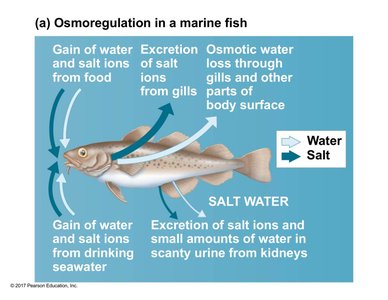
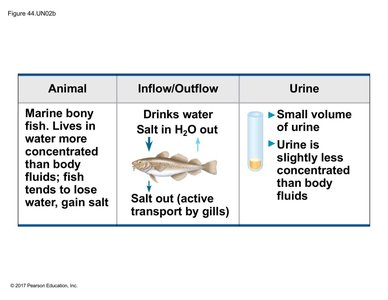
Marine fish are hypoosmotic to their environment, facing challenges of water loss and salt gain.
Key Point: Marine fish drink seawater and excrete excess salt ions through gills and kidneys, producing scanty urine to conserve water.
Example: Active transport of ions across gill surfaces helps eliminate excess salt.
Animal | Inflow/Outflow | Urine |
|---|---|---|
Marine bony fish | Drinks water; Salt in, H2O out; Salt out (active transport by gills) | Small volume; Slightly less concentrated than body fluids |
Freshwater Fish
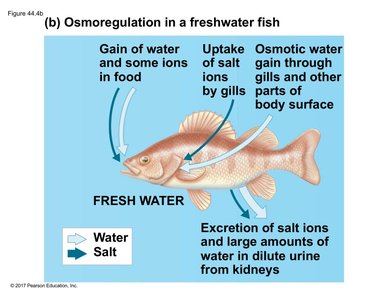
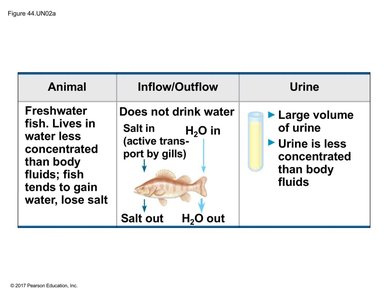
Freshwater fish are hyperosmotic to their environment, tending to gain water and lose salt.
Key Point: Freshwater fish do not drink water; they excrete large volumes of dilute urine and actively uptake salt ions through gills.
Example: Active transport mechanisms help retain essential ions.
Animal | Inflow/Outflow | Urine |
|---|---|---|
Freshwater fish | Does not drink water; Salt in (active transport by gills); H2O in; Salt out; H2O out | Large volume; Less concentrated than body fluids |
Adaptations to Extreme Water Loss
Anhydrobiosis in Tardigrades
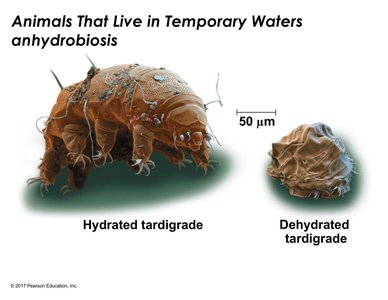
Some invertebrates, such as tardigrades, can survive extreme dehydration by entering a dormant state known as anhydrobiosis.
Key Point: Tardigrades lose almost all body water and remain viable until rehydration.
Example: Hydrated and dehydrated states of tardigrades demonstrate remarkable adaptation to temporary water environments.
Osmoregulation in Terrestrial Animals
Challenges and Solutions
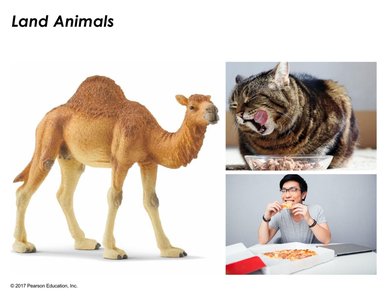
Land animals face constant water loss to the air and must obtain water through food and drinking. Behavioral adaptations, such as nocturnality, help reduce water loss.
Key Point: Water acquisition is achieved through food and water intake, and evaporation is minimized by behavioral and physiological adaptations.
Example: Camels and cats illustrate different strategies for water conservation in terrestrial environments.
Energetics of Osmoregulation
Energy Expenditure
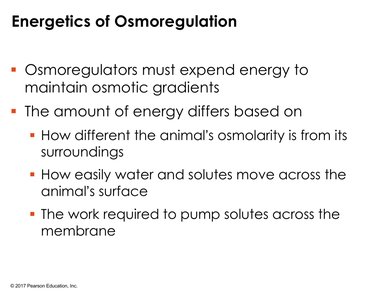
Osmoregulators must expend energy to maintain osmotic gradients, with energy requirements varying based on several factors.
Key Point: Energy use depends on the difference between animal and environmental osmolarity, membrane permeability, and the work required for active transport.
Example: Active transport of solutes across membranes is a major energy-consuming process.
Transport Epithelia in Osmoregulation
Specialized Cells and Structures
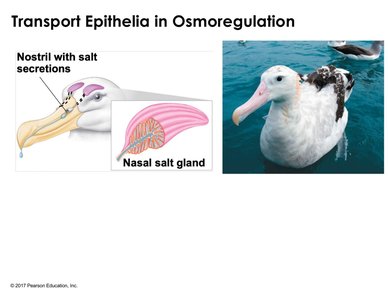
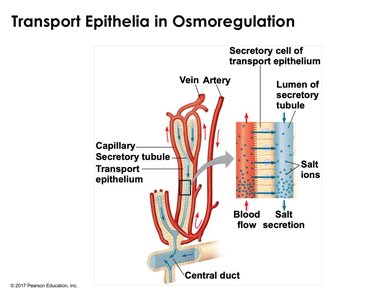
Transport epithelia are specialized cells that facilitate the movement of solutes and water, playing a key role in osmoregulation. Marine birds, for example, possess nasal salt glands that remove excess salt from their blood.
Key Point: Transport epithelia are organized into tubular networks, allowing efficient removal of solutes.
Example: Marine birds use nasal salt glands to excrete concentrated salt solutions, enabling them to drink seawater.