 Back
Osmoregulation and Excretion: Mechanisms and Adaptations in Animals
Study Guide - Smart Notes
 Tailored notes based on your materials, expanded with key definitions, examples, and context.
Osmoregulation & Excretion
Osmoregulation: Maintaining Solute and Water Balance
Osmoregulation is the process by which organisms control the concentration of solutes and water in their body fluids. This regulation is essential for proper cellular function, as cells require a stable internal environment to operate efficiently.
Purpose: To maintain specific, stable solute concentrations for cell function.
Osmolarity: Defined as moles of solute per liter of solution, measured in mOsm/L. For example, 150 mM NaCl contributes to osmolarity as follows: (since NaCl dissociates into Na+ and Cl-).
Osmotic Challenges: Conformers vs. Regulators
Conformers: Internal osmolarity changes with external conditions. If the environment is stable, internal conditions remain stable.
Regulators: Maintain internal osmolarity regardless of external changes. Two main scenarios:
Hyperosmotic to environment: Gains water, loses salts (e.g., freshwater fish).
Hypoosmotic to environment: Loses water, gains salts (e.g., marine fish).
Osmoregulation in Aquatic Animals
Freshwater Fish
Freshwater fish face the challenge of water gain and salt loss because their body fluids (300 mOsm) are much more concentrated than the surrounding water (0.5–15 mOsm).
Solution:
Import Na+ and Cl- by active transport across gills.
Excrete dilute urine to remove excess water.
Conserve solutes to maintain internal balance.
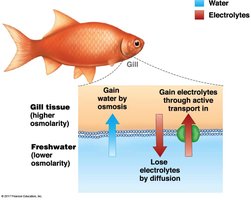
Marine Bony Fish
Marine bony fish have body fluids (300 mOsm) that are less concentrated than seawater (1000 mOsm), leading to water loss and salt gain.
Solution:
Drink seawater to compensate for water loss.
Excrete excess Na+ and Cl- by active transport across gills.
Conserve water by producing concentrated urine.
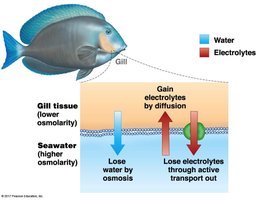
Terrestrial Animals
Terrestrial animals primarily face dehydration due to water loss in dry environments.
Adaptations:
Nocturnal activity to reduce water loss.
Waxy coating on exoskeleton or keratinized skin to minimize evaporation.
Osmoregulation and Homeostasis
Water loss due to sweating increases blood osmolarity, leading to dehydration unless compensated by kidney reabsorption of water.
Excretion: Removal of Waste and Regulation of Body Fluids
Excretory Processes and Organs
Excretion involves removing salts, water, and metabolic waste from the body. Vertebrate excretory organs, such as kidneys, play a central role in this process.
Transport Epithelium: Specialized thin cell layers with large surface area for selective transport of ions and solutes.
Regulation: Rate of osmosis is controlled by ion concentrations and water channel proteins (aquaporins) in cell membranes.
Transport Across Epithelial Cells
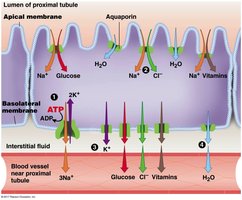
Apical membrane: Faces external space (e.g., filtrate).
Basolateral membrane: Faces interstitial and circulatory fluid.
Different transport proteins in each membrane set up electrochemical gradients, determining solute transport direction.
Example: Shark Rectal Gland
Na+-K+ ATPase in basolateral membrane creates a Na+ gradient.
Na+ gradient drives co-transport of Cl- and K+ into cell via NKCC co-transporter.
Cl- diffuses into external fluid through apical membrane channel; Na+ diffuses between cells.
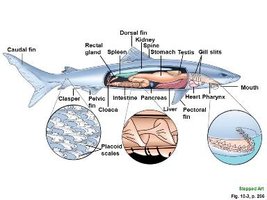
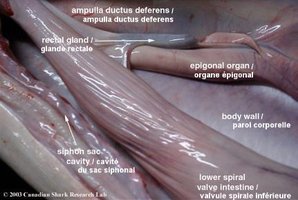
Water Transport in the Kidney
Water movement across transport epithelium is crucial for urine concentration and reabsorption.
Na+-K+ ATPase in basolateral membrane creates a Na+ gradient.
Na+ gradient drives co-transport of glucose, Cl-, and vitamins into cell via apical membrane.
High solute concentration makes epithelial cell hyperosmotic to blood, causing solutes to diffuse into blood.
Water diffuses through aquaporins in both membranes, re-entering blood.
Role of Antidiuretic Hormone (ADH)
ADH signals kidney epithelial cells to insert more aquaporin molecules, increasing water reabsorption from filtrate into blood.
Results in higher solute concentration in filtrate and increased solute concentration in blood.
Metabolic Waste: Nitrogenous Compounds
Metabolic breakdown of proteins and nucleic acids produces nitrogenous waste, which must be excreted efficiently.
Ammonia (NH3): Highly toxic, requires large amounts of water for excretion. Common in aquatic animals.
Urea: Synthesized from ammonia in vertebrate liver. Less toxic, requires less water, but energy-intensive. Used by mammals, adult amphibians, sharks, and some marine fish.
Uric Acid: Low toxicity, excreted as a paste, conserves water, but requires energy to synthesize. Used by birds, reptiles, insects, and land snails.
Comparison of Nitrogenous Waste Excretion
Waste Type | Toxicity | Water Requirement | Energy Cost | Typical Animals |
|---|---|---|---|---|
Ammonia | High | High | Low | Aquatic animals |
Urea | Moderate | Moderate | Moderate | Mammals, amphibians, sharks |
Uric Acid | Low | Low | High | Birds, reptiles, insects |
Homeostasis Under Multiple Challenges
Animals must balance water and solute regulation with other physiological demands, such as temperature regulation. For example, a shaved camel requires more water for evaporative cooling due to loss of insulation.
Evaporative cooling: Maintains body temperature but increases water loss.
Insulation: Reduces heat gain and water loss.
Summary Table: Osmoregulatory Strategies
Animal Type | Osmotic Challenge | Solution |
|---|---|---|
Freshwater Fish | Water gain, salt loss | Active ion uptake, dilute urine |
Marine Fish | Water loss, salt gain | Drink seawater, active ion excretion |
Terrestrial Animals | Dehydration | Behavioral and structural adaptations |
Key Terms
Osmoregulation: Regulation of solute and water balance.
Osmolarity: Concentration of solutes in solution.
Transport epithelium: Specialized cells for selective transport.
Aquaporin: Membrane protein facilitating water movement.
Antidiuretic hormone (ADH): Hormone regulating water reabsorption in kidneys.
Ammonia, urea, uric acid: Forms of nitrogenous waste.
Additional info: Academic context was added to clarify osmolarity calculations, the role of ADH, and the comparison of nitrogenous waste excretion.
