 Back
Osmoregulation and Excretory Systems: Study Guide
Study Guide - Smart Notes
 Tailored notes based on your materials, expanded with key definitions, examples, and context.
Osmoregulation and Excretory Systems
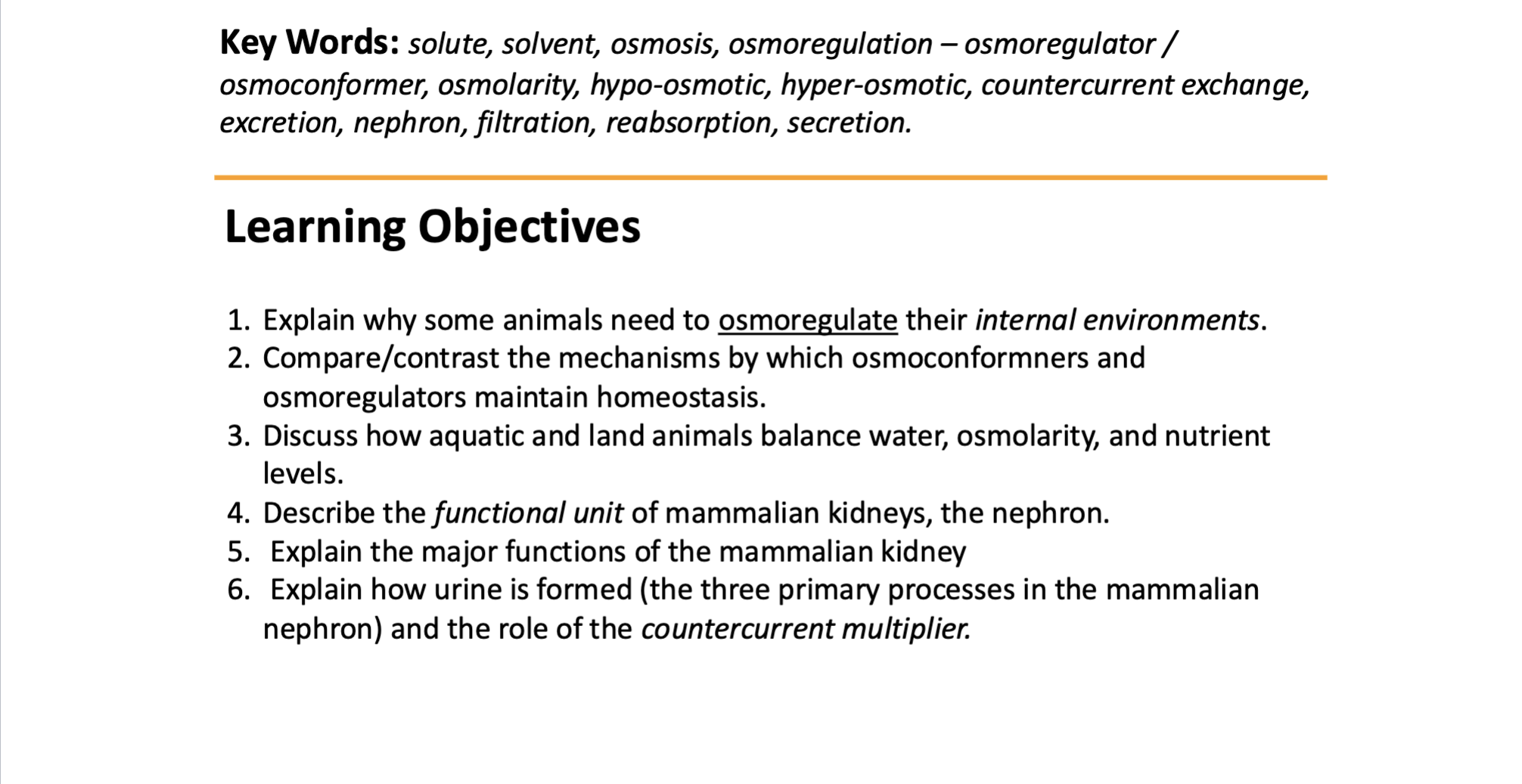
Key Concepts and Definitions
Osmoregulation is a critical physiological process that enables animals to maintain the balance of water and solutes within their bodies, ensuring homeostasis. The excretory system, particularly the mammalian kidney, plays a central role in this regulation.
Solute: A substance dissolved in a solvent, forming a solution.
Solvent: The medium in which solutes are dissolved; in biological systems, this is typically water.
Osmosis: The passive movement of water across a semipermeable membrane from an area of lower solute concentration to higher solute concentration.
Osmoregulation: The process by which organisms control the concentration of water and solutes in their internal environment.
Osmoconformer: An organism whose internal osmolarity matches its environment.
Osmoregulator: An organism that actively regulates its internal osmolarity, independent of the environment.
Osmolarity: The concentration of solutes in a solution, measured in osmoles per liter (Osm/L).
Hypo-osmotic: A solution with lower osmolarity compared to another.
Hyper-osmotic: A solution with higher osmolarity compared to another.
Countercurrent exchange: A mechanism where fluids flow in opposite directions, enhancing transfer efficiency (e.g., in kidneys).
Excretion: The removal of metabolic waste products from the body.
Nephron: The functional unit of the mammalian kidney responsible for filtration and urine formation.
Filtration: The process of separating waste and excess substances from blood in the nephron.
Reabsorption: The process by which useful substances are reclaimed from the filtrate back into the blood.
Secretion: The active transport of additional waste substances into the filtrate.
Why Animals Need to Osmoregulate
Animals must regulate their internal environments to maintain cellular function and overall homeostasis. Changes in water and solute concentrations can disrupt metabolic processes, enzyme activity, and cell structure.
Key Point: Osmoregulation prevents dehydration or overhydration, ensuring proper cell function.
Example: Marine fish must excrete excess salts, while freshwater fish must retain salts and excrete excess water.
Osmoconformers vs. Osmoregulators
Organisms employ different strategies to maintain osmotic balance depending on their environment.
Osmoconformers: Match their internal osmolarity to the environment; common in marine invertebrates.
Osmoregulators: Maintain constant internal osmolarity regardless of environmental changes; typical of freshwater fish and terrestrial animals.
Comparison Table:
Strategy | Internal Osmolarity | Environment | Examples |
|---|---|---|---|
Osmoconformer | Matches environment | Stable (e.g., ocean) | Marine invertebrates |
Osmoregulator | Regulated, constant | Variable (freshwater, land) | Freshwater fish, mammals |
Water, Osmolarity, and Nutrient Balance in Aquatic and Land Animals
Aquatic and terrestrial animals face distinct challenges in maintaining water and solute balance.
Aquatic animals: Must balance water uptake and salt loss (freshwater) or salt uptake and water loss (marine).
Land animals: Must conserve water and manage salt intake due to risk of dehydration.
Example: Amphibians absorb water through skin; mammals rely on kidneys for water conservation.
The Nephron: Functional Unit of the Mammalian Kidney
The nephron is the structural and functional unit of the kidney, responsible for filtering blood and forming urine.
Structure: Consists of the glomerulus, Bowman's capsule, proximal tubule, loop of Henle, distal tubule, and collecting duct.
Function: Filters blood, reabsorbs essential substances, and secretes waste.
Example: Each human kidney contains about one million nephrons.
Major Functions of the Mammalian Kidney
The kidney maintains homeostasis by regulating water, solute concentrations, and removing metabolic wastes.
Filtration: Removal of waste and excess substances from blood.
Reabsorption: Recovery of water, glucose, and ions.
Secretion: Addition of waste products to the filtrate.
Excretion: Elimination of urine from the body.
Urine Formation and the Countercurrent Multiplier
Urine formation involves three primary processes in the nephron: filtration, reabsorption, and secretion. The countercurrent multiplier in the loop of Henle creates a concentration gradient, allowing efficient water reabsorption.
Filtration: Occurs in the glomerulus; blood pressure forces water and solutes into Bowman's capsule.
Reabsorption: Essential substances are reclaimed in the tubules.
Secretion: Additional wastes are actively transported into the tubule.
Countercurrent multiplier: The loop of Henle establishes a gradient for water reabsorption, concentrating urine.
Equation: Osmosis is governed by the equation: where is water potential, is solute potential, and is pressure potential.
Example: The countercurrent mechanism allows mammals to produce concentrated urine, conserving water in arid environments.
 ----------------------------------------
