 Back
Osteichthyes: Ray-Finned Fishes, Lobe-Finned Fishes, and the Origin of Tetrapods
Study Guide - Smart Notes
 Tailored notes based on your materials, expanded with key definitions, examples, and context.
Osteichthyes: The Bony Fishes and Their Evolutionary Significance
Overview of Osteichthyes
The clade Osteichthyes encompasses the vast majority of vertebrates, including both aquatic and terrestrial forms. Traditionally known as the "bony fishes," this group is now understood, based on molecular evidence, to also include tetrapods (vertebrates with limbs).
Osteichthyes means "bony fish," but not all members are strictly fish.
Members possess an ossified skeleton with a hard matrix of calcium phosphate.
Evidence suggests the common ancestor of both Chondrichthyans (cartilaginous fishes) and Osteichthyans was highly ossified, though this is debated.
Fishes: Structure, Physiology, and Adaptations
Respiration and Buoyancy
Most fishes within Osteichthyes breathe by drawing water over gills, which are protected by a bony flap called the operculum. Buoyancy is regulated by a specialized organ called the swim bladder.
Water enters the mouth, passes through the pharynx, and exits between the gills via operculum movement and muscle contraction.
The swim bladder is an air sac that adjusts buoyancy by exchanging gases with the blood.
Early osteichthyans had lungs for supplemental air breathing; swim bladders evolved later from these lungs in some lineages.
External Features and Sensory Systems
Fishes have flattened bony scales (distinct from the tooth-like scales of sharks).
Skin glands secrete mucus to reduce drag during swimming.
The lateral line system is a row of sensory pits that detect water movement and vibrations.
Reproduction
Most species are oviparous, reproducing by external fertilization of eggs.
Some species exhibit internal fertilization and live birth.
Ray-Finned Fishes (Actinopterygii)
Characteristics and Diversity
Ray-finned fishes represent the largest group of aquatic osteichthyans, with over 27,000 species. Their fins are supported by long, flexible bony rays.
Fins are adapted for maneuvering, defense, and other functions.
Originated in freshwater, later colonized marine environments, and some species (e.g., salmon) migrate between both.
Human Impact
Ray-finned fishes are a major protein source for humans.
Overfishing has led to the collapse of major fisheries (e.g., North Atlantic cod).
River diversion and dams disrupt migratory and spawning behaviors.
Case Study: Cod Fisheries Collapse
Cod populations in the northwest Atlantic dropped to 5% of historic levels in the 1990s due to overfishing.
Top-down effects: Decline of large predatory fish altered marine food webs, increasing the role of marine mammals and forage fish.
Recovery is hindered by ongoing ecological changes and competition from other fish species.
Lobe-Finned Fishes (Sarcopterygii)
Key Features and Evolution
Lobe-finned fishes are characterized by their fleshy, lobed fins, which contain rod-shaped bones surrounded by muscle. This group includes both extinct and extant lineages.
Devonian lobe-fins lived in brackish coastal wetlands and used their fins for swimming and "walking" on substrates.
Some were large predators with robust teeth.
Living Lobe-Finned Fishes
Coelacanths (Actinistia): Once thought extinct, rediscovered in the 20th century off Africa and Indonesia.
Lungfishes (Dipnoi): Six species in three genera, now found only in freshwater environments. They possess both lungs and gills, allowing survival in oxygen-poor water and during dry periods by estivating in mud.
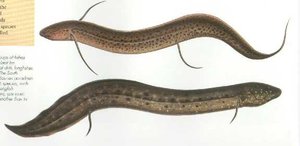
African lungfish are an example of extant lobe-finned fishes capable of air breathing and estivation.
Tetrapods: The Transition to Land
Origin and Adaptations
Tetrapods are the most diverse surviving lineage of lobe-finned fishes. They evolved limbs and feet from fins, enabling the colonization of terrestrial environments.
The transition occurred about 360 million years ago during the Devonian period.
Tetrapods have limbs with digits, a neck for head movement, and a pelvic girdle fused to the backbone for weight support.
Gill slits are absent in adults; embryonic pharyngeal clefts develop into ear and gland structures.
Fossil Evidence and Transitional Forms
Early tetrapods evolved from lobe-finned ancestors adapted to shallow, oxygen-poor waters.
Transitional species like Acanthostega had both aquatic and terrestrial adaptations: limbs with digits, internal gills, and finned tails.
Most early tetrapods remained closely tied to aquatic habitats.
Key Fossil: Acanthostega
From the Upper Devonian of East Greenland (~360 mya).
Had well-ossified gill arches, paddle-like limbs with eight digits, and a finned tail.
Represents a stem-tetrapod with both aquatic and terrestrial features.
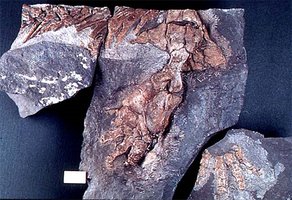
Fossil of Acanthostega, a key transitional form in tetrapod evolution.
Key Fossil: Ichthyostega
Another early tetrapod from the Upper Devonian of East Greenland.
Historically considered the first "four-legged fish," though interpretations of its anatomy continue to evolve.
Summary Table: Major Groups of Osteichthyes
Group | Key Features | Modern Examples |
|---|---|---|
Ray-Finned Fishes (Actinopterygii) | Fins supported by bony rays; diverse habitats; swim bladder | Salmon, trout, cod |
Lobe-Finned Fishes (Sarcopterygii) | Lobed fins with rod-shaped bones; lungs in some species | Coelacanths, lungfishes |
Tetrapods | Limbs with digits; adaptations for terrestrial life | Amphibians, reptiles, birds, mammals |
Key Terms and Concepts
Osteichthyes: Clade of bony vertebrates including fishes and tetrapods.
Operculum: Bony flap covering gills in fishes.
Swim bladder: Gas-filled organ for buoyancy control.
Lateral line system: Sensory organ for detecting water movement.
Lobe-finned fishes: Fishes with fleshy, lobed fins; ancestors of tetrapods.
Tetrapods: Vertebrates with four limbs; evolved from lobe-finned fishes.
